What should you check before buying?
First decide whether your main priority is ageing wine for several years or serving it regularly. Then compare the storage conditions, space requirements and capacity with the bottles you actually own.
| Criteria |
What to check |
Who it matters to |
| Storage conditions |
Check whether the model is specified for ageing, how stable its temperature is and what guidance it gives on humidity. |
If I’m storing bottles for several years, I prioritise consistent storage conditions over tasting temperatures. Around 33% of consumers concerned would put this stability first. |
| Installation in your flat |
Check the ventilation and door-opening clearances in the manual, as well as the model’s climate class and noise level. |
In a kitchen or living area, I need to be able to install and use the appliance without blocking its ventilation. This would be the priority for around 27% of consumers concerned. |
| Usable capacity |
Compare the stated capacity with the bottle sizes you own, particularly wider bottles and magnums, and take the shelves into account. |
When my bottles come in different shapes, I want to be able to store them and reach them easily, rather than relying on the stated capacity alone. Around 20% of consumers concerned would make usable capacity their top criterion. |
| Serving temperatures |
If you’re considering a model with multiple zones, check how each one can be adjusted and how much space is available in each. |
If I want different wines ready to serve, I look for separate temperatures rather than a single zone dedicated to storage. This would be the top priority for around 20% of consumers concerned. |
Wine fridge to consider on Joybuy
This two-zone model is worth considering if you want to keep bottles at different serving temperatures. If you’re building a collection to age for several years, check its storage conditions separately.
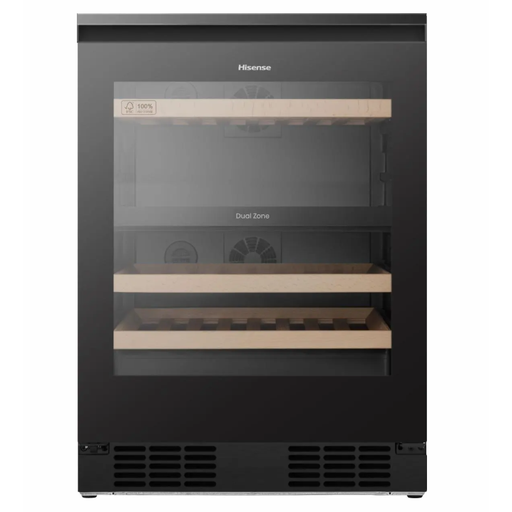 Image unavailable
Hisense RW3N122GALF, 128 L two-zone wine fridge
Worth considering if you need two temperature zones for your bottles. The model is listed with a 128 L capacity, an LED display and an F energy rating.
Before choosing it for long-term storage, check the temperatures and humidity levels it maintains. Also consult the manual for the required clearances and check that your bottle sizes will fit.
View on Joybuy
Frequently asked questions
Is a serving wine fridge suitable for storing wine for several years?
Not necessarily. If long-term storage is your main priority, start by comparing wine fridges explicitly designed for ageing. For the model you choose, check temperature stability, humidity and how well it protects bottles from light and vibrations.
How much space should you leave around a wine fridge?
Follow the clearances specified in the manual for your model and its installation type. Darty gives 10 cm behind a freestanding appliance as a guide, but this figure should not be used for a built-in wine fridge instead of following its own ventilation measurements.
Why might the stated bottle capacity not match my collection?
As UFC-Que Choisir points out, the stated capacity is often calculated using standard Bordeaux bottles packed in as tightly as possible. Magnums, other bottle shapes and shelf layouts designed to make bottles easier to reach all affect usable capacity.
How should you choose a spot for a wine fridge in a flat?
Choose a location that meets the model’s ventilation requirements and climate class, then consider how close it is to your living areas. Check the stated noise level, avoid direct sunlight and heat sources, and make sure the surface is stable.
How can you compare the energy use and noise levels of two models?
Check their energy labels and product information, taking into account the type of wine fridge, its capacity and your planned installation. ADEME says the energy label allows you to compare energy consumption and information about noise levels, among other things.


