
Livraison le jour même ou le lendemain

Qualité garantie

Débloquez vos offres de bienvenue: Livraison GRATUITE | Jusqu'à -80 % | 30 jours d'essai gratuits à JoyPlus
Téléchargez l'application
A wine cooler lets you store your bottles away from temperature fluctuations while keeping them close at hand. However, product descriptions do not always make the choice straightforward: capacity in litres, theoretical bottle count, glass door, single zone or dual temperature… Some details have a direct impact on everyday use.
Before buying an electric wine cooler, check in particular:
Here are the key criteria to consider when comparing models, without being guided solely by their appearance or the number of bottles stated.
A 12-bottle wine cooler, 18-bottle wine cooler or 46-bottle wine cooler is generally sized using standard Bordeaux-style bottles. Burgundy bottles, champagne bottles and some wider formats may take up more space.
A 35 L or 51 L wine cooler therefore does not always guarantee storage for the stated number of bottles if your collection includes several bottle shapes. For convenient everyday use, leave some spare capacity rather than filling every shelf to its maximum.
A wine cooler with a glass door lets you see your bottles at a glance. It can also reduce repeated opening, as the contents remain visible. However, the appliance must be installed away from heat sources and direct sunlight.
A glass door cannot make up for poor installation. Insufficient ventilation, a space that is too cramped or an unstable floor can interfere with the wine cooler’s operation and make the noise more noticeable.
A connected wine cooler may allow you to check certain settings from an app. This can be useful if you want to monitor your appliance remotely, but it is not essential for storing a few bottles at home.
Similarly, a wine ageing cabinet should be chosen according to the desired storage period and conditions. A wine cabinet intended for everyday serving will not necessarily offer the same features as a model designed for a larger collection.
In a flat or small kitchen, a compact wine cooler holding 12 to 18 bottles is easier to fit under a worktop or in a corner of the room, provided you follow the ventilation clearances specified in the instructions.
Mid-sized formats, such as a 33-bottle or 35 L wine cooler, are suitable for a regular collection without taking up as much space as a large fridge. A 51 L wine cooler can hold up to 18 bottles, depending on its internal layout. Volumes from 97 to 128 L are better suited to collectors or households that regularly entertain.
A single zone is sufficient if you mainly store one type of wine or want an even temperature throughout. A dual-temperature wine cooler, on the other hand, lets you set two compartments separately to suit different storage requirements.
Check the adjustment range in the product description. The Hisense model shown below, for example, offers a range of 5 to 20 °C and two independent zones. These figures indicate the appliance’s capabilities : they are not a medical recommendation or a guarantee of storage conditions for every bottle.
Always check whether the model is designed for freestanding installation or built-in use. The appliances shown here are specified as freestanding. You must therefore leave sufficient space around the cabinet and never obstruct the ventilation openings.
To compare models, check the annual energy consumption, expressed in kWh/year, as well as the noise level in dB(A). As an indication, the Hisense RW3N122GALF has a stated consumption of 105 kWh/year and a noise level of 37 dB(A). Actual consumption may vary depending on the room temperature, how often the door is opened and the selected setting.
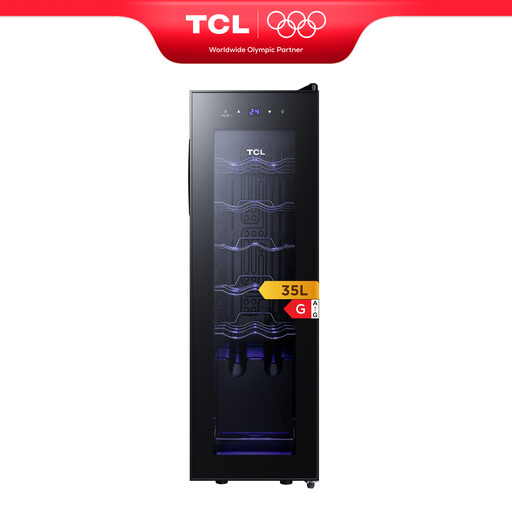
Why this choice suits this profile : Its compact size is ideal for people starting a collection or with limited space in their flat.
Its limited capacity means you do not pay for an oversized appliance or take up unnecessary room for just a few bottles.
Stated 35 L capacity, storage for up to 12 bottles and a glass door for viewing the contents.
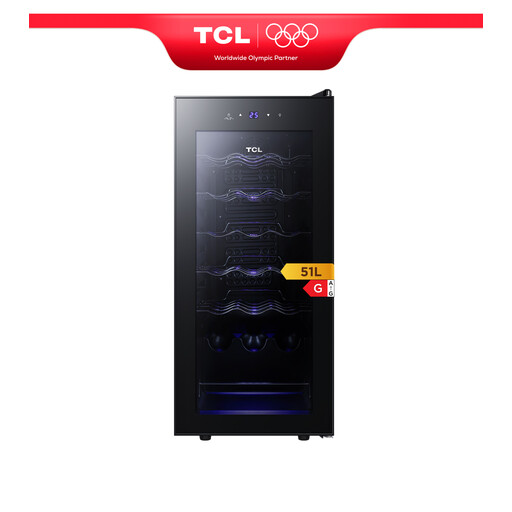
Why this choice suits this profile : It provides more storage while remaining suitable for a kitchen, dining room or bar area.
The product description specifies freestanding installation and adjustable shelves, so measure the available ventilation space before installing it.
51 L capacity, storage for up to 18 bottles, glass door, display, interior lighting and temperature control.
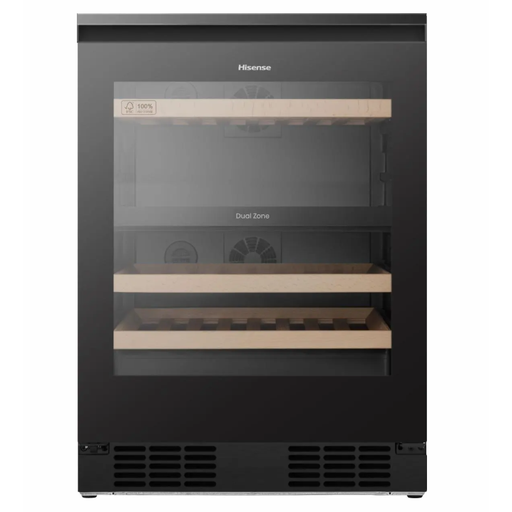
Why this choice suits this profile : This model is aimed at collectors who want to separate different types of wine and manage the settings from an app.
The two zones let you adjust the temperature for different wines instead of treating the entire collection in the same way. However, its size means you need to measure the intended location precisely.
Two adjustable zones from 5 to 20 °C, Wi-Fi with the ConnectLife app, glass door with UV protection, four wooden shelves and a door alarm.
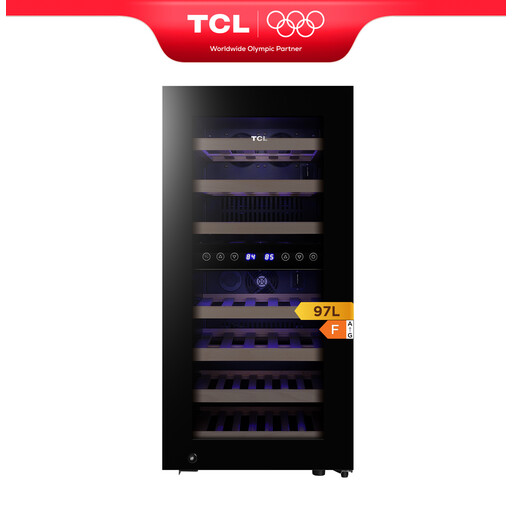
Why this choice suits this profile : Its stated capacity suits households that store wine regularly and want a dedicated space without moving straight to a very large appliance.
This extra capacity means you do not have to cram bottles together. Nevertheless, check the dimensions and shelf layout according to your bottle sizes.
Stated 97 L capacity, storage for up to 33 bottles and a glass door for easily viewing the collection.
We have put together a complete, real-time updated list of products that fully meet these strict selection criteria and European safety regulations.
To keep your wine cooler working properly:
A reversible door can make installation easier in a small room. Interior lighting and adjustable shelves make access more convenient, but should not distract you from checking the external dimensions, weight and door-opening direction.
Consumption depends on the capacity, cooling system, selected setting, room temperature and how often the door is opened. Check the energy label and annual consumption in kWh/year. This information allows you to compare appliances objectively, but the final cost depends on the tariff charged by your electricity supplier.
A compact wine cooler can be placed in a kitchen, dining room or bar area. It should be kept away from heat sources, excessive humidity and direct sunlight. Measure the width, height, depth and space required for ventilation before delivery.
It is particularly useful if you want to store wines requiring different settings in the same appliance. For a small, uniform collection, a single zone may be sufficient. Before choosing this feature, also compare the actual available capacity, noise level, energy consumption and maintenance requirements.