Bottles you serve regularly
You want to free up space in the fridge and keep bottles at your chosen serving temperature. Check whether one or two zones suit your habits, as suggested by the ranges from EuroCave and Haier France.


Choose a serving wine cabinet if you want bottles close to hand, an ageing wine cabinet if long-term storage is your priority, or non-electric storage if you simply need to organise your bottles. Before buying an appliance, check that its usable capacity suits your bottle sizes, as well as its installation type, noise level and stated energy consumption. A wine cabinet runs continuously, as ADEME points out. A non-electric rack avoids this constant energy use, but does not regulate the temperature.
You want to free up space in the fridge and keep bottles at your chosen serving temperature. Check whether one or two zones suit your habits, as suggested by the ranges from EuroCave and Haier France.
You’re looking for a consistent temperature, capacity that suits your bottle sizes and an installation location that works for the type of fitting. EuroCave and UFC-Que Choisir highlight the importance of layout and bottle sizes when assessing usable capacity.
You’re weighing up the space an appliance takes up, the noise it makes in a living area and the energy it uses while running continuously. ADEME notes that wine cabinets are appliances that run continuously. If you don’t need temperature regulation, non-electric storage is another option to consider.
Choose this if: you want bottles close to hand without taking up space in the family fridge.
Bear in mind: the appliance runs continuously, so check its noise level, capacity and the temperature it can reach in the room where it will be kept.
Choose this if: your priority is to keep a collection for the long term at a consistent temperature.
Bear in mind: an ageing wine cabinet won’t necessarily offer several serving temperatures, and its capacity depends on your bottles and shelf layout.
Choose this if: you mainly want to organise your bottles and already have a suitable place for the way you plan to use them.
Bear in mind: a rack doesn’t cool bottles or regulate changes in room temperature.
Consider this if: a separate compartment is specified for the temperature and capacity your bottles need.
Bear in mind: an adjustable zone designed for food doesn’t, by itself, mean it’s suitable for storing bottles.
| What to consider | What to check before buying | Who cares most about it |
|---|---|---|
| Serving and temperature zones | Decide whether you need one or several temperatures. Check the capacity for your bottle sizes and the temperature the cabinet can reach in the room where it will be kept. | I want to keep bottles ready to serve without cluttering up the fridge. Around 27% of consumers prioritise having wine ready to serve regularly. |
| Long-term storage | Check that the model is designed for ageing, along with its adjustable temperature range and capacity for your bottle sizes and shelf layout. | For a collection I plan to keep for the long term, I prioritise a consistent temperature and a suitable layout. Around 20% of consumers prioritise long-term storage. |
| Space and noise | Check the dimensions, installation type, ventilation requirements and stated noise emissions in dB(A). | In a home where space is limited, I want to know whether the appliance can be installed without disrupting the living area. Around 20% of consumers prioritise space and noise. |
| Energy consumption | Compare the kWh/year and stated capacity on the model’s label; don’t rely on the energy rating alone. | As the appliance runs continuously, I want to know its annual energy consumption before bringing it into my home. Around 20% of consumers put energy consumption first. |
| Storage without an appliance | Decide whether you simply need to store bottles, get them ready to serve or maintain controlled storage conditions. | If I only need to organise bottles, I’d rather avoid another appliance, provided the location is suitable. Around 13% of consumers prioritise storage without an appliance. |
Maximum capacities may be calculated using traditional Bordeaux bottles stacked together. Other bottle sizes and shelf arrangements can reduce the usable space, as UFC-Que Choisir points out.
Make a note of the bottle sizes you plan to store and compare the shelf configurations before choosing.
A lower usable capacity may mean changing your planned layout or considering an appliance of a different size.
The ventilation requirements for a freestanding wine cabinet are not interchangeable with those for a model designed to be built in, according to manufacturers EuroCave and La Sommelière.
Check the installation type and ventilation diagrams for the exact model before deciding where to put it.
An unsuitable alcove may require changes to your kitchen layout.
Climadiff says that cooling with its hybrid technology depends on the ambient temperature and is less suitable in very hot conditions.
Compare the conditions in the room with the model’s stated capabilities. A low noise level doesn’t guarantee the temperature you want.
An electric wine cabinet runs continuously, while a non-electric rack doesn’t add to your energy consumption but won’t regulate the temperature.
First decide whether you need to organise bottles, get them ready to serve or maintain suitable storage conditions.
The Wine Bank range includes freestanding models with two temperature zones.
The brand offers hybrid serving wine cabinets, including the CC18F.
The brand offers serving and ageing wine cabinets. The Compact V-059V3 is an example of a built-in, single-temperature ageing model.
Liebherr offers single-zone wine cabinets for long-term storage, as well as two- and three-zone models for different serving temperatures.
The brand distinguishes between built-in wine cabinets and freestanding models, which is useful when space is limited.
The models below are serving wine cabinets with adjustable temperature settings. Compare their capacity, stated temperature range, dimensions and listed noise or energy specifications to find one that suits your space and how you plan to use it.
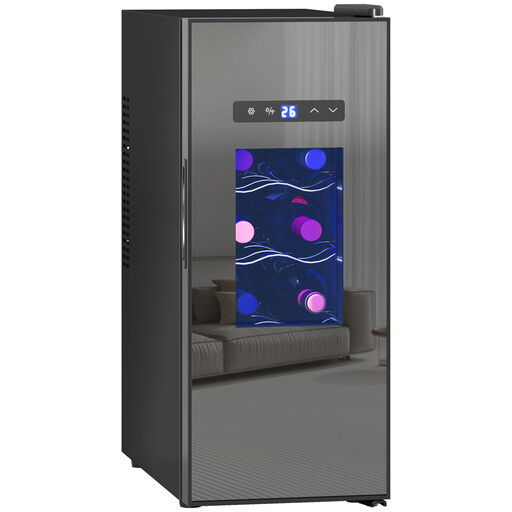 Image unavailable
Worth considering if you’re looking for a compact serving wine cabinet for storing bottles at home.
The description states a capacity of 12 bottles, an adjustable range of 8 to 18 °C, a glass door, a touch screen and a stated noise level of 37 dB.
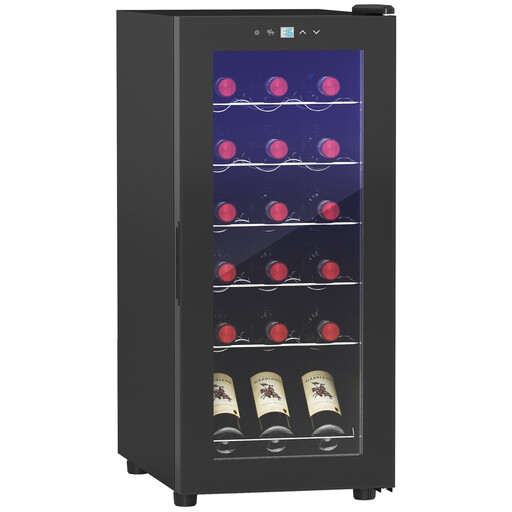 Image unavailable
This capacity is worth considering if you want to store more bottles for serving in a model listed as compact.
The description states a capacity of 18 bottles, an adjustable range of 5 to 18 °C, adjustable shelves and a stated noise level of 41 dB.
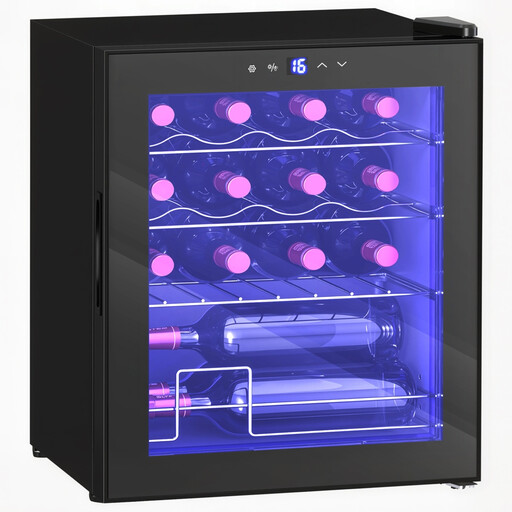 Image unavailable
Compare this model if you’re looking for a serving wine cabinet with a stated capacity of 16 standard 750 ml bottles.
The description states an adjustable range of 5 to 18 °C, dimensions of 43 × 45 × 56,5 cm, a stated noise level of 41 dB and an energy rating of G.
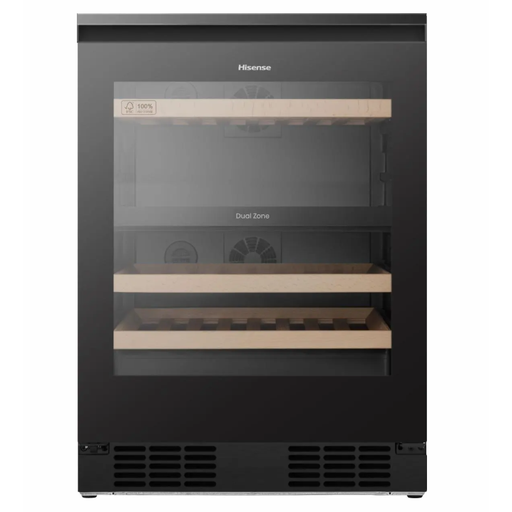 Image unavailable
Worth considering if you’re looking for a serving wine cabinet listed for 46 bottles and want two temperature zones.
The product details state two adjustable zones from 5 to 20 °C, annual energy consumption of 105 kWh, a noise level of 37 dB(A), an energy rating of F and dimensions of 595 × 575 × 819 mm. This is a freestanding model, so follow the ventilation and stability instructions.
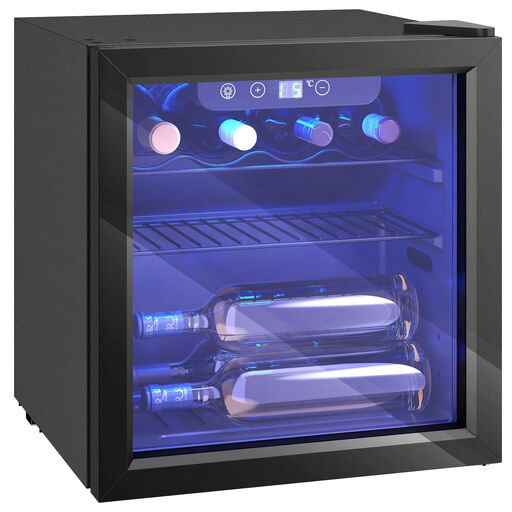 Image unavailable
Compare this serving wine cabinet if its stated capacity of 12 bottles suits your needs.
The description states an adjustable range of 4 to 16 °C, annual energy consumption of 133 kWh, a noise level of 39 dB and dimensions of 43 × 41,5 × 46,5 cm. It needs adequate ventilation and must be left upright for 4 hours before first use.
Compare the stated kWh/year and noise emissions for each model, along with its stated bottle capacity. In May 2026, ADEME gave 200 kWh/year as a guide figure for a wine cabinet running 24 hours a day. This doesn’t guarantee the energy use of any particular model. The European Commission also says that the label for wine storage appliances gives information on energy consumption, noise and bottle capacity.
Don’t assume a freestanding model will fit in an enclosed alcove. EuroCave and La Sommelière set out different ventilation requirements depending on the installation type. Check the diagrams and clearances in the manual for the model you choose.
Not necessarily. UFC-Que Choisir points out that maximum capacities are often calculated using traditional Bordeaux bottles stacked together. Other bottle shapes and shelf layouts can reduce usable capacity, so compare the configuration with the bottle sizes in your collection.
The legal guarantee of conformity applies to new, second-hand and refurbished goods sold by a trader to a private customer. The Ministry of the Economy and Finance explains that it covers, among other things, goods that don’t match their description. Contact the seller, and remember that this mandatory guarantee is separate from any additional commercial guarantee.
No, not if you only need to organise your bottles and have a suitable place to store them. Non-electric storage means you don’t add another appliance that runs continuously, but it won’t regulate the temperature. If you want to get bottles ready to serve or maintain controlled storage conditions, compare the features of a dedicated wine cabinet with your needs.