
Livraison le jour même ou le lendemain

Qualité garantie

Débloquez vos offres de bienvenue: Livraison GRATUITE | Jusqu'à -80 % | 30 jours d'essai gratuits à JoyPlus
Téléchargez l'application
Cleaning glazed doors, mirrors or high windows takes time and quickly becomes complicated when outdoor access is difficult. A window-cleaning robot can make the task easier, but you should not rely solely on suction power or the word ‘smart’ printed on the packaging.
Certain details really do make a difference in everyday use: power supply, glazing compatibility, safety features and pad maintenance. Here are the criteria to check before buying a window-cleaning robot in France.
The phrase ‘integrated battery’ does not necessarily mean that the window-cleaning robot can operate without a cable. On several models, the battery is used only as a backup in the event of a power cut: the appliance must remain plugged in while cleaning.
A window-cleaning robot that can genuinely be used without a power socket should clearly state its battery runtime, charging time and associated usage conditions. For an exterior window or balcony, also check the cable length and whether the station or safety cord can be securely attached.
A value expressed in pascals, such as 2 500 Pa, 2 800 Pa or 5 500 Pa, indicates the power stated by the manufacturer. However, it does not by itself guarantee streak-free cleaning. The result also depends on the condition of the pad, the amount of product used, how flat the glass is and the cleanliness of the sensors.
A suction-based window-cleaning robot must be installed on a clean, smooth and compatible surface. Cracked, poorly secured, highly textured or condensation-covered glass can compromise its grip.
Microfibre pads and spray nozzles require regular maintenance. A pad saturated with dust may move dirt around instead of removing it. Similarly, very hard water can clog the nozzles of a window-cleaning robot with a spraying function.
The safety cord must always be attached before starting, particularly when using a window-cleaning robot on high windows. It provides additional protection, but does not replace a stable installation or supervision of the appliance during its cycle.
When choosing a window-cleaning robot, assess the following separately:
The PuRuiKai PRK-21B states a suction power of 2 500 Pa, a backup battery and power-cut protection of up to 30 minutes, according to its product page. However, it must remain plugged in during use: its battery is not presented as a genuine cordless power supply.
A robot designed for large glazed doors must be able to identify the edges of the surface and adapt its route. Navigation systems generally offer several modes: automatic, fast, intensive or edge-specific. These functions are particularly useful on large areas of glass, but you must always check the minimum compatible window size.
The WINBOT W2 PRO OMNI specifies a minimum size of 30 × 40 cm and uses WIN-SLAM 4.0 planning, according to its product page. For a small mirror, glazed door or frameless window, always check compatibility before first use.
A window-cleaning robot with a spraying function can dampen the surface as it moves. The WINBOT W2 PRO OMNI is equipped with three wide-angle nozzles and a tank to be filled with filtered water or a compatible ECOVACS solution, in accordance with the supplied instructions.
After each cycle, remove the pads, rinse them as recommended and empty the tank. Never immerse the appliance in water and unplug it before carrying out any maintenance. On models without automatic spraying, you may need to lightly dampen the pad before use.

Why this choice suits this profile : This model comes with a remote control, an automatic mode and a 50 ml tank. Its features are easy to use for anyone buying their first window-cleaning robot.
The product page specifies that the appliance must remain plugged in during use. This is important to know so you do not buy it expecting a fully cordless model.
Stated suction power of 2 500 Pa, manual or automatic spraying and a 4.5 m safety cord specified on the product page.
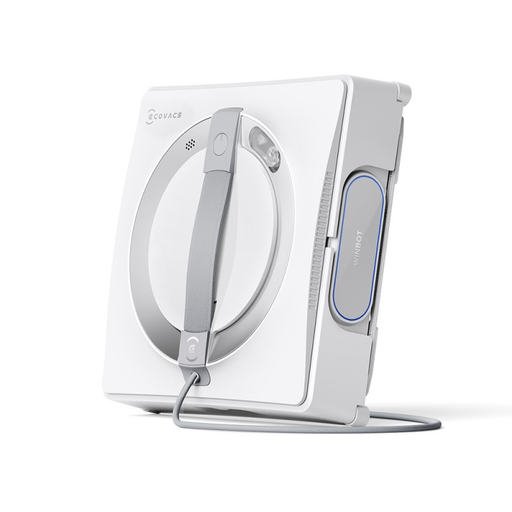
Why this choice suits this profile : Its multifunction station, various modes and spraying system are ideal for homes with large glazed areas and for anyone looking for a complete setup.
The product page specifies the conditions of use, the minimum window size and the mandatory use of the cord and station on exposed glazing.
Stated suction power of 5 500 Pa, battery runtime of up to 110 minutes and a 6-in-1 station that serves, among other things, as a charger and stand.
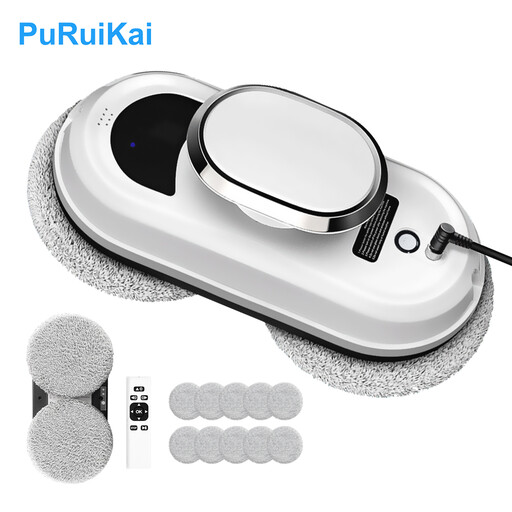
Why this choice suits this profile : Its dual suction system and automatic navigation are designed for users who regularly clean several smooth glazed surfaces.
The product page points out that this is not a cordless model and that it is intended for glass and smooth surfaces only. Check these limitations before buying.
Two stated suction levels of 2 800 Pa, automatic edge detection, remote control and power-cut protection of up to 20 minutes.
We have selected a complete, real-time updated list of products that meet these strict criteria as well as European safety requirements.
Before starting a window-cleaning robot, prepare the surface and its surroundings:
A smart window-cleaning robot can make certain tasks easier, but you still need to check the condition of the glass and monitor an appliance installed at height.
It depends on the model. Some appliances offer a stated battery runtime, such as the WINBOT W2 PRO OMNI, while others use their battery solely as a backup power source. Check the section on the power supply rather than relying only on the phrase ‘integrated battery’.
Yes, provided that the glazed door is smooth, flat and compatible with the minimum dimensions specified by the manufacturer. For a robot intended for large glazed doors, measure the surface, check whether there is a frame or frameless area, and plan a secure anchor point for the cord.
The cost mainly depends on replacing the pads, any recommended cleaning solution and accessory wear. Rinsing the pads after every cycle, using the recommended water and quickly unblocking the nozzles can help prevent premature replacements.