
Livraison le jour même ou le lendemain

Qualité garantie

Débloquez vos offres de bienvenue: Livraison GRATUITE | Jusqu'à -80 % | 30 jours d'essai gratuits à JoyPlus
Téléchargez l'application
Installing a window bird feeder lets you watch birds from a flat or house without taking up ground space in the garden. But some listings just make vague promises like "ultra-strong fixing" or "total rain protection", without detailing the features that really make a difference.
Before you order, make sure to check:
A bird feeder with suction cups only holds properly on a clean, smooth and sufficiently flat surface. Dust, grease marks, condensation or textured glass can reduce adhesion. A product page that simply mentions "strong suction cups" often lacks detail.
Choose a model that clearly states the number of fixing points. Several suction cups distribute the weight of the reservoir and seeds better. That doesn't mean you can skip checking them regularly, especially after large temperature changes.
Transparency makes observation easier, but it doesn't guarantee simple maintenance. Leftover seeds, droppings and moisture can build up in the corners. A transparent bird feeder therefore needs a wide enough opening to remove leftover food and clean the surfaces easily.
Acrylic is often appreciated for its lightness and good visibility. An acrylic bird feeder can be perfectly suitable for installation on glazing, as long as you follow the manufacturer's recommendations and don't overload it.
A small roof protects some of the seeds, but it doesn't make the contents completely waterproof in all conditions. To choose a rainproof bird feeder, look at the width of the overhang, the position of the reservoir and whether water can drain away. When possible, also install the feeder out of prevailing winds.
Damp seeds can clump together and flow less easily. Remove any wet food regularly and avoid filling the reservoir too much before you go away for several days.
For an outdoor window bird feeder, measure the available glazing area and check that the suction cups can be placed without touching a seal, handle or frame. The Blinkit model shown below measures 22 × 9 × 22 cm and weighs approximately 326 g.
A reliable installation relies on a few simple steps:
Clear acrylic lets you keep an eye on the seed level and watch the birds when they land. This visibility is especially useful for a bird feeder for watching birds from a living room, bedroom or home office.
However, transparency shouldn't make you forget about maintenance. Choose a design where the accessible parts can be wiped down easily. Avoid models with lots of cavities that are impossible to reach with a brush or cloth.
For a household that wants to watch a few birds each day, a compact reservoir limits waste and allows you to refresh the seeds regularly. For heavier use, check the actual capacity, how easy it is to fill, and how strong the fixing is when the reservoir is full.
Don't always fill the feeder right to the top. The total weight must stay within the manufacturer's guidelines and the suction cups' capacity.
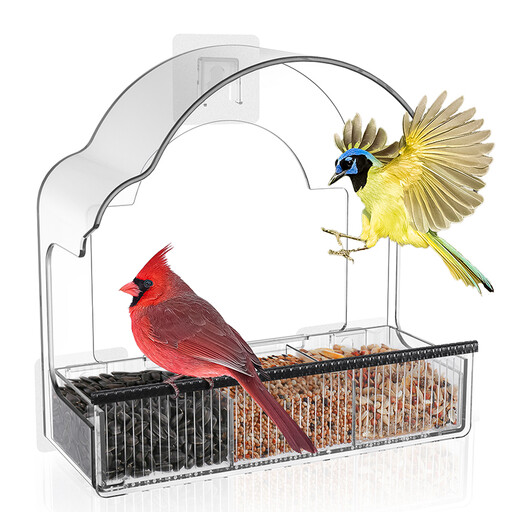
Why this choice suits this profile: Its six suction cups and 22 × 9 × 22 cm size make a first-time installation on a window easy, with no wall bracket or drilling needed.
The product page clearly states six suction cups and installation on glazing, rather than just a vague promise of stability.
Clear acrylic, six suction cups and an extended roof overhang to limit rain ingress.
Why this choice suits this profile: Its understated design, available in several colours, and its transparent construction fit easily into a window dedicated to birdwatching.
The multi-point structure means you don't rely on a single suction cup, while the extended overhang limits direct exposure of the seeds to rain.
Clear acrylic, extended roof overhang and a choice of several colours.
Why this choice suits this profile: The visible reservoir lets you monitor the seed level, and the compact design doesn't take up any floor space, making it ideal for regular use in a flat.
The transparency lets you quickly spot any leftovers or moisture, making it easier to clean the feeder and refresh the seeds.
Detailed dimensions, stated weight of approximately 326 g and direct visual access to the contents.
The other products shown in the shopping environment, such as Lucien Georgelin poultry terrine or Buddy dog food, are food products intended for human or animal consumption. They are not a substitute for suitable wild bird seed and must not be used to fill a feeder.
Clean and dry the glass, then fix each suction cup onto a perfectly smooth area. Start with a small amount of seeds and check the hold before gradually increasing the load. Regular checks are still necessary, especially after rain, frost or intense heat.
A feeder fixed directly onto the window lets you watch the birds very closely, but they will then be right next to the glass. Avoid placing other dangerous objects nearby and keep the area clear. The feeder must also remain accessible for cleaning, without requiring any risky manoeuvres.
The cost depends mainly on the type of seeds and how often you refill it. Routine maintenance involves removing leftovers, wiping down the surfaces and rinsing the feeder when necessary. A small capacity can limit waste, while a larger model reduces the number of refills when the feeder is very busy.