
Livraison le jour même ou le lendemain

Qualité garantie

Débloquez vos offres de bienvenue: Livraison GRATUITE | Jusqu'à -80 % | 30 jours d'essai gratuits à JoyPlus
Téléchargez l'application
A WiFi smart plug lets you control an appliance remotely, schedule when it operates and monitor its energy consumption from a mobile app. Depending on the model, it may also work with Alexa, Google Home, Smart Life or Tuya Smart.
However, not every smart plug is suitable for the same uses. An indoor plug intended for a lamp will have different requirements from a smart home model used with a garden pump or a high-energy appliance. Here are the key criteria to consider to avoid buying an unsuitable product.
A product listing may state 16 A and 3 680 W, but this figure refers to the maximum electrical limit under specific conditions. It does not mean that any 3 680 W appliance can operate for hours without precautions.
For a fan heater, kettle or any other high-powered appliance, check:
Some models specifically state that appliances exceeding 2 000 W, such as a water heater or electric vehicle charger, must not be powered continuously. A standard smart plug can never replace a dedicated electrical installation.
A waterproof IP44 outdoor plug resists water splashes and certain solid objects, but it is not designed to be submerged. It must be positioned correctly, with its cover closed and no standing water around the connections.
For the garden, patio or balcony, check:
Many WiFi plugs only work on the 2.4 GHz band, while some routers prioritise 5 GHz. If your phone is connected to the wrong network during installation, pairing may fail.
Before placing your order, also check:
If you want to control outdoor lighting from a nearby room, a radio-controlled remote plug without WiFi may prove simpler. However, it will not allow remote control from a smartphone.
2.4 GHz WiFi lets you control the plug from outside your home, provided you have an Internet connection. Bluetooth can simplify installation or provide local control on certain models. The 433.92 MHz radio frequency used by some remote-controlled plugs does not depend on an app or your home network.
For a smart home that you expect to expand, choose a plug that is compatible with your software ecosystem. For occasional use without any particular set-up, a pre-programmed radio model will minimise the amount of configuration required.
A plug with energy monitoring generally displays the current power consumption and a usage history in the app. This information lets you compare usage periods, identify a high-energy appliance and schedule when it operates. On its own, it does not guarantee savings: everything depends on the appliances connected and your habits.
The most useful features include:
A 16 A 3 680 W plug must be used within the limits specified in its instructions. On a dual socket, the maximum power often applies to both outlets combined, rather than to each outlet individually.
You should also prioritise:
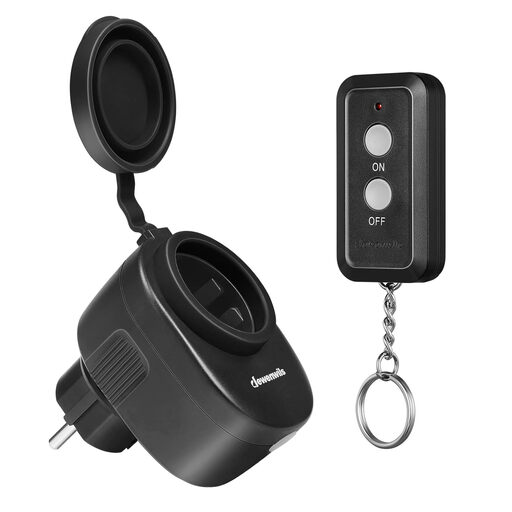
Why this is a suitable choice for this user: This remote-controlled plug is designed for people who want to control a device without creating an account, installing an app or configuring WiFi. The remote control can be used indoors to operate an appliance installed outside.
Its pre-programmed radio operation avoids compatibility issues with a 2.4 GHz router. However, its IP44 rating only protects it against water splashes: it is not suitable for submersion.
Rated power of 2 300 W, range of up to 30 m outdoors without obstacles, child lock and settings retained after a power cut.
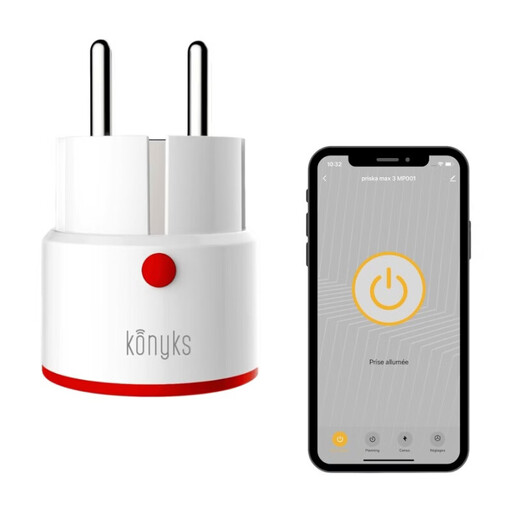
Why this is a suitable choice for this user: This model is designed for households looking to combine automation, energy monitoring and voice control in a compact format compatible with French sockets.
WiFi and Bluetooth connectivity simplifies pairing and can provide local control if the WiFi connection is interrupted. This model is for indoor use only.
Instant consumption readings and one year of history, maximum rated power of 16 A and 3 680 W, random scheduling and a choice of state after a power cut.
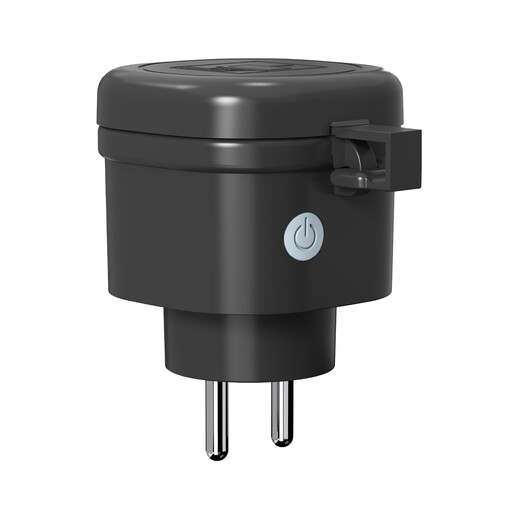
Why this is a suitable choice for this user: Its IP44 design and energy monitoring function make it suitable for garden equipment, pumps, outdoor lighting and certain compatible power tools.
The product information specifies that the IP44 rating does not protect against submersion and recommends installing the outdoor plug correctly. The load remains limited to 16 A and 3 680 W.
Smart Life and Tuya Smart apps, real-time energy monitoring, programmable scenes, Bluetooth-assisted set-up and a stated WiFi range of up to 40 m depending on the environment.
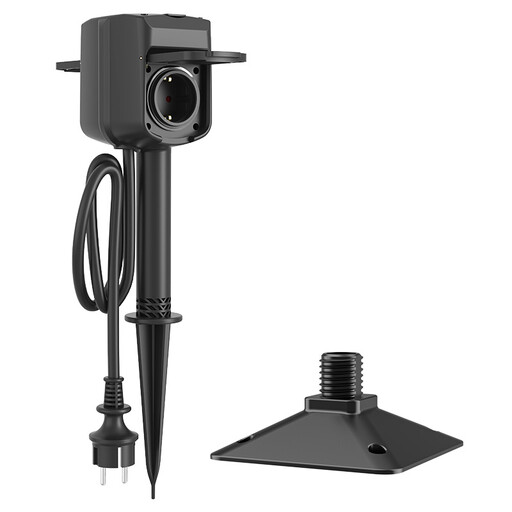
Why this is a suitable choice for this user: With two separately controllable outlets, this model can suit a garden equipped with several lights, a fountain or a pump.
The two sockets are described as independent, but the total power remains limited to 3 680 W. The IP44 housing must remain upright and must never be submerged.
Two outlets, 1.4 m cable, ground stake, app control and stated Alexa compatibility on a 2.4 GHz WiFi network.
We have put together a complete, real-time updated list of products that meet these demanding selection criteria and European safety standards.
To install a smart plug with Tuya Smart, Smart Life or a proprietary app, first connect your phone to the 2.4 GHz WiFi network. Then plug in the socket, activate pairing mode and follow the instructions displayed in the app.
Once set-up is complete:
Flush-mounted models, such as a wall-mounted WiFi socket, require the power to be switched off at the circuit breaker and the French wiring regulations to be followed. For this type of installation, call on a qualified person.
Not always. Many models only work with 2.4 GHz WiFi. Check the technical specifications and, if necessary, temporarily separate the 2.4 GHz and 5 GHz networks in your router’s interface during installation.
Yes. It remains powered to maintain the connection and run its components. Consumption varies between models. For example, a DEWENWILS radio plug states a standby consumption of 0,7 W. To avoid unnecessary energy use, unplug plugs that are only used occasionally when you are away for a long period.
Only if the power, operating time and conditions specified in the instructions are compatible. 16 A and 3 680 W are a stated limit, not general authorisation for every appliance. Avoid high-powered equipment running continuously when the product information advises against it, and never exceed the specified load.