
Livraison le jour même ou le lendemain

Qualité garantie

Débloquez vos offres de bienvenue: Livraison GRATUITE | Jusqu'à -80 % | 30 jours d'essai gratuits à JoyPlus
Téléchargez l'application
Making your home smarter, controlling devices from anywhere, and lowering your electricity bill—these promises are now within everyone's reach. The WiFi smart plug is often the perfect entry point into the world of home automation. But with an overwhelming number of options on the market, it can be tough to know where to start.
As the Head of Product Recommendations at Joybuy, my mission is to cut through the noise for you. In this guide, we'll give you the keys to finding the perfect smart plug for your needs, all without the unnecessary technical jargon.
Before diving into our top picks, let's go over a few key points that will guide your decision.
The real value of a smart plug lies in its integration with the ecosystems you already use, starting with voice assistants. If you're an Alexa or Google Assistant user, compatibility is a non-negotiable feature.
The good news is that many plugs rely on apps like Tuya Smart, which has become a go-to platform for centralising control over numerous home automation devices.
Not all smart plugs are created equal. Two features truly stand out and make all the difference in daily use:
The maximum supported power is a critical safety criterion. A 16A (ampere) plug is the standard to look for: it can handle up to 3680W, enough to safely power the most energy-intensive appliances (space heaters, washing machines, ovens, etc.). While a 10A model might be sufficient for a simple lamp, choosing 16A ensures versatility and peace of mind. Finally, always check for the CE marking and, ideally, additional safety certifications like the T?V label.
We have selected products for you that cover every use case, from simple remote control to the most advanced smart home integration.
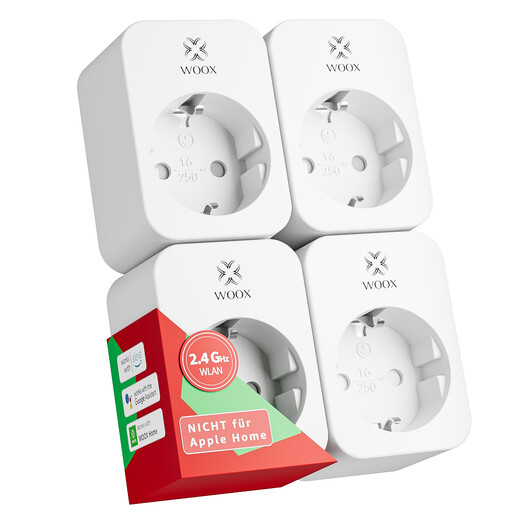
What makes this model stand out? This WOOX pack is the ideal solution for outfitting multiple rooms at once. It checks all the boxes for a modern WiFi smart plug: voice control, detailed scheduling, and energy monitoring.
Advantages:
Who is it for? For those who want to get serious about home automation, control multiple devices, and keep their energy bills in check, all within a unified ecosystem.
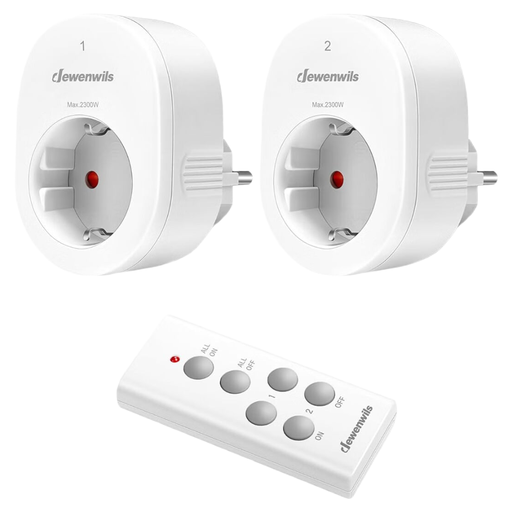
What makes this model stand out? There's no WiFi here, just simple and proven radio frequency (RF) technology. This Dewenwils solution is the perfect alternative for controlling appliances without relying on a smartphone or an internet connection.
Advantages:
Who is it for? For anyone who values simplicity and doesn't want to bother with an app or a voice assistant. It's also a very practical solution for controlling hard-to-reach lights or for assisting people with limited mobility.

What makes this system stand out? Much more than a simple socket, the Goneo rail is a fully modular wall-mounted system. It spells the end for unsightly power strips, offering an elegant, customisable, and seamlessly integrated solution.
Advantages:
Who is it for? For renovation or design projects (kitchen, office, media room). It's the solution of choice for those who place design, customisation, and impeccable cable management at the top of their priorities.
Our selection covers the main needs, but the world of the smart home is vast. If you haven't found what you're looking for yet, or if you're simply curious to discover other gems to simplify your daily life, feel free to explore our full catalogue.
Discover more home products in our outlet >
A WiFi smart plug connects to your home internet network. You control it from a smartphone app or with your voice (via Alexa, Google Assistant, etc.), even from the other side of the world. A remote-controlled plug, on the other hand, works using radio waves (RF) without needing the internet. Its control is limited to the physical remote provided, within a range of 20 to 30 metres.
No, its standby consumption is negligible, almost always less than 1 watt. That's far less than what you'll save by cutting standby power to your other devices (TVs, consoles, chargers, etc.). Models with energy monitoring are perfect for seeing these savings in real-time.
The vast majority of current WiFi plugs do not require a hub. They connect directly to your internet router, making setup as simple as possible. However, be aware that some specific ecosystems (like Zigbee or Z-Wave) require a dedicated gateway to communicate. Always be sure to check this on the product page. Rest assured: the models in our selection do not need one.