Livraison le jour même ou le lendemain

Qualité garantie

Débloquez vos offres de bienvenue: Livraison GRATUITE | Jusqu'à -80 % | 30 jours d'essai gratuits à JoyPlus
Téléchargez l'application
There's a unique tranquility in a grandparent's living room. Light filters through the sheer curtains, casting soft shapes on the wooden sideboard where silver frames rest. Each photo is a milestone: a wedding, a birth, a holiday from another time. Yet, between these frozen moments, life flows on, fast and distant, captured in the endless stream of our smartphones.
These digital memories, as precious as they are, often remain trapped on our screens. They require an action, a search, a deliberate share. They don't inhabit the space. They don't catch you by surprise with a passing glance. For the generations before us, this technological gap can quickly become an emotional one—a silent divide between their daily lives and the small joys of their children and grandchildren.
In response to this, a new philosophy of remembrance is emerging: ambient memory. The idea is no longer to actively look up memories, but to let them infuse our living space, creating a gentle and continuous presence. The challenge is to transform an everyday object into a living window to shared moments, bridging distance with a visual presence that is as discreet as it is warm.
This approach relies on technology that knows how to fade into the background. Here, true sophistication lies not in the complexity of features, but in the simplicity of the experience. An object that integrates into a home without disrupting it, that activates effortlessly, and that receives, as if by magic, fragments of life sent from across the country. Remote photo sharing is no longer a technical act, but a gesture of affection, a thought made tangible. It's a gift idea for grandparents that asks nothing of them but the pleasure of watching. The key to success? An intuitive interface for the sender, and an almost total absence of an interface for the receiver.
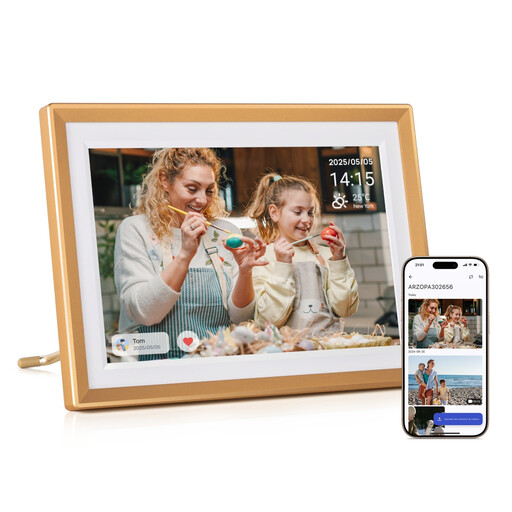
To bring this philosophy to life, the object must be chosen with care. It must combine understated aesthetics with flawless functionality. A connected photo frame is not just a gadget: it's a true decorative piece, a focal point in a room. Its design must complement the existing interior. Brushed metal finishes, clean lines, and a compact form factor, like that of a 10-inch digital photo frame, allow for seamless integration on a mantelpiece, a bedside table, or a bookshelf. The screen itself, with its anti-glare surface, should reproduce the warmth and texture of a film photograph, not the cold, blue light of a tablet.
The fluidity of the experience is paramount. Imagine sending a short video of your child's first steps via a simple app, and it appears moments later in your parents' living room. An object like the ARZOPA D10 photo frame was designed for this very immediacy. Once connected to the home's Wi-Fi, it becomes the stage for a private, evolving family gallery. The ability for multiple family members to contribute to the same frame, each from their own smartphone, weaves a collective narrative in real time.
The longevity of such a gift also lies in its business model. The promise of unlimited free cloud storage is essential: it guarantees that the connection will never be broken by a subscription or hidden fees. The device's internal memory ensures that memories remain accessible, even during an internet outage. It is this combination of thoughtful design, ease of use, and a lack of constraints that transforms a technological object into a true conduit for emotion. And for those who prefer to give the gift of choice, a digital gift card remains a thoughtful gesture, an invitation to find their own object of connection.
For those who wish to explore other gift ideas designed to create connection, our full selection of gift cards offers plenty of inspiration.