
Livraison le jour même ou le lendemain

Qualité garantie

Débloquez vos offres de bienvenue: Livraison GRATUITE | Jusqu'à -80 % | 30 jours d'essai gratuits à JoyPlus
Téléchargez l'application
A Wi-Fi-free video baby monitor gives parents peace of mind when they want to keep an eye on their child’s room without connecting the camera to their home network. The direct connection between the camera and screen generally eliminates the need for online accounts, apps and cloud storage. However, not all specifications are created equal. Some figures are measured in highly favourable conditions, while certain features may prove more limited than advertised.
A range of 300 metres is often measured in an open space, without walls or partitions. In a Parisian flat, a multi-storey house or a property with thick walls, the genuinely usable distance may be significantly shorter.
Before choosing, check the measurement conditions and whether the device has a signal-loss indicator. In a family home, a stable connection from one room to another matters far more than an impressive figure printed on the box.
A 720p baby monitor displays enough detail to identify your child’s general position and follow their movements. However, perceived image quality also depends on the screen size, camera angle, infrared lighting and transmission smoothness.
A 5-inch screen may be more comfortable to use than a smaller display, particularly when the monitor is placed on a bedside table. As for digital zoom, it does not reveal any additional detail: it simply enlarges the image available.
The battery life advertised for a rechargeable baby monitor varies depending on the mode used. A screen that remains on constantly consumes more power than audio-only mode or sound-activated operation. You should therefore distinguish between battery life with the display active, standby time and the available duration in audio mode.
Also check whether the camera runs on battery power or must remain plugged into the mains. This detail directly affects how it can be installed in the child’s room.
When choosing a baby monitor without an app, look for a direct connection between the camera and the parent monitor. The VAVA VA-IH006 PRO uses a private 2.4 GHz connection and requires neither a home Wi-Fi network, an account nor an app. This makes setup easier, as well as simplifying the management of connected devices in your home.
Of course, this configuration does not replace adult supervision. A baby monitor is an aid to observation and should not be used as the sole means of supervision.
A baby camera with night vision should switch automatically to infrared when the room becomes dark. The range and clarity of night vision depend on the distance between the camera and the cot, as well as on whether there are any obstacles in front of the lens.
Panning and tilting functions are particularly useful when the room has several areas that need monitoring. 2× or 4× digital zoom can help you check your child’s position, but it cannot compensate for poor camera placement.
A baby monitor with a temperature sensor displays the room temperature. This is a useful point of reference, but the reading can vary depending on how close the device is to a radiator, window or power supply. It must never be used as a substitute for a medical measurement.
The two-way intercom baby monitor function allows you to speak from the monitor to the camera. Some models also offer lullabies or a night light. For night-time use, pay attention to the brightness of the indicator lights, the sound volume and whether unnecessary functions can be switched off.
Finally, check the compliance information provided by the manufacturer, whether instructions are available in French, the warranty terms and, where required, the contact details of the responsible person established in the European Union. This information is far more useful than a marketing promise that is difficult to verify.
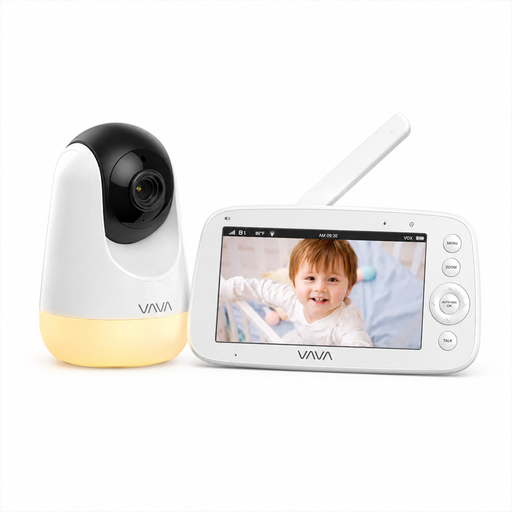
Why this choice suits this profile : The camera and screen communicate directly, with no app setup required. The 5-inch IPS screen and automatic night vision make the first installation particularly straightforward at home.
The advertised 300 m range is measured in an open space, so it should be treated as an indication rather than a guarantee between several rooms.
5-inch 720p screen, two-way communication, temperature monitoring, and a monitor battery offering up to 10 hours with the screen on or 24 hours in audio mode.
Why this choice suits this profile : Remote controls let you adjust the viewing angle without immediately going back into the room, with 270° horizontal panning and 108° vertical tilting.
The specifications distinguish between the different battery-life modes and do not present 24 hours as continuous video time: this figure refers to audio-only use.
2× and 4× digital zoom, automatic movement mode, five built-in lullabies and a night light adjustable across three brightness levels.
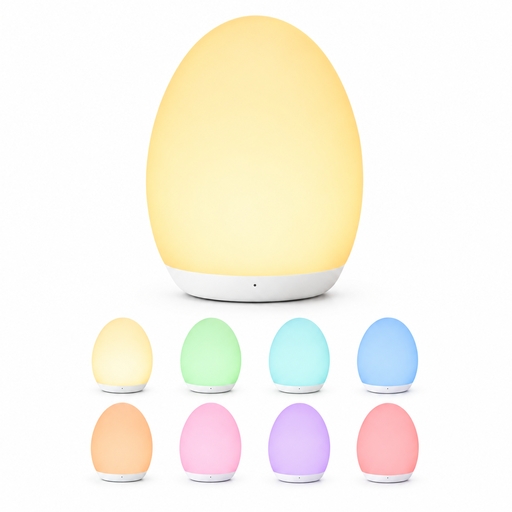
Why this choice suits this profile : This night light complements a Wi-Fi-free baby monitor for night-time feeds, nappy changes or moving around, without an app or network connection.
The advertised maximum battery life of 100 hours corresponds to the lowest brightness setting; at full power, the stated duration falls to around 7 hours.
2 000 mAh rechargeable battery, touch control, adjustable warm white light, eight colours and a one-hour timer.
We have put together a complete, real-time updated selection of products that meet these demanding criteria, while also taking European safety regulations into account.
Yes, provided it has a dedicated parent monitor and a direct connection between the camera and screen. It then needs no account, app or Wi-Fi router. However, consult the instructions to find out how to complete the initial pairing process.
It depends entirely on the mode selected. Continuously displayed video generally uses more power than audio-only monitoring or standby mode. For the VAVA VA-IH006 PRO, the specifications state up to 10 hours with the screen on and up to 24 hours in audio mode. The camera itself must remain plugged into the mains.
It may be suitable for many homes, but the 300 m figure is measured in an open space. Walls, ceilings, electronic devices and the layout of the house can reduce the range indoors. It is better to test the connection in the rooms you actually use before permanently positioning the camera.