If you want a wholemeal base for your crêpes and prefer to choose the toppings yourself, T150 wholemeal wheat flour that you prepare at home is the more direct option. Ready-to-eat crêpes save you the trouble of making batter, but terms such as ‘organic’ or ‘wheat’ don’t guarantee that the flour is wholemeal. Check the ingredients, nutritional information, allergens and storage instructions on the pack you choose.
Who are these options for?
Households looking to make wholemeal crêpes
If you’re happy to make the batter, look for flour explicitly labelled ‘T150 wholemeal wheat flour’ or ‘T150 wholegrain flour’. Simply saying ‘wheat’, ‘rustic’ or ‘organic’ doesn’t tell you whether the flour is wholemeal.
Households who prefer crêpes ready to fill
For a quick breakfast, snack or dessert, check how many crêpes are in the pack and the storage instructions. Ingredients matter too: Auchan’s product information for ready-to-eat crêpes lists wheat, milk, eggs and sugar, among other ingredients.
People who mainly compare recipes
If the type of flour, sugars or allergens influence your choice, read the ingredients list and nutritional information for the specific product you’re buying, rather than relying on the recipe name alone.
What should you check when shopping?
First decide whether you want to make the batter or use ready-to-eat crêpes. Then compare products within your chosen category.
| Priority |
What to check |
Who is this for? |
| A wholemeal base |
Look for ‘T150 wholemeal wheat flour’ or ‘T150 wholegrain flour’. Compare the fibre content per 100 g between products in the same category. |
If I’m making crêpes for the week, I want to know which flour is going into my batter, without confusing ‘organic’ with ‘wholemeal’. Around 42% of consumers put this need for wholemeal flour first. |
| Convenience and storage |
For fresh crêpes, check the number of crêpes in the pack, the storage temperature and how long they keep after opening, as stated on the packaging. |
When I’m short on time, ready-to-fill crêpes suit me, as long as I can store and use the pack as instructed. Saving time is the top priority for around 33% of consumers. |
| Ingredients |
Read the ingredients, sugars and allergen information; compare the nutritional values per 100 g of similar ready-to-eat crêpes. |
Before choosing a recipe for my household, I want to see what it contains, especially any ingredients that could be a problem for one of its members. Ingredients are the main concern for around 25% of consumers. |
Common mix-ups to avoid
-
Assuming ‘organic’ or ‘wheat’ means ‘wholemeal’
The product information for Dessaint and Auchan Bio organic crêpes lists wheat or wheat flour, but doesn’t describe it as wholemeal. These terms alone aren’t enough to identify a wholemeal crêpe.
To make your own batter, look for flour explicitly labelled wholemeal or wholegrain T150. For ready-to-eat crêpes, check the type of flour in the ingredients list.
-
Comparing dry flour directly with cooked crêpes
Their water content and ingredients differ, so the fibre listed per 100 g of flour doesn’t tell you about a portion of filled crêpes.
Compare flour with flour, or ready-to-eat crêpes with similar crêpes. Also consider the ingredients and the portion you’ll be eating.
-
Choosing a pack without planning when to open it
Auchan Bio’s product information states that its crêpes should be stored between 0 and 4 °C and eaten within 48 hours of opening. If the pack is too large for the occasions you have in mind, you may not finish it in time.
Check the instructions on the pack you choose, then match the number of crêpes to the meals and snacks you have planned.
-
Reading only the front of the pack
The crêpe recipes reviewed contain wheat, milk and eggs, among other ingredients. Other allergens or traces may also be listed, depending on the product.
If you have an allergy, read the ingredients and allergen information on the exact pack. The DGCCRF reminds consumers that allergens must be highlighted in the ingredients list of pre-packed foods.
Flour brands to know
Francine
Francine offers T150 wholemeal wheat flour in a 1 kg pack, for making your own batter at home.
- Francine states that its T150 wholemeal flour contains 9.5 g of fibre per 100 g; check the value on the pack you buy.
- This is wheat flour that needs to be prepared, not ready-to-eat crêpes. It isn’t suitable for a gluten-free diet.
Mon Fournil
Carrefour’s product information describes its organic T150 wholemeal wheat flour as suitable for making crêpes.
- Carrefour’s product information lists ‘organic T150 wholemeal wheat flour’ as an ingredient.
- The product contains wheat and you’ll need to make the batter.
Celnat
Celnat offers T150 wholegrain wheat flour in 1 kg and 5 kg packs. It’s worth considering if you use this type of flour regularly.
- The brand describes it as wholegrain flour containing the wheat germ and a large proportion of the bran.
- Celnat notes that traces of soya, nuts and sesame may be present. Check the information on the pack you choose.
Wholemeal flour for homemade crêpes
This Joybuy selection is for making homemade crêpes with T150 wholemeal wheat flour. It isn’t a substitute for choosing ready-to-eat crêpes if speed is your priority.
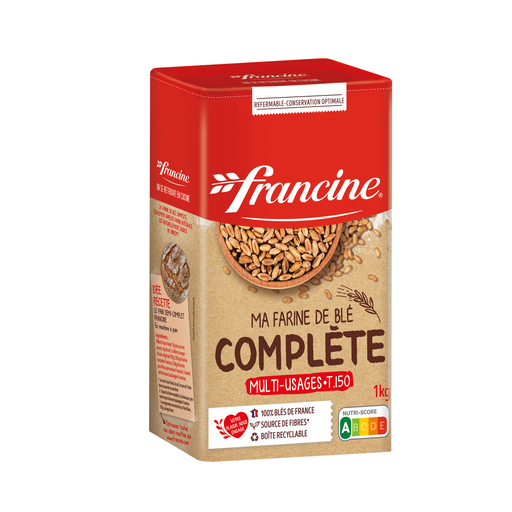 Image unavailable
Francine T150 wholemeal wheat flour, 1 kg
Choose this if you’re planning to make your own crêpe batter with wholemeal flour rather than buying crêpes ready to fill.
T150 wholemeal wheat flour in a 1 kg pack. As it contains wheat, check the packaging if you need to avoid this ingredient or gluten.
View on Joybuy
Frequently asked questions
How can you tell if flour or crêpes are wholemeal?
For flour, look for a clear label such as ‘T150 wholemeal wheat flour’ or ‘T150 wholegrain flour’. For ready-to-eat crêpes, check the type of flour in the ingredients: ‘organic’, ‘wheat’ and ‘wheat flour’ don’t mean ‘wholemeal’ on their own.
Is T150 wholemeal wheat flour suitable for a gluten-free diet?
No. It’s wheat flour, so it contains gluten. Check the ingredients and allergen information on the exact product before using it.
How long can you keep fresh crêpes after opening?
Follow the storage instructions on the pack. Auchan Bio’s product information states that the crêpes should be stored between 0 and 4 °C and eaten within 48 hours of opening; these instructions don’t apply to all fresh crêpes.
Where can you find allergen information on pre-packed crêpes?
Check the ingredients list on the pack you buy. The DGCCRF says that allergens in pre-packed foods must be highlighted in the ingredients list; also read any ‘may contain’ warnings on the product.


