If wholemeal flour is your priority for a lunchbox, making crêpes at home lets you choose the flour. If you’re buying ready-made crêpes, check the ingredients and fibre per 100 g before treating them as an equivalent option. A buckwheat galette is a different choice, and it isn’t automatically gluten-free once made. If your child needs to avoid gluten, check the labelling and the arrangements in place at their school.
Who is this for?
Households focused on wholemeal flour
When choosing the base for lunchbox crêpes, these households look for clearly identified wholemeal flour and an easy-to-check fibre figure in the nutritional information. A rustic or organic look is no substitute for these details.
Parents who prefer ready-made crêpes
Ready-made crêpes save you from cooking before putting together a lunchbox. You’ll still need to tell the difference between sweet crêpes, filled crêpes and galettes, then check the ingredients of the product you choose.
Families who need to avoid gluten
If your child follows a special diet, the name “buckwheat galette” isn’t enough to confirm what’s in the finished product. The French Ministry of Education provides for an Individualised Welcome Plan, or PAI, when a pupil’s health means they need special arrangements at school.
What should you look for?
For a secondary school lunchbox, the main trade-off is between choosing the flour yourself and saving time on preparation. If gluten needs to be avoided, you’ll also need to check the finished product and the arrangements for meals at school separately.
| Criterion |
What to check |
Who it matters to |
| Wholemeal flour and fibre |
Look for wholemeal flour in the ingredients, then compare the fibre figures per 100 g. |
I want to know what flour goes into the lunchbox crêpes, rather than relying on an organic or rustic presentation; around 50% of consumers would make this their priority. |
| Convenience |
Distinguish between sweet crêpes, filled crêpes and galettes; check the format and nutritional information for the ready-to-eat product. |
When I’m short on time to prepare a lunchbox, I mainly look for ready-made crêpes; convenience would be the priority for around 30% of consumers. |
| Avoiding gluten |
Check that the finished product is labelled “gluten-free” and suits your child’s diet, as well as confirming the arrangements agreed with their school. |
If my child needs to avoid gluten, I have to choose a product that suits their diet and school meal arrangements; this would be the priority for around 20% of consumers. |
Common mix-ups to avoid
-
Assuming “made with wheat”, “organic” or “buckwheat” means “wholemeal”
These terms don’t mean the same thing. Carrefour, E.Leclerc and Auchan list several types of crêpes and galettes; the product name alone doesn’t tell you which flour is used or how much fibre it contains per 100 g.
Look for wholemeal flour in the ingredients list and check the “fibre” line in the nutritional information for the specific product.
-
Assuming a buckwheat galette is necessarily gluten-free
The name of a galette doesn’t tell you about all its ingredients or the finished product. Carrefour also lists buckwheat galettes and products labelled “gluten-free” as separate categories.
If gluten needs to be avoided, check for the appropriate label on the packaging and make sure the product suits your child’s diet.
-
Planning a special meal without speaking to the school
You can’t work out the arrangements for a packed meal for a pupil who needs special provision just by checking the crêpes’ ingredients. The French Ministry of Education describes the PAI as an individualised support plan for pupils who need one.
Contact the school to find out how it handles packed meals and, if your child’s health requires it, what steps to take to arrange a PAI.
Retailers and brands to explore
Carrefour
Its range lets you distinguish between wheat crêpes, buckwheat galettes and crêpes labelled “gluten-free”.
- Separate categories to explore depending on whether you’re prioritising the crêpe’s ingredients or avoiding gluten.
- A category name doesn’t mean you can skip checking the ingredients and nutritional information for the product you choose.
Bio Village / E.Leclerc
The E.Leclerc range includes Bio Village crêpes made with cane sugar.
- An option to explore if you’re looking for ready-to-eat crêpes.
- An organic label or cane sugar doesn’t tell you whether wholemeal flour has been used.
Auchan
The range includes filled crêpes and galettes, which are suited to different uses from a plain crêpe you prepare yourself.
- Filled options are worth exploring when convenience is your main priority for a meal.
- The filling doesn’t tell you what kind of flour has been used or how much fibre the product contains.
Flour for making crêpes
If you’re making wholemeal crêpes at home for a lunchbox, this selection features wholemeal wheat flour rather than ready-to-eat crêpes.
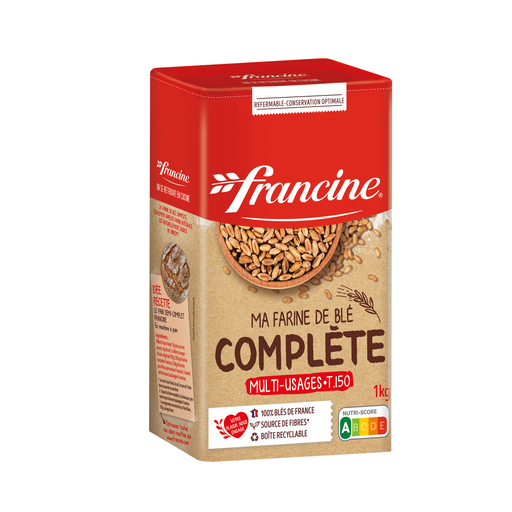 Image unavailable
FRANCINE T150 wholemeal wheat flour, 1 kg
For households who make their own crêpes and want to choose a clearly identified wholemeal wheat flour. The pack contains 1 kg of T150 flour, so you’ll still need to make the crêpes yourself. If fibre content is important to your choice, check the figure per 100 g on the packaging. This wheat flour isn’t suitable for a gluten-free diet.
View on Joybuy
Frequently asked questions
Are crêpes described as wholemeal necessarily high in fibre?
No. Check the flour in the ingredients and the fibre content in the nutritional information. For the regulated claim “high in fibre”, Regulation (EC) No 1924/2006, published on EUR-Lex, sets a threshold of at least 6 g of fibre per 100 g or 3 g per 100 kcal. The name of the crêpe alone isn’t enough to justify using this claim.
Is a buckwheat galette enough for a gluten-free lunchbox?
No. Having buckwheat in the name doesn’t guarantee that the finished galette is suitable for someone avoiding gluten. Check all the ingredients and look for a “gluten-free” label on the product you choose, taking your child’s diet into account.
What should you agree with the school for a meal that meets a special dietary requirement?
Ask the school how your child’s meal should be organised before bringing in a lunchbox. The French Ministry of Education provides for a PAI when a pupil’s health means they need special arrangements. If a PAI is in place, the arrangements for a packed meal should be agreed as part of it.
Ready-made crêpes or wholemeal flour: how do you choose?
Choose wholemeal wheat flour if you want to control which flour is used and can make time to prepare the crêpes. If saving time matters most, consider ready-made crêpes, but only treat them as wholemeal after checking the ingredients. Compare the fibre per 100 g separately if that’s one of your criteria.


