When choosing muesli while keeping an eye on your carbohydrate intake, check that the wholegrains are clearly identified, then compare carbohydrates, sugars and fibre based on the amount you actually serve. A dried-fruit mix may fit into your meals depending on your individual needs : the words “no added sugars” don’t mean there are no naturally occurring sugars.
Who are these criteria for ?
People tracking their carbohydrate intake at breakfast
If you tailor your meals to your individual needs, compare the carbohydrate values on the pack with the amount of muesli you actually pour. France’s national health insurance service reminds us that diets should be tailored to each person’s needs.
People looking for wholegrains
You may want to identify wholegrains in the ingredients and compare the fibre per 100 g, then check the amount in your portion. France’s national health insurance service includes wholegrain and semi-wholegrain cereal products among the foods to include regularly as part of a varied diet.
People drawn to recipes with dried fruit
Raisins, dates and figs can be part of the recipe while also contributing naturally occurring sugars. Compare the “of which sugars” line, carbohydrates, portion size and allergen information for the product you choose.
What should you check before choosing ?
Start with the carbohydrates in your usual portion, then look at the muesli’s ingredients : two recipes with the same name may combine grains, dried fruit and seeds in different ways.
| Criteria | What to check | Who is it for ? |
|---|
| Carbohydrates and portion size |
Compare the carbohydrates per 100 g with the amount you actually put in your bowl. |
When I plan the carbohydrates in my breakfast, the portion shown on the pack isn’t enough if I serve myself a different amount ; around 36 % of consumers prioritise this need. |
| Wholegrains and fibre |
Look for wholegrains clearly listed in the ingredients and compare the fibre per 100 g. |
If I want a wholegrain muesli, I need to be able to identify the grains rather than relying on the product name alone. This is the main criterion for around 29 % of consumers. |
| Dried fruit, sugars and allergens |
Check the ingredients, the “of which sugars” line and the allergen information, even if the pack says “no added sugars”. |
I enjoy fruity mixes, but I want to know what the dried fruit contains and whether the recipe is right for me ; around 21 % of consumers put this check first. |
| Recipe and availability |
Check that the product on offer matches the recipe you’re looking for and is available where you do your food shopping. |
To plan my shopping, I need to find a comparable recipe rather than randomly replacing plain muesli with a fruit mix. This comes first for around 14 % of consumers. |
Common misconceptions to avoid
-
Assuming “no added sugars” means “sugar-free”
This claim doesn’t rule out naturally occurring sugars. For example, the Auchan product listing for Jordans Organic Fruit & Nut Muesli gives 18,9 g of sugars per 100 g, despite stating “no added sugars”.
Check the ingredients, carbohydrates and the “of which sugars” line too, then consider these values in relation to your portion.
-
Assuming all flakes are wholegrain
A list of grains doesn’t necessarily tell you whether each one is wholegrain. The Carrefour Bio product listing for Muesli 5 Céréales Nature Bio names five types of flakes without describing each as “wholegrain”.
Look for this detail in the ingredients or on the pack before choosing the product on this basis.
-
Overlooking how toppings affect what’s in your bowl
Dried fruit contains naturally occurring sugars, while nuts, seeds and grains mean you should check the allergen information carefully for the specific recipe.
If you’d rather choose your toppings separately, start with plain flakes and take into account everything you add.
-
Assuming the pack’s portion size matches what you eat
Nutrition information per portion only describes your breakfast if the stated amount is the same as the amount you serve. Diabetes UK highlights the importance of the total amount of carbohydrates consumed after a meal.
Compare the weight of your usual portion with the values per 100 g and, if your treatment requires it, agree your individual targets with your healthcare professional.
Brands to consider
Jordans
The range includes mueslis that combine wholegrains, fruit, nuts or seeds.
- The Auchan listing for Bio Fruits & Noix states that it contains 65 % wholegrains.
- This same product contains 18,9 g of sugars per 100 g ; check the allergen information for the specific recipe too.
Carrefour Bio
Muesli 5 Céréales Nature Bio can be a good base if you’d like to add your own toppings.
- The Carrefour listing names oat, wheat, rye, barley and rice flakes.
- It doesn’t state that each of these grains is wholegrain ; if this matters to you, check the pack to confirm.
Bio Village
The brand offers products including wholegrain oat flakes and a dried-fruit muesli : two different recipes to distinguish between.
- The E.Leclerc listing for Muesli floconneux fruits secs states 11,0 g of sugars and 7,7 g of fibre per 100 g.
- This recipe contains dried fruit : check its ingredients and portion size rather than applying the values for a product made with plain flakes.
Muesli and oats to compare on Joybuy
These two products suit different needs : an organic fruit muesli for a ready-made recipe, or organic oat flakes so you can make your own mix. In either case, choose your serving size to suit your individual dietary needs.
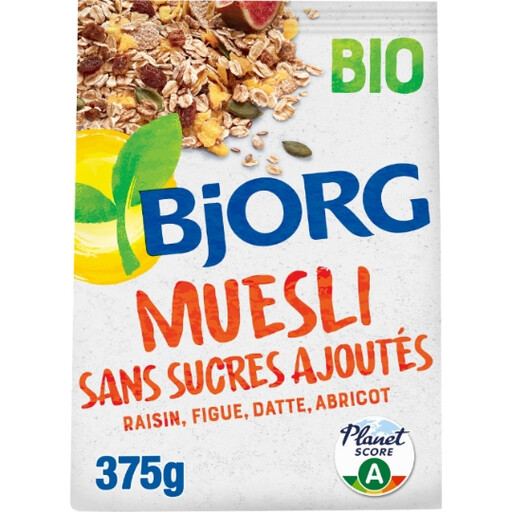 Image unavailable
BJORG Organic Muesli 375 g
For anyone looking for a ready-made fruity muesli. The Joybuy listing mentions wholegrains and 23 % fruit ; this fruit may contain naturally occurring sugars. Check the carbohydrates in the amount you serve, as well as the allergen information on the pack.
View on Joybuy
 Image unavailable
BJORG Organic Oat Flakes 500 g
For making your own mix and choosing the toppings separately. These are oat flakes, not a ready-to-eat fruit muesli : any ingredients you add will change what’s in your bowl. Check the nutrition information and allergens on the pack.
View on Joybuy
Frequently asked questions
Does “no added sugars” mean “sugar-free” ?
No. The “no added sugars” claim is governed by European Regulation (EC) No 1924/2006, but muesli may contain naturally occurring sugars, particularly in dried fruit. Check the “of which sugars” line alongside the ingredients and carbohydrates.
Why compare carbohydrates rather than just sugars ?
The “carbohydrates” line gives you a broader indication of the amount you’re consuming. Diabetes UK highlights the importance of the total carbohydrates in a meal for blood glucose levels afterwards ; compare the values per 100 g with your actual portion and individual targets.
Is the Nutri-Score enough to choose a muesli ?
No. It doesn’t replace checking carbohydrates, sugars, fibre, ingredients and serving size. France’s national health insurance service reminds us that diets should be tailored to each person’s needs.
How should you store BJORG muesli after opening ?
Follow the instructions on your pack. For BJORG Organic Muesli 375 g, the Joybuy listing advises closing the pack securely after opening and storing it in a dry place.


