Busy people looking for a wholegrain cereal base
You want muesli that’s quick to serve, with an ingredients list that makes it easy to spot the wholegrains. The fibre content per 100 g then helps you compare recipes on a like-for-like basis.


To choose a muesli that’s quick to serve, first look for clearly identified wholegrains in the ingredients, then compare the fibre and sugar content per 100 g. A fruit recipe with no added sugars may suit your preference, but it will still contain sugars naturally present in the fruit. Remember to check the allergens for the product you choose, too.
You want muesli that’s quick to serve, with an ingredients list that makes it easy to spot the wholegrains. The fibre content per 100 g then helps you compare recipes on a like-for-like basis.
You’d like to keep dried fruit in your bowl without mistaking the words ‘no added sugars’ for the total sugar content shown in the nutritional information.
Before making a recipe part of your quick morning routine, check the cereals and nuts it contains, as well as any ‘may contain’ warnings on the pack you buy.
Start with the ingredients, then compare the nutritional information and packaging details with what matters most to your household.
| Criteria | What to check | Who is it for? |
|---|---|---|
| Wholegrains and fibre | Look for cereals explicitly described as wholegrain in the ingredients, and compare the fibre content per 100 g. | When I’m making a quick bowl, I don’t want to choose based on the front of the pack alone. I want to see how much wholegrain cereal it contains. Around 33% of consumers put this and checking the fibre content at the top of their list. |
| Added and naturally occurring sugars | Read the ingredients list, check for any ‘no added sugars’ claim, and look at the ‘of which sugars’ line per 100 g. | I’m interested in a fruity recipe, but first I want to distinguish added sugars from those naturally present in dried fruit. Around 27% of consumers share this priority. |
| Allergens | Check the highlighted ingredients and any ‘may contain’ warnings on the pack you choose. The DGCCRF states that allergens must be emphasised in the ingredients list. | When an allergy is a concern, I need to check the exact recipe before making it part of my morning routine. Around 20% of consumers put allergen suitability first. |
| Pack size and storage | Choose a pack size that suits how much you eat, and follow the instructions for closing and storing it after opening. | If the pack will stay open over several mornings, I want a size that’s easy to use and store at home. Around 20% of consumers prioritise this convenience. |
Recipes vary. The word ‘muesli’ alone doesn’t tell you which cereals are wholegrain or how much of them the recipe contains.
Look for ‘wholegrain oats’, ‘wholemeal wheat’ or another cereal clearly identified as wholegrain in the ingredients, then compare the fibre content per 100 g.
A recipe containing dried fruit may say ‘no added sugars’ while still listing sugars in its nutritional information.
Check the claim on the packaging, the ingredients and the ‘of which sugars’ line per 100 g.
Ingredients and ‘may contain’ warnings vary by product, even between mueslis in the same range.
Read the ingredients list and warnings on the pack you’re buying, especially for gluten-containing cereals, milk and nuts.
The details below apply to the specific products mentioned, not to every product from each brand.
Auchan lists a Bjorg organic muesli with raisins, figs, dates and apricots, made with wholegrain cereals and fruit.
The organic fruit muesli listed by Auchan is available in a 1 kg pack.
Jordans’ traditional muesli range includes a variety of recipes. The Special Muesli listed by Auchan combines wholegrain cereals, dried fruit and nuts.
Country Store is a muesli made with ingredients including wholegrain oats, maize, raisins and wholemeal wheat.
Carrefour’s Organic 5 Cereal Plain Muesli is made with oat, wheat, rye, barley and rice flakes.
This 375 g pack of organic muesli is worth considering if you’re looking for a quick breakfast option. To see how it compares with wholegrain recipes, check the ingredients on the pack.
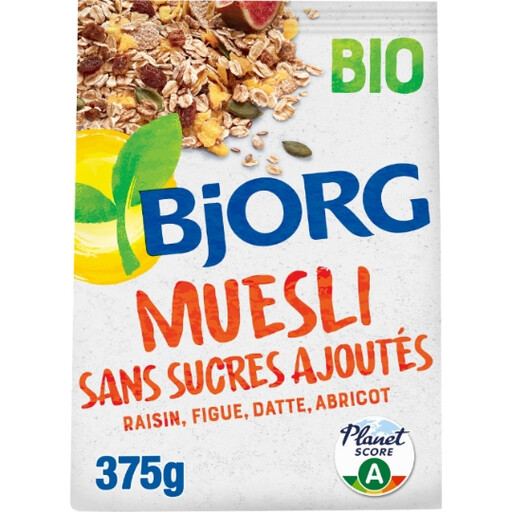 Image unavailable
If you need a quick breakfast, this organic muesli comes in a 375 g pack. If the proportion of wholegrain cereals is important to you, check the packaging. Also read the ‘of which sugars’ line and the allergen information.
Read the ingredients and look for cereals described as ‘wholegrain’ or ‘wholemeal’, rather than relying on the name of the muesli alone. Then compare the nutritional information per 100 g and, where stated, the proportion of wholegrain cereals.
No. It refers to the fibre content, not the type of every cereal. Under European Regulation (EC) No 1924/2006, published by EUR-Lex, the ‘high in fibre’ claim requires at least 6 g of fibre per 100 g or 3 g per 100 kcal. Check the ingredients list separately to identify the wholegrains.
No. Muesli containing dried fruit can carry a ‘no added sugars’ claim and still contain sugars naturally present in its ingredients. To compare two recipes, check the ‘of which sugars’ line per 100 g as well as the ingredients.
Check the specific recipe and any ‘may contain’ warnings. Depending on the product, the examples featured contain gluten-containing cereals, milk or nuts. The DGCCRF reminds consumers that allergens must be emphasised in the ingredients list on prepacked foods.
Choose a pack size that suits how quickly your household gets through it, and follow the storage instructions on the pack once it’s open. For the 1 kg pack of Terres & Céréales Bio fruit muesli, make sure you reseal it properly and store it away from heat and moisture.