What should you compare?
Start by checking what the packet means by ‘wholegrain’. Then compare sugar, allergens and pack size according to what matters most for your breakfast.
| Criteria |
What to check |
Who is it for? |
| Wholegrains and fibre |
The name and proportion of wholegrain flakes in the ingredients; fibre per 100 g. |
If wholegrains are my priority, I want to spot them in the recipe rather than infer it from the product name. Around 36% of consumers prioritise this ingredient information and comparing fibre. |
| Sugar and recipe |
Sugar per 100 g and ingredients such as honey or chocolate. |
For an indulgent weekend recipe, I want to know what it contains instead of relying on its name alone. This is the main criterion for around 29% of consumers, who compare sugar first. |
| Allergens |
Allergens highlighted on the packet and any ‘may contain’ warnings. |
If I need to rule out certain ingredients before serving granola, the exact recipe matters more than its flavour. This check comes first for around 21% of consumers. |
| Pack size and storage |
The packet’s weight and storage instructions after opening. |
If I save granola for weekend breakfasts, I want a pack size that suits how often I serve it. Around 14% of consumers prioritise this practical consideration. |
According to the DGCCRF, ingredients are listed in descending order by weight, and allergens must be highlighted in the ingredients list of pre-packed foods. The nutrition declaration per 100 g gives you a common basis for comparing two recipes, but it doesn’t replace checking the amount you’ll actually serve.
Brands to consider
These examples refer to specific products. Compare their labels, and don’t assume that every granola from the same brand has the same ingredients.
Bjorg
The Bjorg Chocolate Granola listing describes a recipe made with wholegrain oat flakes.
- The product contains 71% wholegrain oat flakes and 7.5 g of fibre per 100 g.
- It also contains 12 g of sugar per 100 g. Check the ingredients and allergen information on the packet.
Carrefour Bio
The listing for the 500 g Organic Plain Granola specifies two wholegrain cereals.
- It contains 48% wholegrain oat flakes and 14% wholegrain barley flakes.
- The recipe also contains cane sugar and honey. Check for ‘may contain’ warnings if they’re relevant to you.
Jordans
The Carrefour listing for Jordans Almond, Hazelnut and Seed Granola states the proportion of wholegrain oats in this product.
- It contains 56% wholegrain oat flakes.
- The recipe includes almonds and hazelnuts, among other ingredients. Check the allergens and nutritional information for the variety you choose.
Auchan
The listing for Auchan Plain Granola, 350 g, lets you compare nutritional values per 100 g.
- It contains 8.6 g of fibre and 6.3 g of sugar per 100 g.
- It describes toasted oat flakes without calling them wholegrain. Check the packaging if this is a deciding factor for you.
Grainea
The E.Leclerc listing for Grainea Nut Granola describes a mix of oats, spelt, seeds and nuts.
- It contains 8.9 g of fibre and 8.4 g of sugar per 100 g.
- The flakes aren’t described as wholegrain. If you need to avoid nuts, check the ingredients on the packet.
Granolas available on Joybuy
These two granolas are worth considering if you’re looking for wholegrains for a weekend breakfast: one is a nut-based recipe and the other is chocolate flavoured. To decide between them, compare the ingredients and nutritional information on the packets with what matters most to you.
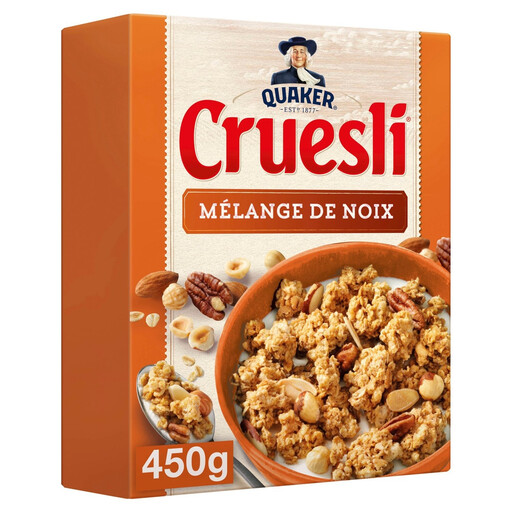 Image unavailable
QUAKER Cruesli Mixed Nuts, 450 g
Worth considering if you want a nut-based recipe for several breakfasts. This comes in a 450 g pack. Before choosing it, compare the proportion of wholegrains, sugar and fibre listed on the label. If you need to avoid certain allergens, also check the ingredients and any ‘may contain’ warnings on the packet you receive.
View on Joybuy
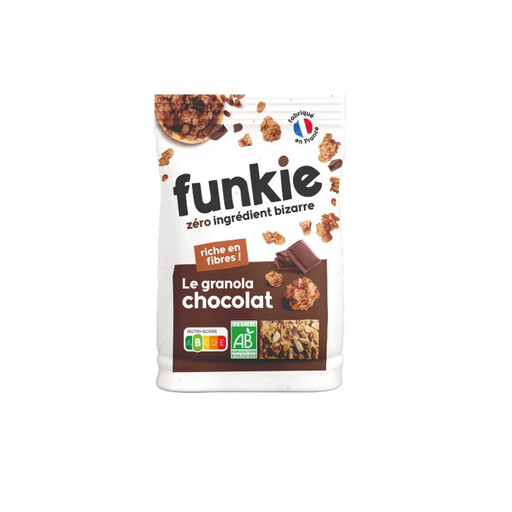 Image unavailable
FUNKIE Organic Chocolate Granola, 300 g
Worth considering if you’re looking for a chocolate recipe in a 300 g packet. To see if it suits your priorities, check the label for the proportion of wholegrain flakes and sugar per 100 g. Also check the allergens and storage instructions after opening for the packet you buy.
View on Joybuy
Frequently asked questions
How can you identify wholegrains in granola?
Look for explicit descriptions in the ingredients list, such as ‘wholegrain oat flakes’ or ‘wholegrain barley flakes’, and check their proportions if stated. According to the DGCCRF, ingredients are listed in descending order by weight, so their position helps you understand how much they contribute to the recipe. The word ‘granola’ alone doesn’t confirm that it contains wholegrains.
Should you compare sugar per serving or per 100 g?
Start by comparing sugar per 100 g so you’re using the same basis for each packet. The DGCCRF states that nutritional information is given per 100 g or 100 ml. Then consider how much granola you actually serve.
Is nut granola suitable if I need to avoid allergens?
Don’t assume it’s suitable based on the name alone. Check the highlighted ingredients and any ‘may contain’ warnings on the specific packet, as the cereals and other ingredients vary between recipes.
How should you store granola between weekends?
Follow the instructions on the product you buy. For example, the Auchan listing for A&O almonds and honey granola recommends storing it in an airtight container after opening. Don’t assume this instruction applies to other products.
Is the Nutri-Score enough to confirm that granola contains wholegrains?
No. To identify wholegrains and find out how much the product contains, if stated, read the ingredients list. Check the nutritional information and allergens separately, according to what matters for your choice.


