People comparing fibre content
If wholegrains are important to you, check the ingredients and the fibre content per 100 g. Manger Bouger recommends choosing wholegrain or semi-wholegrain starchy foods, which are naturally high in fibre.


For a saucisson evening, compare wholemeal flour, fibre and salt per 100 g before choosing a texture: the word ‘wholemeal’ alone doesn’t tell you everything about the recipe. A crispbread makes a good base for cold toppings, while a part-baked wholemeal loaf is a good choice if you’d like to make warm toast and have an oven. In either case, check the allergen information for any guests who need to avoid certain ingredients.
If wholegrains are important to you, check the ingredients and the fibre content per 100 g. Manger Bouger recommends choosing wholegrain or semi-wholegrain starchy foods, which are naturally high in fibre.
With saucisson on the platter, the salt content per 100 g helps you compare the crispbreads you’re considering, whatever the pack says about them being ‘wholemeal’.
Depending on the recipe, crispbreads may contain wheat or rye and may carry warnings about traces of other allergens. Check the pack you plan to serve for any guests who need to avoid certain ingredients.
When serving crispbreads with saucisson, start with the ingredients, then compare the salt content and allergen information for the products you’re considering.
| What to compare | What to check | Who it matters to |
|---|---|---|
| Wholemeal flour and fibre | Check which grain is used and the stated proportion of wholemeal flour, then compare the fibre content per 100 g. | If I want a wholegrain base, the ingredients and fibre content matter more than the ‘wholemeal’ label alone; around 42% of consumers make this their priority. |
| Salt | Compare the ‘salt’ figure per 100 g and take into account how many crispbreads you’ll serve. | With saucisson on the menu, I want to choose a suitable base without overlooking its salt content; around 33% of consumers put this first. |
| Allergens | Read the highlighted ingredients and any ‘may contain’ warnings on the pack you buy. | If a guest needs to avoid certain ingredients, I need to find a product that meets their requirements; for around 25% of consumers, this comes before other criteria. |
The Epi d’Or and Brioche Pasquier product information lists recipes that combine wholemeal flour with wheat flour. So the product name alone won’t tell you what’s in it.
Check the ingredients list, the proportion of wholemeal flour if stated, and the fibre content per 100 g.
The word ‘wholemeal’ doesn’t tell you how much salt is in a crispbread served with saucisson.
Compare the figures per 100 g on the packs you’re considering, then decide how many to put on the platter.
The wheat and rye products reviewed contain gluten; some also carry warnings about traces of other allergens.
Check the ingredients and any warnings about traces on the packaging of the product you plan to serve.
A product’s availability may vary depending on the shop or collection option you choose.
Check that the product you have in mind is available before preparing the toppings, and find another option with ingredients that meet your criteria.
The Wasa Complet product listed by Carrefour is a crisp rye wholemeal crispbread for cold toppings.
These wholemeal wheat crispbreads make it easy to compare the figures given per 100 g.
Carrefour’s product information for these toasted crispbreads states that they contain 45% wholemeal wheat flour.
Le Complet 330 g is a part-baked wholemeal loaf to consider if you’d like to make warm toast.
For serving with cold toppings, this selection features a Wasa crispbread. Compare its ingredients with your requirements for fibre, salt and allergens by checking the packaging of the product you buy.
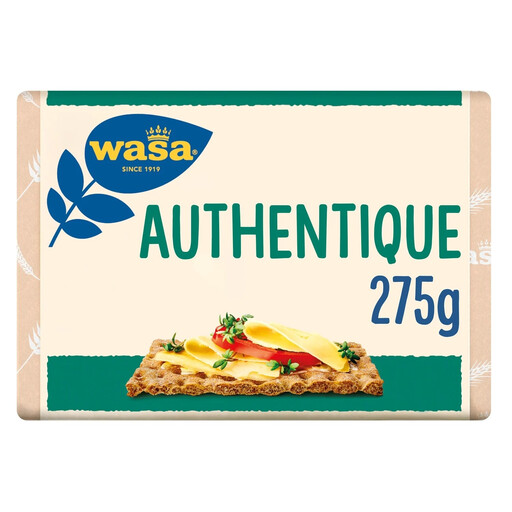 Image unavailable
This 275 g pack could be a good choice if you’re looking for a crisp base to serve with cold saucisson. The product information describes a wholemeal rye crispbread; it contains rye gluten and may contain traces of lupin, milk, mustard, sesame and soya. Check these details on the packaging before serving it to any guests who need to avoid these ingredients.
Read the ingredients and compare the ‘fibre’ figure per 100 g, taking into account the proportion of wholemeal flour if stated. Manger Bouger’s recommendation to choose wholegrain or semi-wholegrain starchy foods doesn’t mean all recipes are the same.
No. E.Leclerc lists both wholemeal wheat flour and wheat flour in its Epi d’Or crispbreads; Carrefour’s product information for Brioche Pasquier crispbreads also lists both types of flour. Check the ingredients of the pack you choose.
Check the highlighted ingredients and any warnings about traces on the pack you buy. The wheat or rye products described here contain gluten, so they are not gluten-free alternatives.
Follow the instructions on the pack. For its Authentique product, Wasa’s product information on Joybuy says to reseal the packaging tightly after opening to keep the crispbreads crunchy.