Households comparing fibre content
If fibre is a priority when you shop, the value per 100 g lets you compare different recipes without relying on the product name alone.


To keep wholegrain crispbreads at the office, start by comparing fibre and salt per 100 g, then check the ingredients, allergens and storage instructions. Auchan’s product page for Wasa Complet lists 20 g of fibre per 100 g, but this recipe contains rye. If you prefer wheat or multigrain, compare specific products rather than relying on the word ‘wholegrain’ alone.
If fibre is a priority when you shop, the value per 100 g lets you compare different recipes without relying on the product name alone.
If you want crispbreads to keep in a cupboard and eat with a topping, check the storage instructions and whether the pack can be resealed after opening.
Depending on the product, check which gluten-containing cereals it includes, whether it contains milk and any ‘may contain’ warnings on the packaging. ‘Wholegrain’ alone doesn’t tell you this.
When choosing between wholemeal wheat, wholemeal rye and multigrain, start with the factor that matters most to your purchase, then compare products that meet your needs.
| Criteria | What to check | Who it matters to |
|---|---|---|
| Fibre and main cereal | Compare fibre per 100 g and the order of the flours in the ingredients list. | If fibre is my priority for the crispbreads I keep in stock, I want to be able to compare recipes on a like-for-like basis. Around 42% of consumers put this need first. |
| Ingredients and allergens | Check the cereals, highlighted allergens and any ‘may contain’ warnings on the pack you buy. | If I need to avoid an ingredient, the exact product’s ingredients matter more than the ‘wholegrain’ label. This is the first priority for around 33% of consumers. |
| Storage at the office | Check the best-before date, storage instructions and whether the pack can be closed again after opening. | To keep crispbreads crunchy in an office cupboard, I need to be able to protect them from moisture once opened. This is the priority for around 25% of consumers. |
The label doesn’t tell you how much fibre a product contains. The product pages for Wasa Complet, Epi d’Or wholemeal wheat and LU Cracotte Fibres show different values.
Compare the fibre per 100 g and the main cereal before buying several packs.
For the Brioche Pasquier wholemeal wheat crispbreads listed by Carrefour, this claim doesn’t tell you about allergens, fibre or salt.
Also read the ingredients list and nutrition information for the product you choose.
E.Leclerc’s product page for Epi d’Or and Auchan’s pages for Wasa Complet and LU Cracotte Fibres list 1.0 g, 1.2 g and 1.4 g of salt per 100 g respectively.
Once you’ve found products that meet your fibre and ingredient requirements, compare the salt per 100 g on the same basis.
A container that doesn’t close properly can leave crispbreads exposed to moisture. Joybuy’s product page for WASA Authentic recommends using an airtight container after opening.
Follow the instructions on the pack you buy and, if needed, use a clean container that seals tightly.
The Wasa Complet product listed by Auchan is a crispbread made with wholemeal rye flour.
Epi d’Or, a brand sold by E.Leclerc, includes 250 g packs of crunchy wholemeal wheat crispbreads.
The Brioche Pasquier wholemeal wheat crispbreads listed by Carrefour carry a ‘no added sugars’ claim.
Cracotte Fibres 250 g combines wholemeal wheat and rye, among other ingredients, in a crunchy multigrain crispbread.
This selection features rye crispbreads to consider for your office cupboard. Check the recipe and nutritional values on the pack you choose rather than assuming they’re the same as Wasa Complet.
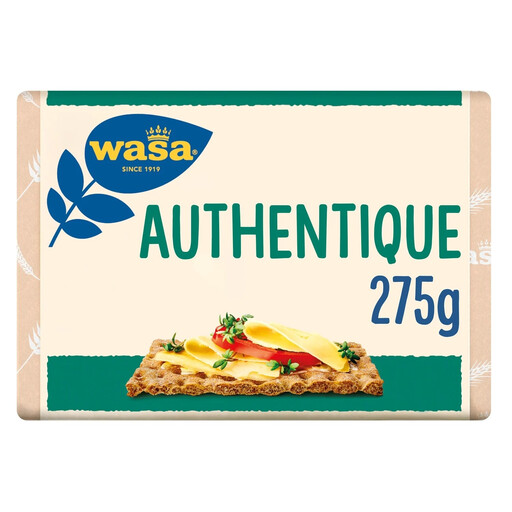 Image unavailable
If you’re keeping crispbreads at the office, take care to seal this 275 g pack properly after opening. Joybuy’s product page for WASA Authentic recommends an airtight container to keep them crunchy. This product contains rye; if these factors matter to you, check the allergens and nutritional values on the packaging.
No. Fibre content varies by product. Auchan’s product pages list 20 g of fibre per 100 g for Wasa Complet and 11 g for LU Cracotte Fibres; E.Leclerc’s page lists 9.8 g for Epi d’Or wholemeal wheat crispbreads. Always compare the values per 100 g for the product you buy.
Follow the instructions on the pack and protect crispbreads from moisture. Wasa Complet says to store it in a cool, dry place; Joybuy’s product page for WASA Authentic recommends an airtight container after opening. Also check the best-before date on your pack.
The wheat and rye products mentioned here are not: these cereals contain gluten. Check the label on the product you buy, including highlighted allergens and any ‘may contain’ warnings. A ‘wholegrain’ recipe isn’t necessarily gluten-free.
Start by comparing the nutritional values per 100 g, particularly fibre, sugars and salt, rather than the values per pack. France’s Directorate-General for Competition, Consumer Affairs and Fraud Control states that nutrition declarations for the foods concerned are given per 100 g or 100 ml.