If you’d like to reduce your fat intake, start by comparing semi-skimmed with whole milk: Santé publique France says that the level of skimming does not change how much calcium milk provides. Whole milk is still an option if its fat content suits the way you cook. If you’re looking for organic credentials, a particular origin or specific production standards, check those details on the product you choose.
Who is this choice for?
People who use milk regularly
If you’d like to reduce the fat in the milk you drink or use in cooking, semi-skimmed is the first option to compare with whole milk. According to Santé publique France, both types of milk provide the same amount of calcium.
People who care about origin and production standards
If organic certification, a declared French origin or production commitments matter to you, check these details for each product after choosing the type and size of milk that suit you.
Households with specific dietary needs
If you’re choosing milk for a child or need a « lactose-free » product, the level of skimming isn’t enough to guide your choice. Check the exact product and its ingredients; lactose-free milk can still contain milk proteins.
Which criteria should you compare?
First choose the level of skimming to suit how you’ll use the milk, then look separately at production details and pack size. The DGCCRF defines whole milk as containing at least 3.50% fat, semi-skimmed milk as containing between 1.50% and 1.80%, and skimmed milk as containing no more than 0.5%.
Whole milk
Worth considering: if you’re looking for higher-fat milk for cooking.
Bear in mind: it contains more fat than semi-skimmed milk, but Santé publique France says it offers no particular advantage in terms of calcium.
Semi-skimmed milk
Worth considering: if you want to reduce fat compared with whole milk while still getting a comparable amount of calcium.
Bear in mind: « semi-skimmed » tells you neither where the milk comes from nor how it was produced.
Skimmed milk
Worth considering: if reducing fat is your main priority.
Bear in mind: « skimmed » doesn’t mean « lactose-free »; check separately if this matters to you.
| Criterion |
What to check |
Who this matters to |
| Fat |
The milk description and the fat content stated per 100 ml; check calcium if you’re comparing two specific products. |
For the milk I usually buy, I want to reduce fat without assuming that skimming removes calcium. Around 36% of consumers make this their top priority. |
| Origin and production standards |
Any organic certification, declared origin and commitments associated with the specific product. |
If I prioritise a particular origin or production method, I want to see those details on the milk I choose rather than rely on the brand name alone. This comes first for around 29% of consumers. |
| Pack size and storage |
The volume of each container and the storage instructions after opening shown on the packaging. |
A multipack only works for me if my household can use each opened container within the stated time. Around 21% of consumers put this first. |
| Specific needs |
The age of the person concerned or, if necessary, the « lactose-free » label and the allergen list. |
When choosing milk for a child or to meet a dietary requirement, I need to check the exact product before considering pack size or production claims. This is the top priority for around 14% of consumers. |
What should you watch out for?
-
Assuming lower-fat milk contains less calcium
Santé publique France says whole, semi-skimmed and skimmed milk all provide the same amount of calcium; it’s the fat content that changes.
Compare the type of milk first, then check the nutritional values of each product if you need a precise comparison.
-
Treating « low fat » as a specific milk category
This phrase doesn’t distinguish between semi-skimmed and skimmed milk. The DGCCRF gives different fat content ranges for the two categories.
Look for the French description on the packaging and check the fat content per 100 ml.
-
Buying a large pack without checking storage advice after opening
Instructions vary by product: the product information for Lactel Bio, Candia GrandLait and Auchan Solidaires Bio gives different timescales after opening.
Choose a pack size that suits how much you use, and follow the refrigeration and storage-time instructions on the packaging you buy.
-
Confusing « lactose-free » with « dairy-free »
The Lactel Matin Léger milk listed as lactose-free on Joybuy still contains milk. So the label doesn’t mean that the product is suitable for someone with a milk protein allergy.
Check the ingredients and allergens. If you have an allergy, ask a healthcare professional for advice rather than switching from your usual product on your own.
Brands and retailers to consider
These products offer useful points of comparison for milk type, nutritional information and production claims. Always check each detail on the product in question.
Lactel
Lactel Bio includes whole and semi-skimmed UHT milk.
- According to Lactel, both its whole and semi-skimmed Bio products contain 120 mg of calcium per 100 ml, with 3.6 g and 1.5 g of fat respectively.
- Lactel advises using these products within three days of opening. Its lactose-free skimmed Matin Léger milk is a separate product that still contains milk.
Candia
Candia’s range includes whole and semi-skimmed GrandLait products, as well as a Viva product described as semi-skimmed.
- The information published by Candia allows you to compare the nutritional values of whole and semi-skimmed GrandLait separately.
- The production commitments presented by Candia are claims made by the brand; check which products they apply to.
Carrefour
Carrefour Bio describes its semi-skimmed UHT milk as coming from French organic farming.
- The product information lets you check the type of milk and production claims for the same product.
- Organic certification doesn’t replace checking the fat content, pack size and storage instructions.
E.Leclerc
The retailer’s range includes Bio Village semi-skimmed UHT milk in 1 L bottles.
- According to the E.Leclerc product information, the Bio Village product in question states that the milk comes from France and contains 120 mg of calcium per 100 ml.
- Check the product details and availability with the store or online shop where you do your shopping.
Auchan
Auchan offers Solidaires Bio Cultivons le Bon semi-skimmed UHT milk, including in a pack of 6 × 1 L.
- Auchan states that this product is collected and packaged in France.
- Other production commitments shown for this milk shouldn’t be assumed to apply to every Auchan product.
Lidl
Lidl France offers a range of dairy products, including organic options.
- To choose a specific milk, check the description, fat content, origin and storage instructions on its packaging. Being part of an organic range doesn’t tell you these details.
Semi-skimmed milk available on Joybuy
These two products let you compare different pack sizes among the options described as semi-skimmed. Before choosing, check the product description and nutritional information on the packaging, especially if the stated fat content needs clarification.
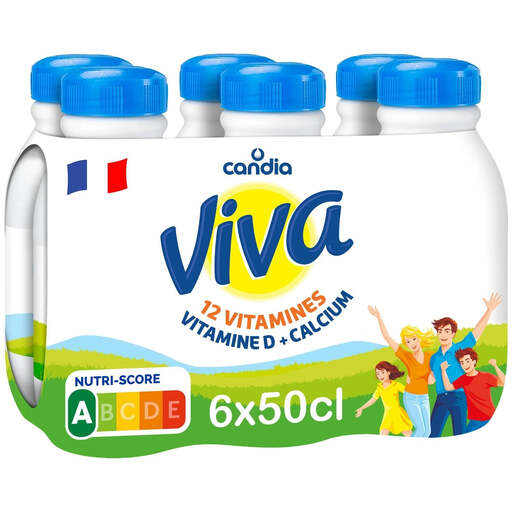 Image unavailable
Candia Viva semi-skimmed milk, 6 × 50 cl
The 6 × 50 cl pack may suit you if you prefer to open smaller containers. Joybuy lists this product as containing 1.0% fat, while the DGCCRF defines semi-skimmed milk as containing between 1.50% and 1.80%. Check the description and nutritional information on the packaging before comparing it with other semi-skimmed milks.
View on Joybuy
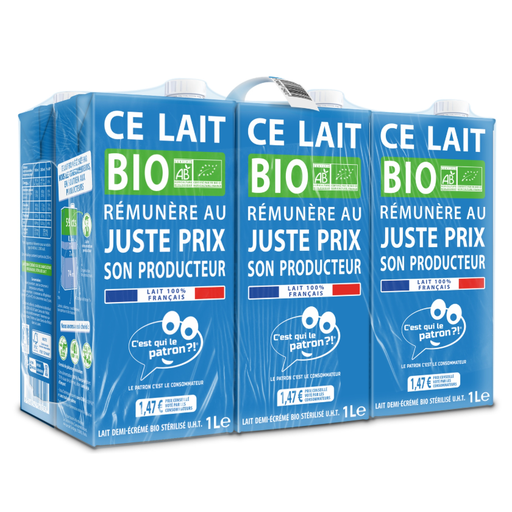 Image unavailable
C'EST QUI LE PATRON semi-skimmed milk, 6 × 1 L
This pack of 6 × 1 L is for households that use semi-skimmed milk regularly. If the production commitments stated for this product matter to you, treat them as claims made by the seller. Also check the nutritional values and instructions for use after opening on the packaging.
View on Joybuy
Frequently asked questions
Does semi-skimmed milk contain less calcium than whole milk?
No. Santé publique France says whole, semi-skimmed and skimmed milk all provide the same amount of calcium, although their fat content differs. To compare two specific products, check their nutritional values per 100 ml.
What does « low fat » mean when choosing milk in France?
This phrase isn’t enough to identify a milk category. Look for the description « semi-skimmed » or « skimmed ». According to the DGCCRF, semi-skimmed milk contains between 1.50% and 1.80% fat, while skimmed milk contains no more than 0.5%.
How long can you keep UHT milk after opening?
Follow the storage time and temperature shown on the packaging of the product you buy. The instructions published for the Lactel Bio, Candia GrandLait and Auchan Solidaires Bio milks mentioned here aren’t the same. UHT processing doesn’t mean there’s one standard storage time after opening.
Is lactose-free milk suitable for someone with a milk allergy?
No. « Lactose-free » doesn’t guarantee that a product contains no milk proteins: the Lactel Matin Léger product listed on Joybuy as lactose-free states that it contains milk. If you have an allergy, check the allergens and ask a healthcare professional for advice.


