People who need to avoid milk
If you’re allergic to milk or its proteins, ‘lactose-free’ isn’t enough: check the ingredients of every product. The whole milk products listed by Lactel and Carrefour declare that they contain milk.


If milk is the allergen you need to avoid, steer clear of whole milk, even if it’s labelled ‘lactose-free’: Lactel’s Matin Léger whole milk still contains whole milk. If you’re managing lactose intolerance instead, compare the lactose content and ingredients of the exact product. If you can drink milk, your choice of standard, organic, UHT or pasteurised milk will then depend on how you plan to use it and how it should be stored.
If you’re allergic to milk or its proteins, ‘lactose-free’ isn’t enough: check the ingredients of every product. The whole milk products listed by Lactel and Carrefour declare that they contain milk.
Assurance Maladie describes lactose intolerance as difficulty digesting the sugar in milk. It is different from a food allergy. Lactel states that its Matin Léger whole milk contains less than 0.1 g of lactose per 100 ml, but its ingredients still include whole milk.
If milk isn’t the allergen you need to avoid, the UHT or pasteurised treatment, pack size and storage instructions after opening can help you choose between products. Organic describes a production method, not the absence of milk.
When shopping with food allergies in mind, first identify the allergen you need to avoid. Lactose content, followed by processing and pack size, only become factors when choosing whole milk if you can drink it.
| What matters to you | What to check | Who this is for |
|---|---|---|
| Milk content | Identify the allergen you need to avoid, then check the ingredients and allergen declaration for the exact product. | If milk is the allergen, I need to avoid whole milk, including lactose-free varieties. Around 42% of consumers would make avoiding it their priority. |
| Lactose content | Compare the amount stated per 100 ml and check the ingredients; ‘lactose-free’ does not mean ‘milk-free’. | If I need to manage lactose rather than a milk allergy, I want to keep whole milk in my diet while limiting this sugar. Around 33% of consumers would have this priority. |
| Use and storage | Compare UHT and pasteurised options, pack sizes and instructions for after opening. | If milk isn’t the allergen I need to avoid, I’m mainly looking for a pack size that suits how much I drink and how I cook. Nearly 25% of consumers would prioritise this kind of practical choice. |
Assurance Maladie distinguishes lactose intolerance from food allergy. Lactel’s lactose-free Matin Léger whole milk contains whole milk.
If milk is the allergen you need to avoid, don’t rely on the ‘lactose-free’ label alone: check the ingredients of the product you’re buying.
According to Candia, GrandLait Bio whole milk is made from whole milk produced using organic farming methods. This production method doesn’t remove milk from the product.
Check first for the allergen in question, then compare organic credentials, origin and any other features that matter for your shopping.
Instructions vary by product: Lactel says its pasteurised whole milk should be consumed within three days, while Candia gives a four-day period for GrandLait whole milk.
Choose a pack size to suit how much you’ll use, and follow the storage temperature and time limit shown on the packaging.
A pack that’s too large can lead to waste if you don’t finish the milk within the stated time.
These terms don’t tell you whether liquid whole milk contains milk or how much lactose it contains.
Start with the ingredients and allergen information, then compare the details given for the exact product, including lactose content, processing and storage.
The range lets you choose between pasteurised whole milk and a lactose-free whole milk product.
GrandLait whole milk and GrandLait Bio whole milk offer a choice of standard or organically produced whole milk.
Carrefour’s UHT whole milk product pages offer an initial way to check the declared ingredients and allergens.
This pack of whole milk may be an option if milk isn’t the allergen you need to avoid. Before adding it to your basket, check the ingredients and instructions on the packaging.
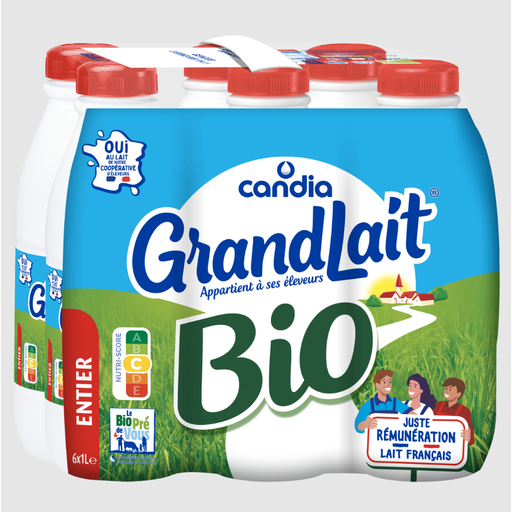 Image unavailable
A pack to consider if milk is suitable for your shopping needs. It contains 6 cartons of 1 L; if your choice depends on lactose or another allergen, check the information for the exact product before buying.
No, not if you need to avoid milk: removing or reducing lactose doesn’t remove dairy ingredients. Lactel lists whole milk in the ingredients for Matin Léger whole milk, despite stating that it contains less than 0.1 g of lactose per 100 ml.
Read the ingredients and allergen information for the exact product. Service Public states that allergens must be listed for processed foods; the Carrefour whole milk product pages reviewed declare ‘MILK’ or ‘COW’S MILK’ among other details.
Follow the storage temperature and time limit shown on the packaging of the product you’ve bought. Lactel says its pasteurised whole milk should be kept chilled and consumed within three days; Candia gives a four-day period for GrandLait whole milk.
No: organic describes a production method, while UHT describes a treatment, and neither removes milk. Candia lists whole milk in the ingredients for GrandLait Bio whole milk, while the Carrefour UHT products reviewed identify milk among their ingredients or allergens.