Parents of a child under 3
Age comes before looking for a mild taste. Anses recommends choosing growing-up milk rather than cow’s milk after the age of one, and Assurance Maladie says it can be given until the age of 3.


Before choosing whole milk at your local shop, check your child’s age. According to Anses, cow’s milk only meets their nutritional needs from the age of 3; for younger children, Anses and Assurance Maladie recommend infant milk, followed by growing-up milk according to age. From age 3, compare the type of milk, pack size and storage instructions rather than assuming that a “mild” label guarantees your child will enjoy the taste.
Age comes before looking for a mild taste. Anses recommends choosing growing-up milk rather than cow’s milk after the age of one, and Assurance Maladie says it can be given until the age of 3.
Whether you’re serving milk on its own, adding it to cereal or cooking with it, your choice will depend on the type of milk, pack size and storage requirements. A taste described as “mild” is still a matter of personal preference, not a guaranteed feature.
Lactose-free whole milk may suit this particular need. However, it is not a solution for an allergy to cow’s milk proteins, which requires medical advice.
When buying milk for a child, start with their age. Then compare the type of milk you’re looking for and choose a volume that suits how quickly you’ll use it and the storage instructions.
| Criteria | What to check | Who it matters to |
|---|---|---|
| Child’s age | Check your child’s age before choosing drinking milk: Anses says cow’s milk meets nutritional needs from the age of 3. For younger children, follow the guidance on infant milk and growing-up milk. | If my child is under 3, I want to choose a milk category that’s right for their age before comparing flavours. Around 42% of consumers would put this first. |
| Taste and type of milk | Choose between UHT and fresh milk based on your storage options. If your child is lactose intolerant, check the product description. A “mild” taste label doesn’t guarantee your child will like it. | For a child aged 3 or over, I’m looking for whole milk with a type and taste that suit the way we use it, without mistaking a taste preference for a guarantee. Taste or type of milk would be the top priority for around 33% of consumers. |
| Pack size and storage | Compare the volume of the cartons and the storage instructions before and after opening. According to their product information, Candia says GrandLait whole milk keeps for 4 days at +6 °C maximum, while Lactel Bio whole milk keeps for 3 days in the fridge. | When we don’t use much milk, I prefer a pack size we can finish within the time stated on the packaging. This would be a priority for around 25% of consumers. |
For a child under 3, drinking cow’s milk is not simply a substitute for infant milk or growing-up milk. Anses and Assurance Maladie provide different guidance depending on age.
Check your child’s age before comparing whole milks. If there are any medical considerations, ask a healthcare professional for advice.
A brand’s description, including the “gentle pasteurisation” claimed by Candia for its GrandLait Frais de Montagne whole milk, doesn’t prove that all children will enjoy the taste more.
If taste is your priority, try a smaller pack if one is available. Don’t assume your child will prefer a milk based on its processing method alone.
Each opened carton must be stored and used according to the manufacturer’s instructions. A pack that’s too large could mean you end up throwing milk away.
Choose a number of cartons that suits your usual consumption and check the instructions on the packaging.
Lactose-free whole milk is intended for people with lactose intolerance. It is different from a formula designed for an allergy to cow’s milk proteins.
If you suspect an allergy or notice a reaction, seek medical advice rather than simply switching to lactose-free whole milk.
The GrandLait range includes UHT whole milk and pasteurised GrandLait Frais de Montagne whole milk.
Lactel offers products including UHT organic whole milk and Matin Léger lactose-free whole milk, each meeting different buying needs.
Carrefour’s whole milk range includes UHT, organic and microfiltered options.
The own-brand Delisse and Bio Village ranges offer whole milk in different pack sizes, including multipacks of 6 × 1 L.
Auchan offers UHT whole milk in 1 L cartons and multipacks of 6 × 1 L, as well as other options in its whole milk range.
This 6 × 1 L multipack of whole milk is suited to households that use milk regularly, for example with cereal or in cooking. If you’re buying it for a child, first check that they’re old enough to have drinking cow’s milk. If you’re looking for a particular processing method, check the packaging.
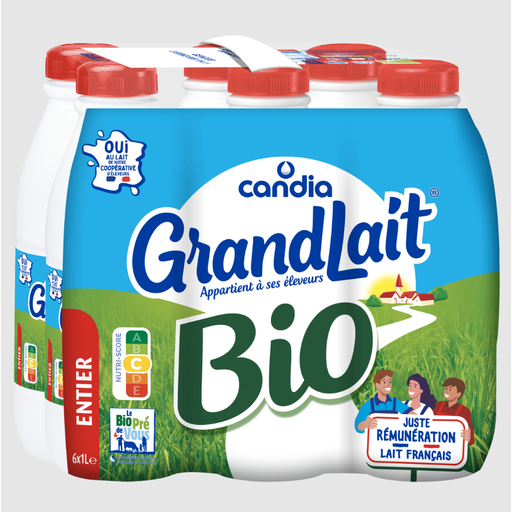 Image unavailable
This pack may suit a household with a child aged 3 or over that regularly uses whole milk with cereal or in cooking.
The multipack contains 6 cartons of 1 L each. Check the packaging for the milk’s processing method and storage instructions before deciding how to store it.
It isn’t the default choice for this age group. Anses recommends choosing growing-up milk rather than cow’s milk after the age of one, and says cow’s milk meets nutritional needs from the age of 3. Assurance Maladie says growing-up milk can be given until the age of 3.
No. The words “lactose-free” aren’t enough if someone has an allergy to cow’s milk proteins. Lactel’s Matin Léger whole milk is intended for people with lactose intolerance. For an infant with a cow’s milk protein allergy, Anses refers to specially formulated products prescribed by a doctor.
Follow the storage time and temperature given for the product you’ve bought. Lactel says its organic whole milk keeps in the fridge for 3 days; Candia says GrandLait whole milk keeps for 4 days at +6 °C maximum, as does Auchan for its 1 L UHT product. The French Ministry of the Economy advises following the manufacturer’s storage instructions after opening.
Yes, for GrandLait Frais de Montagne whole milk: Candia says to store it between 0 and +6 °C before opening. If you buy a different milk, check its own storage instructions rather than applying those for another product.