
Livraison le jour même ou le lendemain

Qualité garantie

Débloquez vos offres de bienvenue: Livraison GRATUITE | Jusqu'à -80 % | 30 jours d'essai gratuits à JoyPlus
Téléchargez l'application
A whiteboard can quickly lose its usefulness if its accessories are poorly chosen. Dried-out markers, stubborn marks, an eraser that leaves smudges or adhesive film applied at an angle: these minor hassles affect classrooms, offices, home-working spaces and homes alike.
Before buying whiteboard accessories, it is therefore worth looking beyond the number of colours and the advertised price. Here are the criteria to consider, the pitfalls to avoid and a selection suited to different uses.
A very comprehensive set is not necessarily the most practical. In everyday use, colours that are difficult to read, a tip that is too broad or a poorly balanced selection can make writing less clear. Conversely, a class or meeting team will often need several shades to organise information by importance.
So check the line width, colour clarity and how easy it is to identify each marker. Classic shades — black, blue, red and green — are generally the most versatile.
Dry-erase markers are not all the same. Ink that does not erase well can leave shadows, especially on a surface used every day. Remember to replace the cap properly after each use and store the pens according to the manufacturer’s recommendations.
In a meeting room or classroom, a formula designed to reduce drying out can help prevent markers needing to be replaced too often. For occasional use, a simpler set will generally do the job.
Self-adhesive whiteboard film can turn a door, smooth wall or desk into a writing surface. However, applying it requires a clean, flat and completely dust-free surface. Textured paint, a damp wall or an uneven surface may cause bubbles and make removal more difficult.
Also measure the available area before ordering. A 91.4 × 60.9 cm roll may be suitable for a small planning area, but not necessarily for a large training room.
For detailed notes, a fine tip provides more precise writing. For presentations viewed from a distance, a wider line improves readability. The Maped Marker’Peps Whiteboard has a 1.5 mm bullet tip, while the STABILO MARKdry can be sharpened to maintain an even point.
A chisel tip can produce several line widths, but this format is mainly useful for highlighting and layout work. So make sure the product is specifically designed for a whiteboard: some coloured markers are intended for paper rather than non-porous surfaces.
The water-based or solvent-free label can help reduce odours in an enclosed room. However, it is still important to check compatibility with your board. The product description should specify the compatible surfaces: whiteboard, slate, glass or flipchart.
A whiteboard eraser with a felt surface is suitable for dry-erase inks. Clean it regularly and replace it when the felt no longer picks up the ink properly. Avoid using it with a permanent marker unless the surface manufacturer explicitly confirms that it is compatible.
A small magnetic whiteboard installed on an individual desk has different needs from a board used every day by a class. For intensive use, keep several spare markers, one or two erasers and a soft cloth to hand.
Flipchart markers are not always erasable from a whiteboard. Read the label carefully: a permanent or wet-ink pen may leave lasting marks on a non-porous surface.
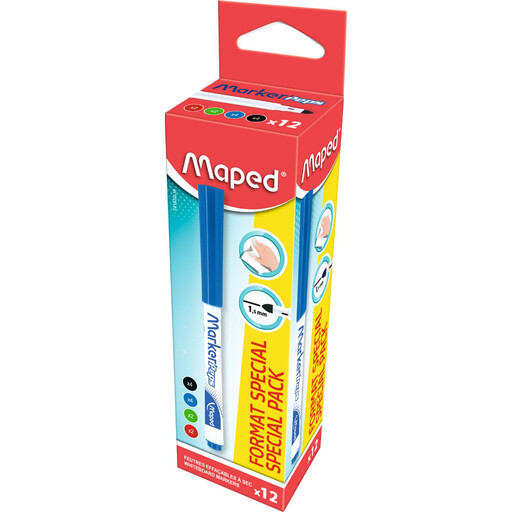
Why this choice suits this profile : This set is ideal for students, families and small offices that want several colours without pushing up the cost.
The four main colours are easy to distinguish, while the 1.5 mm tip prevents lines from being too thick for lists and schedules.
Water-based ink, advertised as erasable from whiteboards, and a pack of 12 markers in red, blue, green and black.
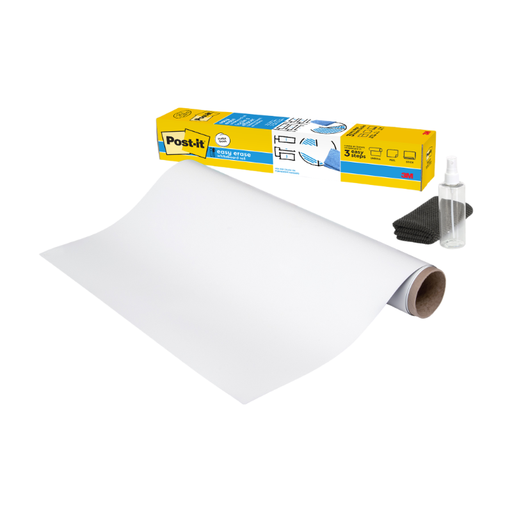
Why this choice suits this profile : This self-adhesive film is designed for home workers, businesses and households that want to create a writing area without installing a rigid board.
Its 91.4 × 60.9 cm format makes it easy to calculate the exact area to cover. However, it must be applied to a clean, smooth and flat surface.
Removable and repositionable adhesive backing according to the product description, designed for use with dry-erase markers.
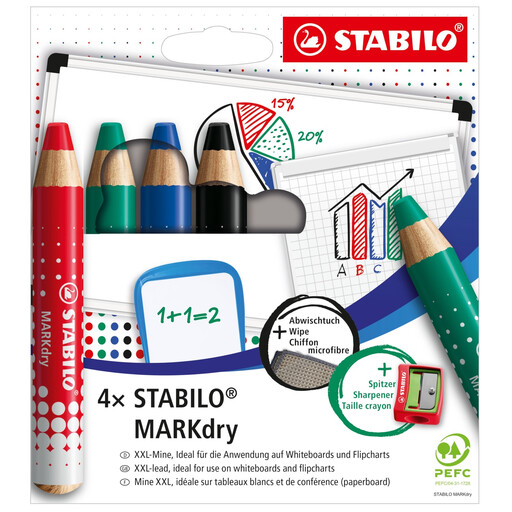
Why this choice suits this profile : This pencil-style format is aimed at teachers, meeting teams and anyone who writes regularly on whiteboards, slates or flipcharts.
Its wooden body does not dry out like a conventional marker: simply sharpen the pencil to refresh the tip. However, it is still essential to check that the line is clear on your surface.
Set of four colours, solvent-free and odourless formula according to the product description, with sharpener and cloth included.
We have brought together a complete, real-time updated selection of products that meet these exacting criteria while complying with European safety regulations.
A few good habits are all it takes to extend the life of your equipment:
For children under three, follow the warnings shown on the packaging and keep small parts out of reach.
A basic kit generally includes whiteboard pens, an eraser, a soft cloth and, depending on your needs, magnets or a marker holder. In a classroom or meeting room, several colours and a few refills may also prove useful.
Use only markers explicitly designed for dry erasing. Erase regularly, clean the eraser and avoid incompatible permanent markers. If in doubt, test the marker in a less visible corner.
It may be suitable for a smooth, clean surface, but compatibility depends on the type of paint and adhesive. Test the product on a small area first and follow the manufacturer’s instructions before covering the entire wall.