
Livraison le jour même ou le lendemain

Qualité garantie

Débloquez vos offres de bienvenue: Livraison GRATUITE | Jusqu'à -80 % | 30 jours d'essai gratuits à JoyPlus
Téléchargez l'application
A white shoe cabinet brings light into your hallway, helps organise a corridor and stops pairs of shoes piling up by the door. But be careful not to let looks alone guide your choice – compartments that are too shallow, the wrong depth or wobbly assembly can quickly make daily use a hassle.
Before comparing different models, take the time to assess your household’s needs, the available space and the features that will genuinely make a difference day to day.
A shallow shoe cabinet saves space in a corridor, but its compartments may lack room. Thick trainers, high-top shoes or ankle boots could stick out or stop the doors from closing properly.
Depth isn’t everything – also check the internal height of each compartment, whether there are dividers and the direction the doors open.
A “12-pair shoe cabinet” usually refers to a specific layout, with shoes stored side by side or slightly tilted. In a family where shoe sizes vary, boots and chunky footwear can quickly reduce the usable capacity.
To avoid disappointment, choose a shoe cabinet with adjustable or removable shelves. That way, you can rearrange the interior as the seasons change.
A white front and pretty handles aren’t enough to make a cabinet functional. Without a drawer, it’s hard to store keys, laces, cleaning products or small accessories. A top surface can also come in handy for a tray, a plant or everyday bits and pieces – as long as it’s easy to clean.
A multi-functional shoe cabinet will often be a better fit for a family hallway than a model designed purely for shoes.
Measure the width available between walls, the maximum acceptable depth and the ceiling height. In a narrow passage, even a few centimetres can make a real difference to how easy it is to move around.
Also think about how the doors open:
A shoe cabinet with a drawer gives you a separate space for keys, gloves and accessories. Adjustable shelves let you free up more height for ankle boots while reducing wasted space above low shoes.
Before ordering, check:
MDF and particle board are very common in indoor furniture. Their durability depends on the thickness of the panels, the quality of the joints and the intended use. Avoid placing a cabinet in an area exposed to splashes or high humidity without checking the manufacturer’s recommendations.
For a tall or narrow white hallway cabinet, pay special attention to the anti-tip device. Follow the instructions, use fixings suitable for your wall and avoid overloading the top. This precaution is especially important in a family home, where children often move around the hallway.
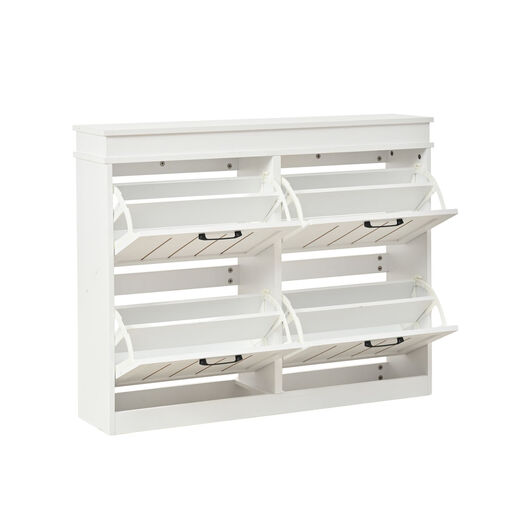
Why this suits this profile: Its shallow depth works well in hallways and corridors where every centimetre counts. The four doors and eight compartments let you organise shoes without cluttering the floor.
The removable dividers let you rearrange the interior rather than being stuck with fixed compartments. However, check your shoes’ dimensions before buying.
MDF construction, eight compartments, four hinged doors, removable dividers and a flat top surface.
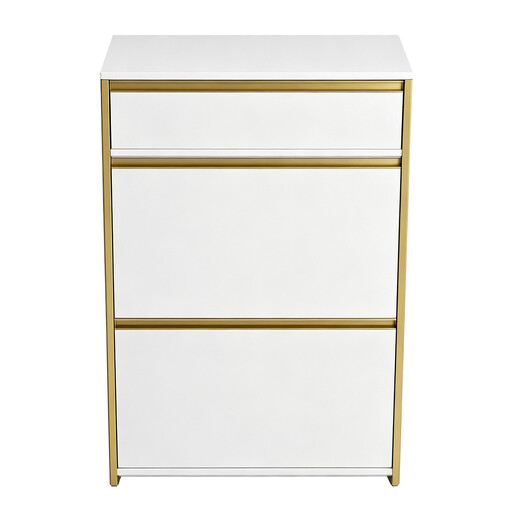
Why this suits this profile: This white hallway cabinet combines enclosed storage, a drawer and a top surface. Its vertical design makes the most of height when floor width is limited.
The adjustable and removable shelves reduce wasted space. The included anti-tip device must be fitted according to the instructions.
Integrated drawer, four adjustable shelves, stated capacity of up to twelve pairs, white finish with gold details.
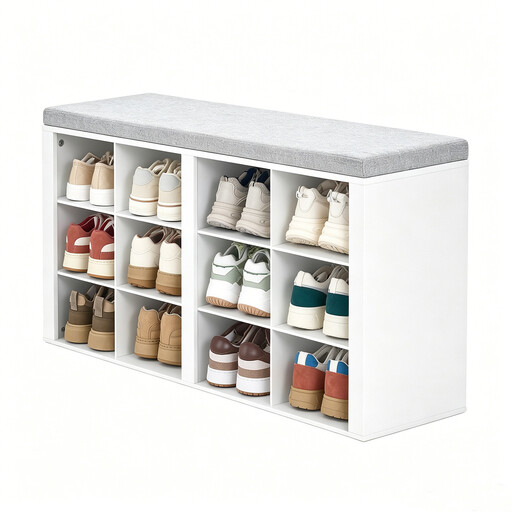
Why this suits this profile: The seat makes it easier to change shoes in a busy family hallway. Depending on your home’s layout, this cabinet can also work well in a bedroom or corridor.
The adjustable shelves adapt to different shoe heights. The cushion cover is removable and can be cleaned separately without moving the whole cabinet.
Twelve compartments, seat supporting up to 150 kg, adjustable shelves and removable cushion.
We’ve put together a full, real-time selection of products that meet these demanding criteria and European safety standards.
Place the cabinet on a level floor and check it’s balanced before filling the compartments. For a tall model, fix the anti-tip device to the wall using wall plugs suitable for your wall type.
To keep your white shoe cabinet looking its best:
A depth of 24 to 25 cm may work for some compact models, but it doesn’t guarantee that all sizes and shapes of shoes will fit. Measure the largest pair in your household and compare their dimensions with the usable space stated in the product description.
The capacity depends on the thickness of the shoes and the shelf layout. A pair of chunky trainers or ankle boots takes up more room than a pair of low shoes. So treat the “twelve pairs” claim as a guide to compare against your own collection.
Yes, provided the seat is fit for purpose and the cabinet is installed on a stable surface. Check the stated maximum weight, the bench width, the space available in front of the hallway and whether there’s storage suitable for each family member’s shoes.