
Livraison le jour même ou le lendemain

Qualité garantie

Débloquez vos offres de bienvenue: Livraison GRATUITE | Jusqu'à -80 % | 30 jours d'essai gratuits à JoyPlus
Téléchargez l'application
A white shoe cabinet can bring a sense of lightness to a hallway, help organise a corridor, or complete a bedroom layout. Behind their modern appearance, however, some models quickly reveal their limitations: a stated capacity that doesn't account for bulky footwear, awkward doors, or a structure that feels too flimsy for daily use.
Before ordering a shoe cabinet, take the time to check its dimensions, internal layout and stability. Here are the criteria to examine when comparing models effectively, followed by a selection tailored to different needs.
A cabinet advertised for several pairs may work well for low shoes, but lack the height for ankle boots, chunky trainers or heels. Capacity also depends on the width of the compartments and whether you can remove a divider.
To avoid unpleasant surprises, check:
In a corridor or small entrance, just a few centimetres can be enough to obstruct the flow. A narrow shoe cabinet should be assessed by its actual depth, including handles and doors. A depth of around 24 to 25 cm can make installation in a passageway easier, but make sure your shoes fit properly inside.
Also remember to measure the space in front of the cabinet. Hinged doors need clearance to open, while a model with drawers or drop-down fronts requires a different arrangement.
White, gold detailing and clean lines fit easily into a contemporary interior. However, appearance alone isn't enough to judge a cabinet's sturdiness. Examine the material, weight, type of feet, and whether a wall-fixing device is included.
In a home with children or for a tall shoe cabinet, an anti-tip device fixed to the wall is an essential precaution. The fixing must be done with fittings suitable for your wall type.
Note the available width, depth and height, then allow a margin for skirting boards, light switches and door openings. In an entrance, a width of around 60 cm can suit a limited space. A longer cabinet, roughly 105 cm, offers more storage but needs a sufficiently clear wall section.
A hallway shoe storage unit can also serve as a handy surface for keys, post or a small decorative item. In that case, check the maximum recommended load for the top panel and its resistance to moisture during cleaning.
A shoe cabinet with adjustable shelves lets you adapt the arrangement as the seasons change. Slim shoes can be spread across several levels, while boots and boxes need more height.
Configurations to consider include:
Particle board and MDF are very common in this category. They clean easily with a slightly damp cloth, but you should avoid standing water and storing very wet shoes. Let them dry before placing them in a closed compartment to reduce odours and moisture.
Also check the seller's listing for information on European regulations, particularly safety instructions, assembly guidance and fixing devices. A general mention doesn't replace checking the specific features of the model.
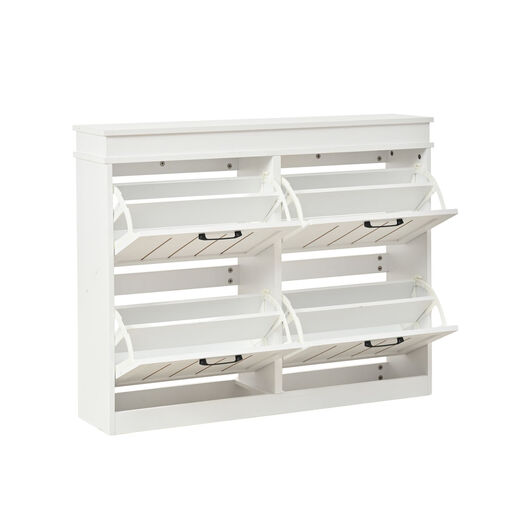
Why this choice suits this profile: With a stated depth of 24 cm, this model can fit into an entrance or corridor where every centimetre counts. Its four doors and eight compartments let you store shoes in a compact cabinet.
The depth and dimensions are clearly stated. The removable dividers let you reorganise the space depending on the shoes you need to store.
MDF, four hinged doors, eight compartments, flat top panel and black handles.
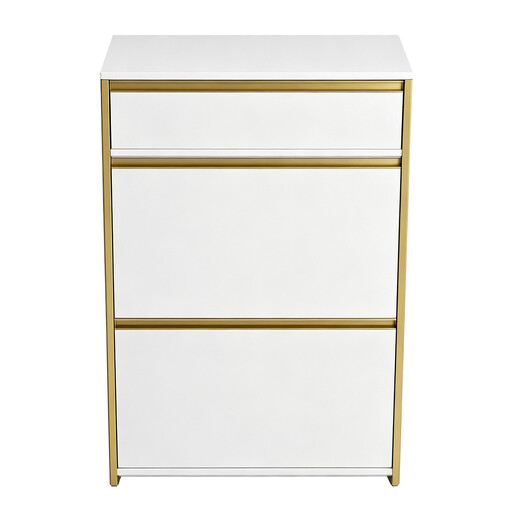
Why this choice suits this profile: Its white and gold finish adds a decorative touch to an entrance or living room. The drawer and top panel also offer practical space for storing small items.
The shelves are adjustable and removable – the configuration can evolve rather than being limited to one type of shoe.
Stated dimensions of 60.5 × 24.5 × 105 cm, four shelves, one drawer and two anti-tip devices supplied.
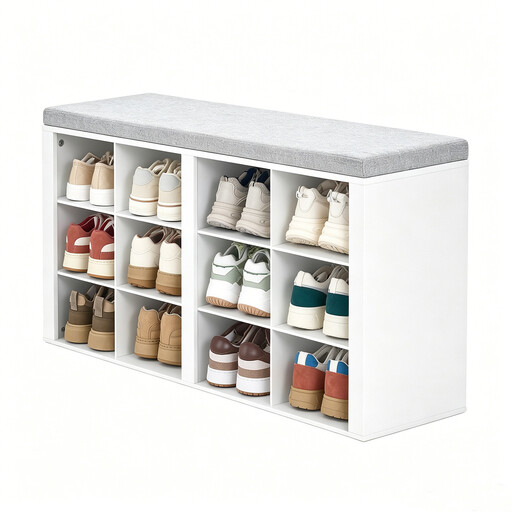
Why this choice suits this profile: This shoe cabinet with a bench makes changing shoes in the hallway easier. It can also work in a bedroom or serve as occasional seating on a balcony.
The adjustable shelves adapt to shoes of different heights. The removable cushion can be taken off for easy cleaning.
Twelve compartments, dimensions of 104.5 × 30.5 × 49.5 cm and a stated load capacity of 150 kg.
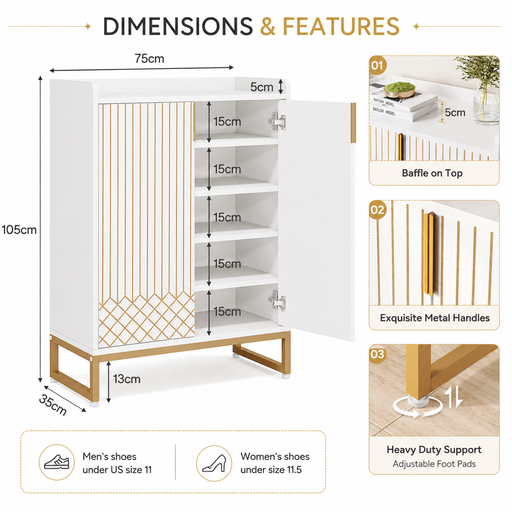
Why this choice suits this profile: With its five tiers, this model is aimed at households wanting to consolidate a large collection in a closed cabinet. Its top panel can hold a plant or a few accessories.
The doors limit dust exposure and the stated capacity is 22 to 25 pairs. It's still essential to check your shoes' dimensions.
Five tiers, closed storage, open bottom shelf and wooden structure with metal feet.
Measure the width of your bulkiest shoes, then compare it to the internal depth stated by the seller. In a corridor, a model around 24 to 25 cm deep can reduce the footprint, but taller shoes may need a higher compartment or an adjustable shelf.
Use a soft, slightly damp cloth, then dry the surface quickly. Avoid abrasive products, which could dull the finish. For a closed cabinet, air the compartments regularly and only store dry shoes.
The lifespan depends on the material, the quality of assembly, the weight placed in the compartments and how often the doors are opened. Following the assembly instructions, using wall fixing where provided, and keeping within the manufacturer's load recommendations all help to maintain the cabinet's stability.