People making Christmas desserts
For ganache, cream or biscuits, a bar labelled for baking is a more straightforward choice than a bag of filled chocolates.


If you’re melting white chocolate or adding it to a Christmas dessert, start with a bar specifically labelled for baking. If you’re giving chocolates as a gift or serving them ready to eat, a large bag of individual chocolates meets a different need: don’t assume its ingredients are the same as those of a baking bar. In either case, check how much you need, along with the ingredients and allergen information for the product you choose.
For ganache, cream or biscuits, a bar labelled for baking is a more straightforward choice than a bag of filled chocolates.
A large bag of chocolates that are already portioned is a good choice when sharing around the table or giving a gift matters more than adding chocolate to a recipe.
To compare two products, check the ingredients, allergens and nutritional values per 100 g. According to the DGCCRF, Nutri-Score is voluntary in France, so its absence is no substitute for checking this information.
For Christmas desserts or the festive table, first decide whether you’ll use the white chocolate as an ingredient or serve it as it is. The format and label can then help you choose a product suited to that purpose.
| What matters | What to check | Who it matters to |
|---|---|---|
| Baking | Look for wording such as ‘dessert’ or ‘for baking’, and check how much the recipe calls for. | If I’m making a cream or biscuits, I want white chocolate labelled as a baking ingredient rather than chocolates to serve. This would be the priority for around 40% of consumers. |
| Serving and sharing | Check the net weight and whether the chocolates are already portioned. | If I’m putting chocolates out on a party table, I want pieces that are ready to share without any preparation. Around 30% of consumers would prioritise this. |
| Label | Compare the nutritional values per 100 g, ingredients and allergen information. | When several people will be eating the dessert, I want to be able to check the ingredients in the product I choose. This would be the top priority for around 20% of consumers. |
| How much to buy | Add up the grams required by your recipes, then compare the total with the net weight of the packs. | If I’m making several desserts, my main concern is buying enough without confusing the weight of a bag of chocolates with that of a baking ingredient. Around 10% of consumers would put this first. |
Lindt describes its LINDOR white chocolates as having a shell and a soft, melting centre. Their structure is different from that of a bar labelled for baking, so you can’t assume the recipe will turn out the same.
If your recipe calls for chocolate to be melted or mixed in, choose a product labelled for that use and stick to the quantities specified.
The DGCCRF states that Nutri-Score is voluntary in France. Its absence alone doesn’t tell you anything about the chocolate’s ingredients.
Read the nutritional declaration per 100 g, the ingredients list and the allergen information for each product.
Article 1613 ter of the French General Tax Code, published by Légifrance, applies to non-alcoholic drinks, not to solid white chocolate bars or bags.
To compare the sugar content of two chocolates, check their nutritional values per 100 g.
A 170 or 180 g bar and a 1 kg bag of chocolates may not be suited to the same use. The pack weight alone won’t tell you how much chocolate suitable for your recipe you’ll have.
Add up the quantities listed in your recipes before deciding how many bars you need.
If you don’t buy enough, you may have to make an extra trip while you’re preparing your dessert.
A range of white chocolate bars labelled for baking, including 170 g and 180 g formats, depending on the products available from Auchan.
Lindt presents its 1 kg bag of LINDOR white chocolates as a format to give as a gift or share.
Carrefour offers, among other products, a 200 g Carrefour Original white chocolate bar.
Auchan offers a 180 g white dessert chocolate bar, separate from the Nestlé Dessert products also in its range.
The Chocolat Blanc Dessert Pâtissier product is a 180 g bar distributed by E.Leclerc.
This selection is for using white chocolate as an ingredient in Christmas baking, not for serving chocolates that are already portioned.
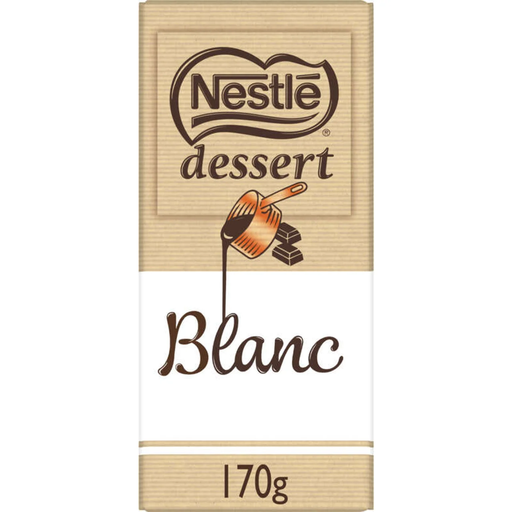 Image unavailable
A bar labelled for baking, worth considering if your Christmas recipe calls for white chocolate to be mixed in.
It comes in a 170 g format, so work out how many bars you’ll need from your recipe. Check the ingredients and allergens on the packaging of the product you buy, especially if a guest needs to avoid certain ingredients.
Don’t assume they’ll give you the same result in a recipe. Lindt describes its LINDOR white chocolates as having a shell and a soft, melting centre. For a recipe that calls for chocolate to be melted or mixed in, it’s better to start with chocolate labelled for baking.
Add together the quantities of white chocolate required by each recipe, then compare the total with the net weight of the bar you’ve chosen. The baking products mentioned here include 170 g and 180 g bars. A bag of chocolates intended for sharing isn’t automatically a suitable substitute.
Read the ingredients, highlighted allergens and ‘may contain’ information on the packaging of the exact product. To illustrate how labels can differ between formats, Auchan’s product listing for the 180 g Nestlé Dessert white chocolate bar mentions milk and whey, as well as possible traces of peanuts, nuts and soya. Don’t assume the same list applies to another bar.
No. The DGCCRF describes Nutri-Score as a voluntary label. When comparing pre-packed white chocolates that require a nutritional declaration, check the sugar and fat content per 100 g, whether or not a Nutri-Score is displayed.
No. Article 1613 ter of the French General Tax Code, published by Légifrance, applies to non-alcoholic drinks, not solid white chocolate. When choosing between two bars or bags, compare their labels and consider how you plan to use them.