People sharing treats across several breaks
If you’re buying for home, the office or several coffee breaks, check the number of bars, their weight and whether they can be broken into squares.


For serving a few squares with coffee or spreading a purchase across several breaks, choose a multipack of bars with a quantity and weight that suit how you plan to use them. A biscuit recipe is a different kind of treat, but you’ll need to check the ingredients and allergen information carefully. A larger baking format is best if you also plan to use it in recipes. In every case, a multipack of bars doesn’t necessarily contain individually wrapped portions.
If you’re buying for home, the office or several coffee breaks, check the number of bars, their weight and whether they can be broken into squares.
If you’ll occasionally portion out the white chocolate, check whether the portions are individually wrapped. Also read the ingredients and allergen information for the product you choose, particularly details about milk and possible traces.
Don’t choose between a plain bar and a biscuit recipe based on the name alone. Compare the ingredients and nutritional information per 100 g; if a Nutri-Score is shown, it shouldn’t replace checking these details.
Start with how you plan to use it, then check the packaging and the label for the exact product variant.
| What matters | What to check | Who should consider it? |
|---|---|---|
| Portioning | Number of bars and whether any portions are individually wrapped. | If I’m splitting the multipack between several breaks or lunchboxes, I want to know how much portioning I’ll need to do myself. Around 36% of consumers would make this their top priority. |
| Recipe and nutrition | Ingredients list, sugars and fat in the nutritional information per 100 g. | To enjoy with my coffee, I want to tell the difference between a plain bar and a biscuit recipe, and check their nutritional information. Around 29% of consumers would prioritise comparing the recipe. |
| How much to buy | Total net weight and the weight of each bar, especially if you plan to use it for both coffee breaks and baking. | If I’m planning squares for breaks as well as a recipe to share, the total weight needs to suit both. Around 21% of consumers would prioritise choosing the right quantity. |
| Allergens | Highlighted ingredients and trace warnings on the exact product variant. | If someone in my household has an allergy, I need to check the recipe before planning a portion for everyone. Around 14% of consumers would make this their first check. |
The contribution described by Légifrance applies to drinks and liquid preparations for drinks, not solid white chocolate bars.
When choosing a bar, focus on its quantity, ingredients and nutritional information.
Anses describes this additional label as optional. If it’s not there, you’ll still need to read the other information on the packaging.
If it is shown, check the nutritional values, ingredients and allergens too.
The multipacks of bars listed by Carrefour include formats such as 2 × 100 g and 2 × 180 g. Having several bars doesn’t mean each portion is ready to pop into a lunchbox.
Check the number of units and how they’re wrapped before assuming they’ll need no preparation.
The French Ministry of the Economy notes that white chocolate contains milk. The recipes listed by Carrefour may include other ingredients or trace warnings, depending on the variant.
Check the ingredients list and warnings on the exact pack every time you buy.
The Carrefour Classic' white chocolate bar listed by Carrefour is available in a multipack of 2 × 100 g.
Carrefour lists a multipack of two 100 g Galak bars.
The Milka Oreo variant listed by Carrefour combines white chocolate and biscuits in a multipack of 2 × 100 g.
Carrefour lists a 2 × 180 g multipack of Nestlé Dessert white chocolate, intended in particular for baking.
The Lindt products listed by Carrefour include a 100 g vanilla white chocolate bar and a 200 g box of white Lindor chocolates: these are two different formats.
These Kinder Bueno White products are white chocolate-coated wafer and hazelnut bar snacks. They could suit you if you want to split a snack across a break, but they’re not a substitute for a multipack of white chocolate bars to break into squares.
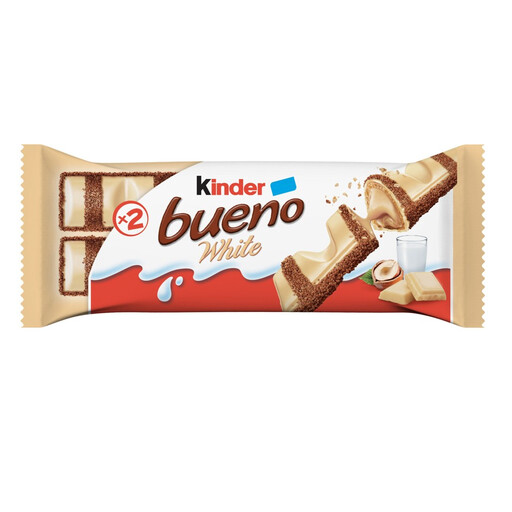 Image unavailable
This 39 g bipack is a good choice if you’d like to split a snack between two occasions. It contains wafer and hazelnuts, not just white chocolate. If you need to put one bar in each of two different lunchboxes, check whether they’re individually wrapped. Also check the information about milk, soya, wheat and hazelnuts.
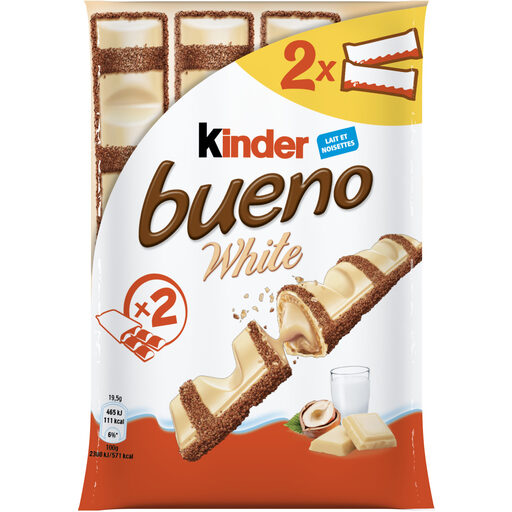 Image unavailable
The 78 g format is described as containing several bars to share out. The title says ‘2 × 2 Bars’, while the description mentions two bars, so check the number of units before you buy. This snack contains wafer and hazelnuts; also check the information about milk, soya and wheat.
No. The contribution described by Légifrance applies to drinks and liquid preparations for drinks, not solid white chocolate bars, even if they contain sugars.
No. According to Anses, this additional label is optional. If it appears, check the nutritional values, ingredients and allergen information for the exact product too.
Start with milk, which the French Ministry of the Economy says is an ingredient in white chocolate. Depending on the recipe, also check for wheat, soya, nuts, peanuts and any trace warnings on the pack you choose.
Follow the storage instructions and best-before date shown on the pack. Once opened, reseal the bar or put it in a suitable container to enjoy at your next break.