Someone planning study breaks
If you’re keeping chocolate for several breaks, compare the sugar, energy and fat per 100 g, then consider the portion size you’d like to have each time.


If you’re looking for white chocolate only, choose a gift box where every piece matches that preference. For a gift to share with people who have different tastes, an assortment that includes white chocolate may be a better fit. If it’s mainly for study breaks, a smaller pack may be more practical than a gift box. In every case, check the ingredients, allergens and nutritional values per 100 g.
If you’re keeping chocolate for several breaks, compare the sugar, energy and fat per 100 g, then consider the portion size you’d like to have each time.
Check the recipe for each gift box you’re considering. White chocolate, praline and assorted chocolates can all have different ingredients and allergen information.
The number of pieces and the flavours matter just as much as the presentation. An assortment with a few white chocolate pieces may not be suitable if you’re looking for white chocolate only.
First decide whether you’re buying to suit a preference for white chocolate, as a varied gift or as a snack for study breaks. For a fair comparison between pre-packed products, use the nutrition information per 100 g as a common reference, as explained by the DGCCRF.
| What to consider | What to check | Who is it for? |
|---|---|---|
| Nutritional composition | Compare the energy, fat and “of which sugars” figures per 100 g. Don’t mistake the latter for an indication of added sugars. | If I keep chocolate near my study materials for several breaks, I want to compare the recipes without relying on the size of the boxes. Around 40% of consumers would prioritise this nutritional comparison. |
| Ingredients and allergens | Read the ingredients list for the exact product, including any “may contain” statements and the ingredients in the fillings. | Before giving pralines as a gift, I need to know whether the recipe is suitable for the person receiving them. Checking the ingredients and allergens would be the main concern for around 30% of consumers. |
| Size and sharing | Check the net weight, the number of pieces if stated, and how the flavours are divided in an assortment. | If I’m sharing during study breaks, I want to know how many pieces are in the box; for my own breaks, I might prefer a smaller pack. Around 20% of consumers would put this choice of format first. |
| Gift presentation | Check the product name and flavours before choosing a box presented as an assortment. | If I’m buying chocolate for someone who asks for white chocolate, I don’t want the presentation to disguise the fact that it’s mainly an assortment. Getting the gift right would be the priority for around 10% of consumers. |
In France, the levy set out in Article 1613 ter of the General Tax Code applies to drinks and liquid preparations for drinks, not to a solid box of chocolates.
When choosing between two gift boxes, compare their ingredients and nutrition information instead.
France’s Ministry of the Economy explains that displaying Nutri-Score is optional in France. For most pre-packed foods, the nutrition information is still the main reference to check.
If the logo is present, read it alongside the nutrition information. If it isn’t, compare the values per 100 g and the ingredients list directly.
An assortment can include white chocolate alongside other recipes. The LINDOR assortment of milk, white and coconut chocolates featured by Lindt France is one example.
If the person wants white chocolate only, check the flavours and product name on the gift box.
Lindt France offers white chocolates and several gift formats, including assortments.
The LANVIN gift box featured by Auchan contains white chocolate praline sweets.
The products considered here include bars combining white chocolate with other ingredients.
Carrefour offers, among other products, a 175 g Carrefour Bio white chocolate bar.
E.Leclerc offers several TABLETTE D’OR white chocolate bars, including plain, coconut and hazelnut varieties.
Auchan offers, among other products, a white chocolate bar with caramelised coconut.
These products are better suited to study breaks than as a gift box: two bar formats and a bag of cereal contain white chocolate, but none is a box of chocolates made entirely of white chocolate.
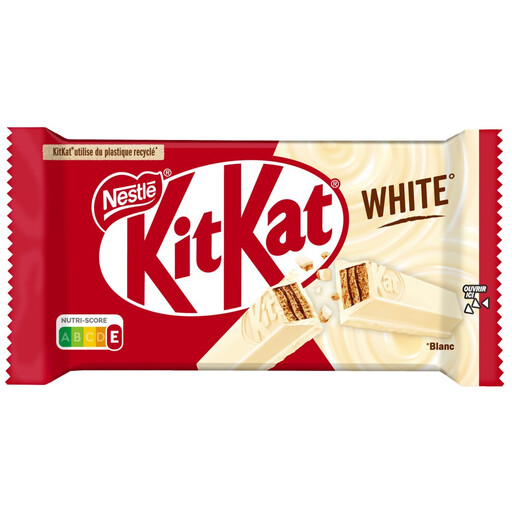 Image unavailable
A bar for an individual break, rather than a gift box. It combines a wafer with a white coating. The product information lists wheat containing gluten and milk. Check the packaging if these ingredients are a concern for you.
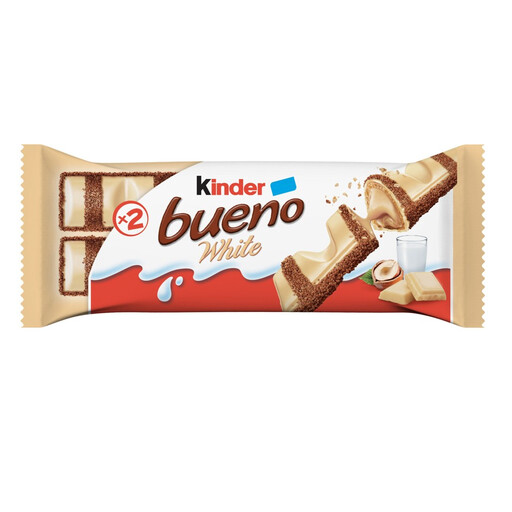 Image unavailable
The bipack contains two 19.5 g bars, so you can keep one for later. They’re filled wafers, not white chocolate sweets: white chocolate makes up 28% of the recipe. The product information lists milk, soya, wheat and hazelnuts, among other ingredients.
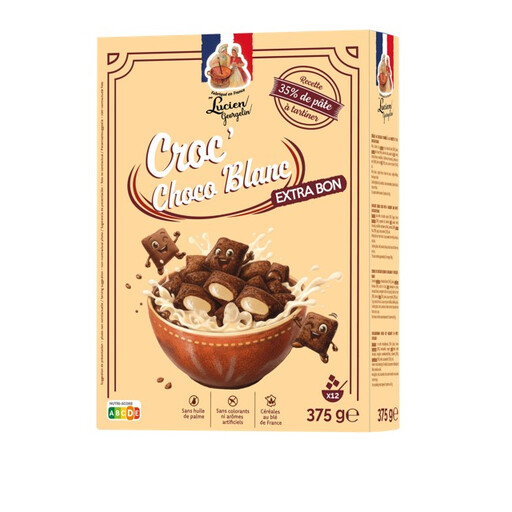 Image unavailable
This bag of cereal coated in a spread is an alternative snack, but it’s not a box of chocolates to give as a gift. The product information states that the spread, which makes up 35% of the product, contains 8% white chocolate. It also lists gluten, milk and hazelnuts. The bag doesn’t contain individual portions.
No, not as a solid gift box. Article 1613 ter of the General Tax Code, published on Légifrance, applies to drinks and liquid preparations for drinks. The sugar content of solid chocolate is nutrition information to check, not a reason to apply this levy.
No. France’s Ministry of the Economy explains that displaying it is optional in France. For most pre-packed products, check the nutrition information instead and compare the values per 100 g, as advised by the DGCCRF.
Read the ingredients list and all allergen information for the exact gift box. The LANVIN gift box featured by Auchan lists milk and almonds, among other ingredients, in its praline recipe. The words “white chocolate” alone don’t tell you what’s in an assortment or filling.
Follow the instructions on the packaging. For the LANVIN gift box featured by Auchan, the product information recommends storing it in a cool, dry place between 15 and 18 °C, away from light. Don’t assume the same temperature range applies to all chocolate; check the label.