Anyone who wants to break a bar into pieces
A bar bought for yourself can be broken into squares and enjoyed over several occasions. If you’d rather not open two bars at once, check whether you’re buying one 100 g bar or a pack of 2 × 100 g bars.


For a solo treat with your Christmas drinks, choose a plain white chocolate bar if you want to break it into squares, a biscuit or cereal recipe if you’re after some crunch, or a filled bar if you prefer a soft, melting texture. Check the weight of each bar rather than the whole multipack, then look at the ingredients, allergens and nutritional information for your chosen recipe.
A bar bought for yourself can be broken into squares and enjoyed over several occasions. If you’d rather not open two bars at once, check whether you’re buying one 100 g bar or a pack of 2 × 100 g bars.
Recipes with biscuits or cereals offer a different texture from plain chocolate. They also contain different ingredients, so check the label carefully if you need to avoid any allergens.
Comparing sugars and saturates per 100 g lets you assess different recipes on the same basis. You should still check the ingredients list and allergens on the specific product, whatever its Nutri-Score.
For a solo treat, start by checking the format you’re actually buying. Then choose your preferred texture and read the label for your chosen recipe.
| Criterion | What to check | Who is it for? |
|---|---|---|
| Format | Number of bars and the weight of each one: 100 g and 2 × 100 g are not the same purchase. | If I’m planning to save some chocolate for later, I want to know what I’m opening and what I can leave sealed. Around 33% of consumers would make format their top priority. |
| Ingredients and allergens | Ingredients list and highlighted allergens on the packaging for the exact recipe. | If I’m sharing a few squares, I need to check whether the recipe is suitable for anyone with an allergy or who needs to avoid certain ingredients. Ingredients are said to be the first consideration for around 27% of consumers. |
| Nutritional information | Sugars and saturates per 100 g; use the Nutri-Score as an additional guide if it is shown. | Before choosing between two recipes, I want to compare their values on the same basis rather than relying on the logo alone. Around 20% of consumers would put this comparison first. |
| Texture | Plain recipe, biscuit or cereal pieces, or a filled centre. | For these Christmas drinks, I’m looking for either crunchy pieces or a soft, melting filling rather than a plain bar. This would be the top priority for around 20% of consumers. |
The Carrefour Classic’ and TABLETTE D’OR products listed by their retailers as 2 × 100 g packs contain two bars, not individually wrapped bites.
Check the number of bars and the weight of each one. If you open a bar, decide how many squares you want to serve.
According to Santé publique France, displaying the Nutri-Score is voluntary. It doesn’t replace checking the nutritional information and ingredients. E.Leclerc also states that the score shown for its TABLETTE D’OR bar uses the previous calculation, which was in use before April 2025.
Compare the values per 100 g and check the exact recipe. Take the Nutri-Score into account when it appears on the products you’re comparing, but don’t draw any conclusions from its absence.
Carrefour’s product listing for Milka Oreo Blanc mentions milk, wheat and soya, among other ingredients, and warns that it may contain nuts. You can’t check a biscuit or cereal recipe by looking at the label for a plain bar.
Read the ingredients list and allergen information again whenever you choose a different recipe, even from a familiar brand.
Lindt’s product listings state that, per 100 g, LINDOR Blanc contains 50 g of fat and 38 g of saturates, compared with 36 g and 22 g for EXCELLENCE Blanc Extra Velouté. This comparison applies to these two specific recipes.
If you choose a filled bar for its texture, compare its own nutritional values with those of the plain bar you’re considering.
Lindt offers two 100 g white chocolate bars with different textures: EXCELLENCE Blanc Extra Velouté and filled LINDOR Blanc.
The Oreo white chocolate bar listed by Carrefour combines white chocolate with biscuit pieces. The product listing checked is for a pack of 2 × 100 g bars.
The white chocolate bar with crunchy cereals listed by Carrefour is offered in a 2 × 100 g pack in the product listing checked.
The plain white chocolate bar listed by Carrefour is sold in a pack of 2 × 100 g in the product listing checked.
E.Leclerc offers this plain white chocolate recipe in a pack of 2 × 100 g.
For an individual treat with your Christmas drinks, these two products suit different cravings: a block of white chocolate you can break into pieces, or a wafer bar coated in white chocolate. The wafer bar isn’t a plain chocolate bar.
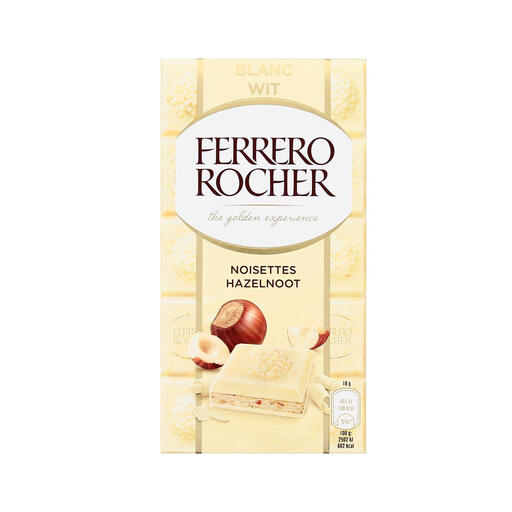 Image unavailable
This block is a good choice if you want to break up white chocolate with hazelnuts for your own treat. It contains milk, hazelnuts and soya, and may contain traces of other nuts. Check the label if you have an allergy. If you need individually wrapped portions, check the packaging for details.
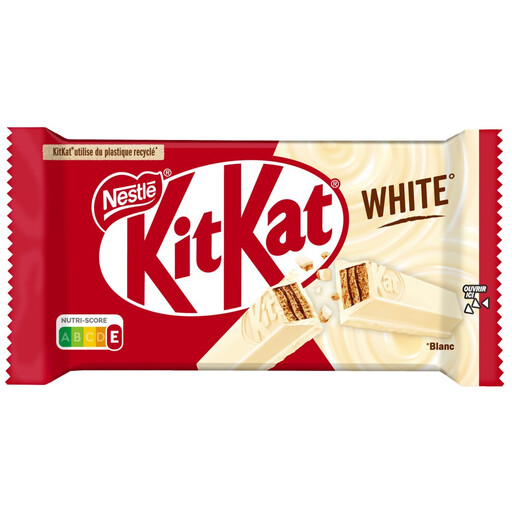 Image unavailable
This wafer bar coated in white chocolate is ideal if you prefer a crunchy texture in a smaller format than a 100 g bar. It contains wheat (gluten) and milk, so check the label if these ingredients are a concern. Also check the packaging if you’re looking for individually wrapped portions.
No. As it applies in France in October 2026, Article 1613 ter of the French General Tax Code covers drinks and liquid preparations for drinks, not solid chocolate bars. You can still compare the sugar content in the nutritional information.
No. Santé publique France states that displaying it is voluntary. For prepacked food sold in France, a nutrition declaration is part of the compulsory labelling information. So the absence of a Nutri-Score doesn’t, by itself, mean that the bar is non-compliant.
Read the ingredients list and the highlighted allergens on the exact product packaging. France’s consumer protection authority (DGCCRF) explains that this labelling helps you identify declared allergens in prepacked food. Don’t assume that the allergens in a plain recipe are the same as those in a version with biscuits or cereals.
The best-before date indicates how long the product is expected to retain its quality. According to France’s consumer protection authority (DGCCRF), going past this date doesn’t automatically mean that a product with intact packaging is unsafe to eat, although its taste and texture may have deteriorated.