
Livraison le jour même ou le lendemain

Qualité garantie

Débloquez vos offres de bienvenue: Livraison GRATUITE | Jusqu'à -80 % | 30 jours d'essai gratuits à JoyPlus
Téléchargez l'application
Building a high-performance PC with a pristine design is a dream for many enthusiasts. For a white build, a white 360mm AIO liquid cooler is often the centerpiece, combining cutting-edge cooling with clean aesthetics. However, the market is saturated with models making alluring marketing promises, and it's easy to end up with a disappointing product.
As a product expert at Joybuy, my role is to help you see things more clearly. Together, let's break down the pitfalls to avoid and the technical criteria that truly make a difference, far from the marketing jargon.
Here are the 3 most common mistakes to avoid:
To avoid these disappointments, it's crucial to focus on a few fundamental technical specifications. These will determine the performance, silence, and longevity of your complete liquid cooling kit.
The pump is the heart of your cooling system. Its reliability and quiet operation are therefore paramount. Recent models often integrate soft-start mechanisms to limit noise on startup. The cold plate, in direct contact with the processor, must be made of copper to ensure optimal thermal conductivity. A large, perfectly flat surface ensures efficient heat dissipation, a non-negotiable feature for a CPU cooler for overclocking intended for demanding processors like the Intel Core i9 or AMD Ryzen 9.
A 360mm radiator offers a large surface area for dissipation, but its effectiveness depends directly on the quality of its fans. Opt for a model equipped with three 120mm PWM fans. PWM (Pulse Width Modulation) technology allows the motherboard to adjust their rotational speed based on the CPU temperature, creating a perfect balance between maximum cooling under load and near-total silence at idle. Also, pay close attention to the fans' static pressure: this is the characteristic that allows them to force air through the radiator's dense fins.
Before you check out, one final check is necessary. Ensure the kit is compatible with your processor's socket (e.g., LGA 1700/1851 for Intel, AM5 for AMD). Next, measure the available space in your case. A 360mm radiator, with its fans, requires a dedicated spot on the front or top of the chassis; plan for a clear length of about 40 cm. Finally, regarding lighting, make sure the ARGB system is compatible with your motherboard's software (Asus Aura Sync, MSI Mystic Light, etc.) for perfect synchronization of the entire setup.
Such a central component should be chosen based on your needs and priorities. Here is a selection that meets our criteria for performance and reliability.
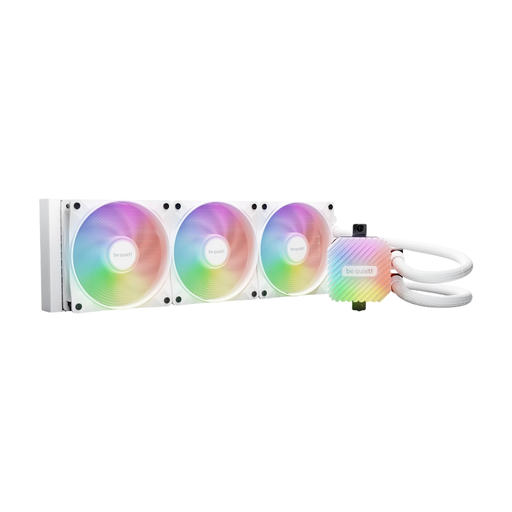
Why it's for you: Perfect for those building a high-end, no-compromise setup where silence, the potential for overclocking cooling, and pristine white aesthetics, enhanced by customizable ARGB lighting, are top priorities.
Its soft-start pump and excellent PWM fans tackle the noise problem head-on. The included ARGB/PWM hub ensures perfect synchronization and puts an end to the visual chaos of unsynced lighting.
Top-tier cooling performance capable of taming the most demanding processors, all in remarkable silence and with a hub that centralizes fan and lighting management.
We have selected a full range of products that meet these demanding selection criteria and current safety standards.
A good complete liquid cooling kit typically has a lifespan of 5 to 7 years. The known points of failure are the pump and permeation (the gradual evaporation of liquid through the micropores of the tubes). Some models, like the be quiet! Light Loop, include a fill port and a bottle of coolant, an operation that should be performed with care to extend their longevity.
Installation is certainly more complex than a simple air cooler, but it is still quite accessible for a knowledgeable enthusiast. The main difficulty lies in managing the space for the radiator and the cable management for the fans and pump. It is crucial to follow the manual to the letter, especially for choosing the correct mounting kit for your Intel or AMD socket.
No, and this is a critical point to watch out for. ARGB (Addressable RGB) lighting uses a 3-pin (5V) connector. You must verify that your motherboard has this type of header. Older models sometimes only have 4-pin (12V) RGB headers, which are incompatible. Fortunately, kits like the Light Loop 360mm include their own ARGB hub. This greatly simplifies connection and synchronization, even if your motherboard only has one suitable port.