What should you look at first?
First, compare appliances that perform the same function, then work out their consumption based on how you’ll use them over a year. To decide whether to replace your current appliance, compare that estimate with its consumption, if you can measure or cautiously estimate it.
| Criterion |
What to check before buying |
Who this matters to |
| Runs all year round |
Compare kWh/year for appliances with the same function, taking usable capacity and the balance between fridge and freezer space into account. |
My fridge or freezer runs all year round, so I want to know whether choosing a suitable capacity would change its annual energy consumption. Around 31% of consumers would make this their priority. |
| Frequent tumble drying |
Work out the kWh/100 cycles based on how many times you tumble dry each year; also check the capacity and installation requirements. |
I use my tumble dryer often, so the cumulative effect of repeated cycles influences my choice. This would be the priority for around 25% of consumers. |
| Dishwashing cycles |
Check the kWh/100 Eco cycles, water consumption per cycle, capacity and programme duration for the programme you’ll actually be able to use. |
If I do lots of washing-up, I want to compare an Eco programme that fits in with my household routine, without running lots of half-empty cycles. Around 19% of consumers would prioritise dishwashing. |
| Cooking |
For an oven, check the kWh/cycle for the cooking mode you use and the capacity you need; for an induction hob, check your cookware and the size of the cooking zones. |
I cook regularly and want to replace an appliance based on how I cook, rather than its energy class alone. Cooking would come first for around 13% of consumers. |
| How long you’ll keep it |
Compare the projected consumption with that of your current appliance, and check that it’s the right size as well as the information available about parts and maintenance. |
My appliance still works, so I want to decide whether replacing it makes sense over the period I expect to use a new one. Around 12% of consumers would make this their priority. |
Brands to consider
There are no brand profiles to show here.
Fridges to compare on Joybuy
These refrigeration appliances illustrate how to compare capacity and configurations before deciding whether to replace your current one. To assess their energy consumption against your existing appliance, check the kWh/year figure on the label for the exact model.
 Image unavailable
Candy CFQQ5T817EPS, 4-door, 467 L
Worth considering if you need a large-capacity fridge freezer. The model name indicates a capacity of 467 L, Total No Frost and an energy class of E. Check that the layout suits your storage needs before comparing kWh/year.
View on Joybuy
 Image unavailable
Haier HTW5618ENMG, 3-door, 360 L
Compare its capacity with your current appliance to see whether 360 L will meet your needs. This fridge freezer is listed with Total No Frost, energy class E, Wi-Fi and My Zone. Compare its annual energy consumption with that of an appliance offering a similar level of service.
View on Joybuy
 Image unavailable
Sonlu CC-520WE, 444 L
Consider this model if a total capacity of 444 L suits your refrigeration needs. It’s listed as frost-free with an energy class of E. Check the compartment layout, dimensions and kWh/year before comparing it with another appliance.
View on Joybuy
 Image unavailable
CHiQ JR227LSE, 227 L
If you’re looking for a more compact refrigeration appliance, check whether 153 L of fridge space and 74 L of freezer space will be enough for you. The model name indicates a width of 54 cm, a reversible door, Low Frost and an energy class of E. Check the kWh/year figure before making any decisions based on energy consumption.
View on Joybuy
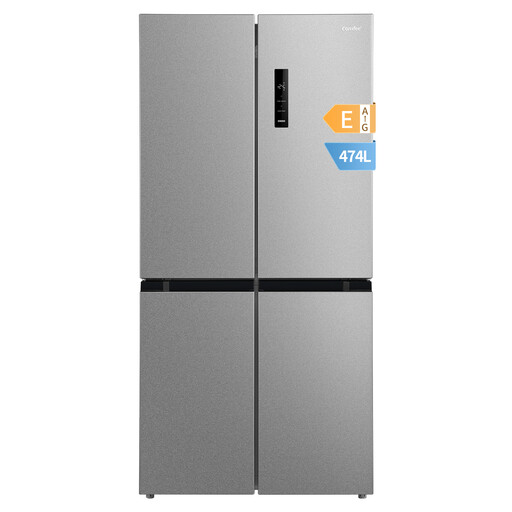 Image unavailable
COMFEE' RCF470LS2EU(E), 4-door, 474 L
Worth considering if a 474 L, four-door fridge suits the space available and the capacity you’re looking for. The model name indicates an energy class of E and a three-temperature vegetable drawer. Check the compartments and the kWh/year figure for the exact model before drawing conclusions about its energy consumption.
View on Joybuy
Frequently asked questions
How do I work out an appliance’s energy consumption over a year?
Start with the unit shown for its category and how often you use it: kWh/year for refrigeration, kWh/100 cycles for a dishwasher or tumble dryer, and kWh/cycle for an oven. For a figure given per 100 cycles, divide it by 100 and multiply it by the number of cycles you run each year. Bear in mind that the label is based on standardised conditions.
Is a better energy class enough to justify replacing an appliance?
No. It doesn’t guarantee that your household will use less energy. Compare appliances with a suitable capacity and function, estimate their energy consumption based on your habits, then compare it with that of the appliance you already use.
Why look at a dishwasher’s Eco programme?
According to the European Commission, the dishwasher label’s energy consumption figure per 100 cycles is based on this standardised programme. Also check its duration, water consumption per cycle and capacity, especially if you usually use other programmes.
What should I check before replacing a frequently used tumble dryer?
Compare its energy consumption per cycle based on how often you tumble dry, then check the capacity and installation requirements. In particular, your choice should take into account whether it needs an outlet to the outside or how you’ll manage condensed water.
Can I compare a hob using an oven’s energy label?
No. The European Commission says that ovens carry an energy label, but there is no equivalent energy labelling requirement for hobs. When choosing a hob, consider the technology, the size of the cooking zones, your cooking habits and, if you’re thinking about induction, whether your cookware is compatible.


