
Livraison le jour même ou le lendemain

Qualité garantie

Débloquez vos offres de bienvenue: Livraison GRATUITE | Jusqu'à -80 % | 30 jours d'essai gratuits à JoyPlus
Téléchargez l'application
Looking for whey protein to complement your diet, make a post-gym shake or increase your daily intake between meals? With whey isolate, whey concentrate, hydrolysate, flavours and family-sized formats, choosing the right product can quickly become a headache.
Marketing claims do not always make it easy to compare products on a like-for-like basis. Here are the criteria to consider before placing your order, along with a selection suited to different needs.
A 2 kg bag may seem like the obvious best-value option. However, the number of servings depends on the recommended serving size. Two products with the same weight can therefore provide a different number of shakes.
For a meaningful price comparison, look instead at:
A larger format is mainly worthwhile if you use this supplement regularly and already know which flavour you like. For your first order, a 300 to 500 g pouch lets you minimise disappointment and waste.
Whey isolate generally undergoes more extensive filtration than whey concentrate. It often has a higher protein content, but this alone is not enough to determine whether it is right for your needs.
Whey concentrate can be perfectly suitable for daily use. A blend of isolate, concentrate and hydrolysate, meanwhile, combines several sources of dairy protein. The key factor is the full composition: check where milk proteins appear in the ingredients list, as well as the amounts of carbohydrates, fat and sugar.
A vanilla protein, chocolate or strawberry protein can be mixed with water, milk or yoghurt, or added to porridge. However, flavours and sweeteners vary from one product to another. Some recipes contain sucralose or acesulfame-K, for example.
The statements ‘contains milk’ and ‘contains soya’ are very common, particularly because of the lecithin used to improve mixability. Anyone with allergies should also check for possible traces of egg, gluten, peanuts or nuts.
Whether you do weight training, fitness, running or another form of regular physical activity, start by comparing the amount of protein per serving. The products featured here generally provide between 22 and 24 g of protein per serving, with serving sizes ranging from 28 to 32 g.
The value per 100 g makes it easier to compare products:
Protein contributes to the maintenance and development of muscle mass as part of a balanced diet and suitable physical activity. Whey is still a supplement: it does not replace meals or a varied diet.
A whey formula may contain:
Always check the exact ingredients list for the flavour you have chosen. The recipe may vary between vanilla, chocolate and strawberry.
A serving is generally mixed with 180 to 250 ml of water or milk. Smaller formats are handy for trying a flavour or taking a few servings with you. Individual sachets fit easily in the office, a gym bag or your luggage when travelling.
After opening, store the powder in a cool, dry place away from light. Close the container carefully to prevent moisture and clumping. Follow the dosage given on the packaging and do not use whey as a substitute for a varied diet.
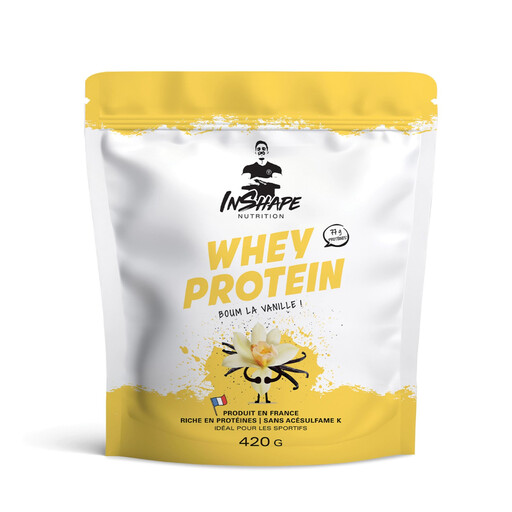
Why this is a relevant choice : At 420 g, this format lets you try vanilla protein without committing to a large bag straight away. Each 30 g serving provides 23.1 g of protein, according to the product information.
The smaller pack reduces the risk of waste if you do not enjoy the flavour or only use whey occasionally.
23.1 g of protein per serving, 1.3 g of fat, and the option to prepare it with water or milk.
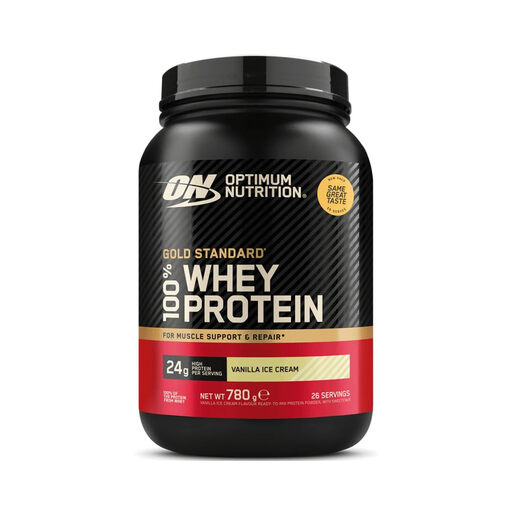
Why this is a relevant choice : This formula combines isolate, concentrate and hydrolysed isolate, providing 23.7 g of protein per 30 g serving. At 780 g, the tub is compact enough for a regular routine without jumping straight to the largest format.
The nutritional information lets you compare servings, protein, fat and carbohydrates directly, rather than focusing solely on the brand name.
23.7 g of protein per serving and 79 g per 100 g, with a powder advertised as easy to mix.
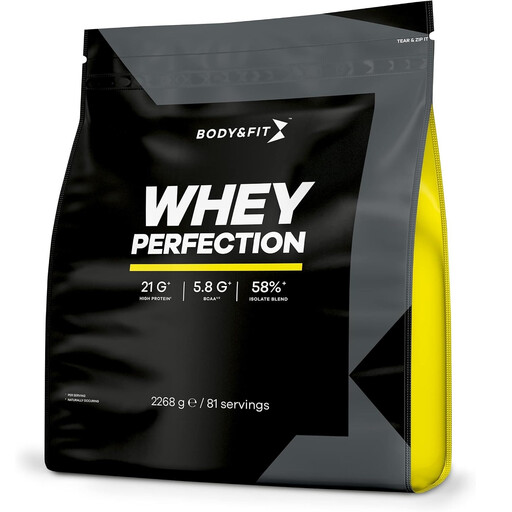
Why this is a relevant choice : With around 81 servings, this large format is designed for users who regularly prepare a post-workout shake or add whey to their recipes.
The number of servings and the 28 g serving size are clearly stated, making it easy to estimate how long the product will last before buying.
22 g of protein per serving, 100 kcal stated, and a blend of whey isolate, concentrate and hydrolysed whey.
We have brought together a complete, real-time selection of products that meet these criteria and European safety requirements.
You can have it after training, between meals or at breakfast, depending on your needs. The exact timing matters less than your total protein intake for the day and the overall balance of your diet.
Check the date shown on the packaging and the manufacturer’s recommendations. Once opened, keep the powder tightly sealed, somewhere dry and away from heat and moisture. An unusual smell, a noticeably altered texture or persistent clumps should be a reason not to consume the product.
Not necessarily, especially when comparing equivalent serving sizes. Look at the price per gram of protein, the serving size, the number of servings and the overall composition. Whey concentrate or a blend may have a different cost per use while still being perfectly suitable for daily consumption.