DIYers using power tools
If you’re sanding, sawing or drilling, a connector that fits your tool can help capture dust at source. Check that compatible filters and bags are available too. This type of vacuum isn’t suitable for hazardous dust.


For post-renovation cleaning, choose a wet and dry vacuum whose instructions confirm it can handle the waste you need to clear: dust, small rubble or liquids, depending on the model. If you’re using a power tool, check the connection and filtration. For a patio covered in leaves, look instead at the accessories and blower function. Don’t assume a domestic vacuum is suitable for dust that could be toxic or carcinogenic.
If you’re sanding, sawing or drilling, a connector that fits your tool can help capture dust at source. Check that compatible filters and bags are available too. This type of vacuum isn’t suitable for hazardous dust.
If the instructions say the vacuum can handle dust, small rubble, dry debris and liquids, consider the tank capacity, how easy it is to empty, the working range and how much storage space you have.
For leaves and larger debris, check the hose diameter and the accessories included. A blower function can help clear awkward corners, as long as the model is suitable for the location and conditions of use.
Start with the waste you need to clear and where you’ll be using the vacuum. Then check the model’s instructions before comparing connectors, accessories, tank capacity and storage. UFC-Que Choisir’s guide highlights the different needs associated with fine dust, small rubble, water and leaves.
| Criterion | What to check | Who this is for |
|---|---|---|
| Dust from tools | Check that the filtration is suitable for the dust produced and that the connector fits your tool. | When I’m sanding or drilling, I want to capture dust at the tool rather than clean the whole area afterwards; around 37% of consumers prioritise this. |
| Mixed waste | Check which types of waste the instructions allow, then compare the tank capacity and how easy it is to empty. | In my garage, I need to pick up dry debris and sometimes a liquid without changing appliances; handling this type of mess is the main need for around 36% of consumers. |
| Leaves and outdoor use | Check the hose diameter and accessories, and whether it has a blower function if you need one. | When clearing leaves from an outdoor entrance, I want to reach awkward corners and pick up larger debris; this is the top priority for around 27% of consumers. |
The INRS states that, in the situations it describes, tasks that produce dust which could contain toxic or carcinogenic substances require Class H appliances. A “wet and dry” label alone doesn’t mean a vacuum is suitable for this.
If the material is old, unknown or could produce hazardous dust, identify the risks and the relevant prevention measures before choosing an appliance.
A large tank may mean fewer trips to empty it, but the vacuum takes up more space. UFC-Que Choisir also notes that a stainless-steel tank can make the appliance heavier.
Measure the space where you’ll store it, and check the handle, emptying system and hose storage if you’ll need to move it regularly.
A switched socket or Auto-Start function won’t, by itself, resolve whether the connector diameter or adaptor is right for your tool.
Compare your tool’s connector with the accessories listed for the exact vacuum model you’re considering.
According to UFC-Que Choisir, a wider tube and hose are better suited to picking up leaves and rubble; narrow accessories can slow the job down.
Check the diameter and the nozzles included against the debris you’ll be clearing most often.
In its wet and dry range, Kärcher France presents the WD 6 P S V-30/8/35/T for workshop jobs. It has a 30 L tank, a switched socket, an 8 m cable and a 3.5 m hose.
Bosch DIY France presents the PAS20-220P for small- to medium-sized DIY projects. It has a 20 L tank, an Auto-Start function and a blower.
In Nilfisk France’s Multi range, the Multi II 30 T combines a 30 L tank, a 4 m hose, an adaptor for power tools and a Push & Clean system.
This wet and dry vacuum is worth considering for an indoor garage or workshop. Before using it with liquids, fine dust or outdoors, check the conditions in its instructions.
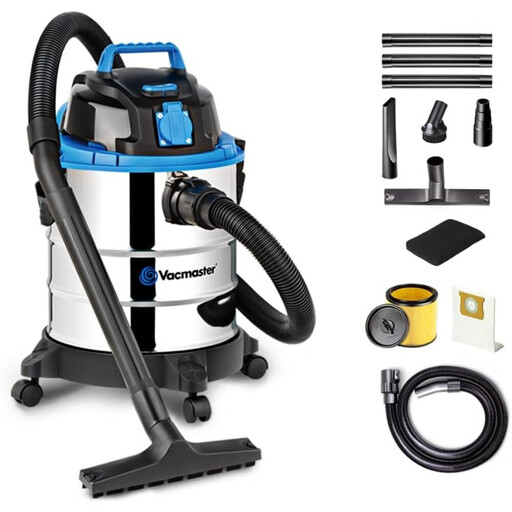 Image unavailable
Worth considering for cleaning an indoor garage or workshop, provided the instructions allow the types of waste you need to clear.
The product listing specifies a 20 L stainless-steel tank. The product name states that it has a 1250 W motor, 20 kPa suction, a 2430 W tool socket and a blower function.
Check that the connector fits your tool and that the filtration is suitable for fine dust. The specified conditions are for indoor use in a dry environment, and exclude vacuuming harmful dust. Check the instructions before using it with liquids or outdoors.
Yes, if the vacuum’s instructions explicitly allow each type of waste. Check the accessories and the instructions for switching between dry materials and liquids too.
Not necessarily. UFC-Que Choisir says a narrow tube and hose may be suitable for fine dust, while a wider diameter is better for leaves and rubble. Check which accessories are actually included.
Yes, if the model has the function you need and a connector that fits your tool. A switched socket or Auto-Start function doesn’t, by itself, confirm that the adaptor will fit.
No. It’s designed to clear awkward corners or gather leaves before you pick them up. If you want to vacuum them up afterwards, check that the model and its accessories are suitable for the job.
Don’t choose a standard domestic model for this. The INRS states that, for the tasks it describes that produce dust which could contain toxic or carcinogenic substances, Class H appliances are required. First identify the material and the relevant prevention measures.