Home DIYers
After drilling, sanding or doing small DIY jobs, check which types of debris the vacuum and its filter can collect. If you regularly use a power tool, also check that its connection is compatible with the vacuum.


For cleaning a garage or patio after small DIY jobs, choose a vacuum whose instructions specifically allow it to collect dry waste and, if needed, water. A tool connection is most useful if you regularly drill or sand. For occasional clean-ups, compare the tank capacity, hose reach and storage space instead. Never use a standard household vacuum to deal with potentially hazardous dust.
After drilling, sanding or doing small DIY jobs, check which types of debris the vacuum and its filter can collect. If you regularly use a power tool, also check that its connection is compatible with the vacuum.
The accessories and operating modes you need will depend on whether you’re collecting dry dirt, leaves or water. Tank capacity and hose length matter more when you have a larger area to clean.
For occasional cleaning, compare the dimensions and weight before choosing a large tank. A smaller capacity may mean more frequent emptying, but it’s easier to store when space is limited.
Start with the materials you need to vacuum, then estimate how much you’ll collect and how far you need to reach without moving the machine.
| Feature | What to check | What I need |
|---|---|---|
| Water and dry waste | Check the instructions for permitted materials, the filter to fit and the accessories intended for each mode. Don’t assume a vacuum can collect liquids just because it has a canister-style design. | I want to clean the garage after DIY jobs and collect water only if the model specifically allows it. |
| Tank capacity and reach | Compare the capacity with the amount you usually need to collect, then check the hose and cable lengths together. Also consider the weight and where you’ll store it. | On a large patio, I’d rather not have to move the vacuum around too often; in a small garage, I also need to be able to store it. |
| Tool connection | Check the adaptor and compatibility with the tool you use. If the vacuum has a synchronised socket, check the conditions for using it; this connection does not determine the dust filtration class. | I regularly drill or sand and want to collect dust close to the tool, without assuming the vacuum is suitable for hazardous dust. |
| Accessories and maintenance | Check which nozzles and filters are included, whether they’re suitable for your floors and corners, and how to clean the filter. Compare the stated noise levels for each model on a like-for-like basis. | I need to clean corners and floors, then put the accessories away without losing any parts. |
High power, a filter or a tool socket does not prove that a model protects you from dust that may contain toxic or carcinogenic substances. The INRS states that a Class H machine is required for tasks that produce this type of dust.
If the material may contain substances such as silica, lead or asbestos, don’t choose a household model based only on its sales listing. Have the risk assessed and check the relevant preventative measures before cleaning.
A larger tank means fewer trips to empty it, but the vacuum still needs to fit in its storage space and be practical to move around.
Measure the space available and compare the weight, hose and accessory holders against the amount you usually collect.
A crevice nozzle, floor accessory, tool adaptor or suitable filter may be essential for the job you have in mind.
Check exactly what’s included in the box and which consumables are compatible with the materials you plan to vacuum.
The stated electrical power tells you nothing about which materials the vacuum can collect, its filtration or its practical reach.
First check the instructions for the waste you need to collect, then compare the tank, hose, accessories and filter maintenance requirements.
These models show a range of formats. The features mentioned apply to each specific model, not to the brand as a whole.
The AdvancedVac 20 is a wet and dry vacuum to consider for the garage or small DIY jobs. Bosch DIY France lists a 20 L tank and a weight of 7.6 kg.
The Multi II 30 T focuses on capacity and reach: Nilfisk France lists a 30 L tank and a 4 m hose.
The SE 33 is a format worth considering for occasional utility cleaning. STIHL France lists a 12 L tank and a weight of 5.5 kg with the cable.
These two 20 L Vacmaster vacuums are designed for different utility tasks: the VQ1220PF is presented as a choice for the garage and car, while the VQ1220SC has a tool socket for workshop jobs.
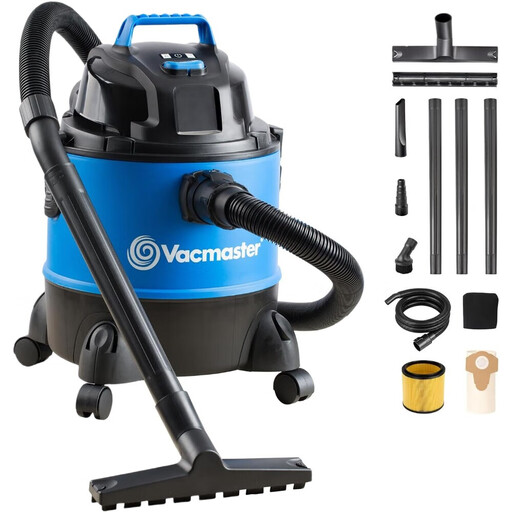 Image unavailable
For occasional cleaning in the garage or car, the product listing specifies wet and dry vacuuming, a 20 L tank and a 2.5 m hose. It also lists a 7.5 m operating radius, a weight of 4 kg and a noise level of 89 dB(A). Before vacuuming fine dust, rubble or leaves, check the instructions for permitted materials and filters. These specifications do not make the machine suitable for hazardous dust.
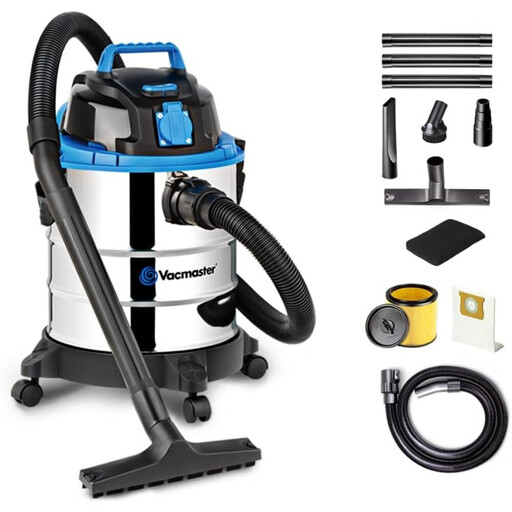 Image unavailable
For dry tasks in a garage or workshop, this model combines a 20 L tank with a tool socket rated at 2430 W and a blower function. Check that the connection is compatible with your tool before buying. Although the product title mentions wet vacuuming, the listing also includes instructions for use in dry environments. Check the exact manual before collecting any liquids, and make sure the filters are suitable for the dust you need to collect.
It depends on the model and the filter fitted. Bosch says the cartridge in its AdvancedVac 20 can be used to vacuum wet and dry materials without changing the filter. For any other machine, follow the instructions before switching between uses.
Choose based on how much you usually need to collect and the space you have available, rather than capacity alone. STIHL lists a 12 L tank for the SE 33, Bosch lists 20 L for the AdvancedVac 20, and Nilfisk lists 30 L for the Multi II 30 T. A larger tank means fewer trips to empty it, but remember to check the weight and overall size of the model you choose.
It’s worth considering if you regularly drill or sand and want to connect the vacuum to your tool. Check the adaptor and the socket’s operating conditions. This connection does not guarantee that the filtration is suitable for every type of dust produced.
Don’t choose a standard canister vacuum for this purpose. The INRS states that a Class H machine is required for tasks that produce dust that may contain toxic or carcinogenic substances. Have the material identified and check the relevant preventative measures before cleaning.