
Livraison le jour même ou le lendemain

Qualité garantie

Débloquez vos offres de bienvenue: Livraison GRATUITE | Jusqu'à -80 % | 30 jours d'essai gratuits à JoyPlus
Téléchargez l'application
Choosing wet food for an adult cat is not simply a matter of selecting your companion’s favourite flavour. Between pouches, tins, recipes in gravy and mousses, the ingredients, texture and packaging can have a noticeable impact on both your budget and how you organise mealtimes.
Some particularly appealing formats can also come with a few unpleasant surprises. Here are the criteria to check before buying a multipack of cat food, along with a selection designed for different needs.
A wet food intended to make up the main meal should carry wording such as “complete food for adult cats”. By contrast, a soup or liquid treat may be designed as a complementary product, even if it contains meat or fish.
For example, Sheba tuna and chicken fillet soup is presented as a liquid complement to be given alongside the daily diet. It therefore cannot replace complete meals.
A description such as “with chicken” or “with salmon” does not guarantee that the named ingredient is present in the greatest quantity. In some recipes, the highlighted ingredient makes up just 4% of the composition. It is therefore better to check the full ingredients list along with the analytical constituents.
This check can also help you avoid unpleasant surprises with cat food that contains no artificial colourings, but whose texture or nutritional profile does not suit your pet’s usual preferences.
A multipack of 50 g pouches can be very convenient for serving small quantities, but you may sometimes need to open several each day. 85 g tins reduce the number of times you need to open a pack, while larger multipacks often lower the price per portion, at the cost of taking up more storage space.
For an adult cat, start by checking the regulatory category and the species for which the food is intended. Requirements then vary according to weight, activity level, whether your cat has been neutered or spayed, and whether dry food is also part of its diet.
The feeding recommendations shown on the packaging are a useful starting point. However, they should be adjusted according to your cat’s body condition. When changing products, gradually mix the old and new food to avoid making the transition too sudden.
Wet cat food generally contains a high proportion of water. For the products featured here, the moisture content is usually between 78% and 83%, depending on the recipe.
The choice of texture primarily depends on your pet’s preferences:
Check the ingredients list, which is presented in descending order, as well as the analytical constituents and nutritional additives. Taurine, vitamins and minerals are commonly included in complete food for adult cats.
If you are looking for cat food without artificial colourings, check the precise formulation of each product. The absence of colourings does not necessarily mean that the recipe is free from thickeners, flavourings or sugars. The label remains the most reliable source of information, particularly when several varieties are included in the same multipack.
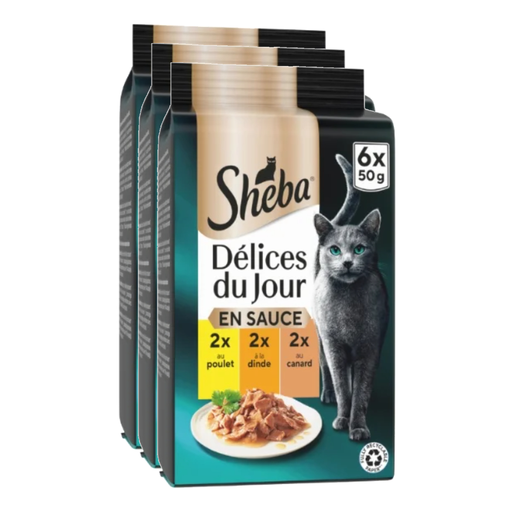
Why this choice suits this profile: The individual 50 g portions make it easy to control serving sizes and minimise leftovers in a household new to wet food.
This product is presented as complete wet food for adult cats and clearly states the daily quantities according to weight.
Three poultry recipes in gravy, packaged in 50 g pouches. The range states that it contains no artificial colourings, flavourings or preservatives.
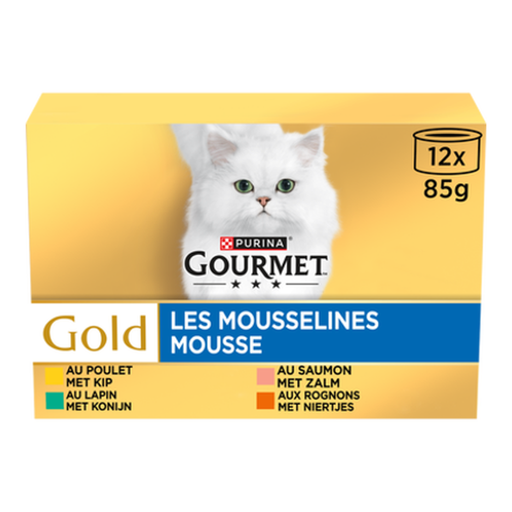
Why this choice suits this profile: Its mousse texture and chicken, salmon, kidney and rabbit recipes make it easy to vary meals for a cat that is sensitive to the consistency of its food.
Its status as complete food for adult cats is clearly stated. Each variety also specifies the highlighted ingredients and their proportion.
Twelve 85 g tins, a creamy texture and four flavours brought together in the same assortment.
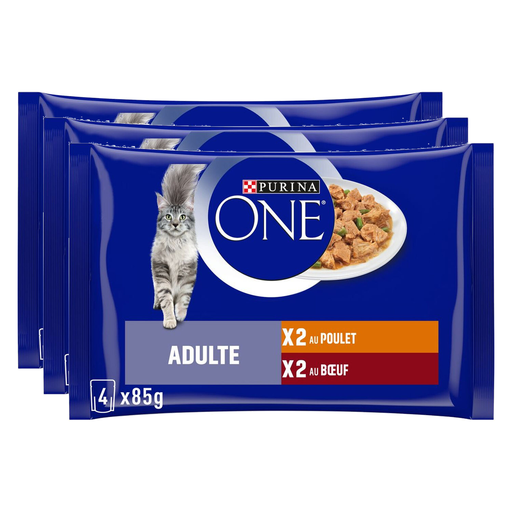
Why this choice suits this profile: The 85 g pouches fit easily into a daily routine, whether fed as wet food alone or as part of a mixed diet, in line with the brand’s recommendations.
The product information distinguishes between portions for an exclusively wet diet and those intended for a mixed diet, helping to prevent overfeeding.
Beef and chicken, plus beef and carrot recipes; 12 x 85 g pouches; 12% crude protein and 78% moisture according to the product information.
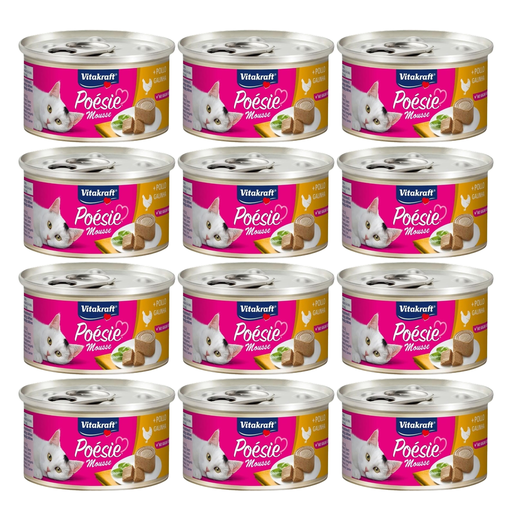
Why this choice suits this profile: This chicken mousse comes in 12 x 85 g tins, with a light texture and a recipe free from cereals and added sugar, according to the product information.
The product information specifies that this is complete food for adult cats, rather than a simple topping or treat.
1 020 g multipack, chicken mousse, 11% crude protein and 78% moisture stated.
We have put together a complete, real-time updated list of products that fully meet these strict selection criteria and European safety regulations.
After opening, place any remaining wet food in the fridge and follow the storage period shown on the packaging, generally 24 to 48 hours depending on the product. Serve it preferably at room temperature and always make sure fresh water is available.
When comparing prices, do not focus solely on the price of the tin. Calculate the cost per 100 g or per portion, then check how many meals the multipack can provide according to the feeding recommendations. A multipack of 48 x 85 g tins may prove worthwhile for everyday use, provided your cat genuinely enjoys the recipes and the best-before date allows for regular consumption.
The amount depends on weight, activity level, whether your cat has been neutered or spayed, and whether dry food is also included in its diet. The manufacturer’s guidance provides a basis for calculation, but portions should be adjusted to maintain a stable body condition.
Yes, provided both foods are included in a balanced daily ration. When adding pouches or tins, reduce the amount of dry food according to the packaging instructions. A gradual transition can also make it easier for your cat to accept the new diet.
Store any leftovers in the fridge and use them within the stated time, often between 24 and 48 hours. If there is an unusual smell, swollen packaging or a change in texture, it is best to throw the product away.