What should you check before buying?
Start with the materials you need to vacuum, then weigh up how often you’ll need to empty the tank, filter maintenance and the space you have available.
| Feature | What to check | Think about your needs |
|---|
| Suitable debris |
Check the instructions to see which liquids, dust and debris the vacuum can handle. If you need to pick up small rubble, check the tube and hose diameters too: Que Choisir distinguishes between narrow hoses for dust and wider models for rubble. |
I need to be able to pick up the debris from my DIY jobs without assuming that a model for everyday cleaning is also suitable for rubble or water. |
| Bag and filter |
Check that the bag is compatible with the model and suitable for wet or dry use. Read the filter care instructions: Bosch, for example, specifies that its paper bags compatible with the AdvancedVac 20 are for dry vacuuming. |
For mostly dry debris, I’d prefer a collection method that reduces handling when emptying the vacuum, while keeping in mind that bags need replacing. |
| Tool connection |
Check that the adaptor is compatible with your tool, whether the vacuum has a synchronised power socket, and how long the hose is. Bosch lists tool connection and synchronised start-up features for the AdvancedVac 20. |
If I’m sanding or drilling, I want to look into capturing dust while the tool is in use, rather than relying on a clean-up afterwards. |
| Tank and storage |
Compare the capacity with the amount of debris you expect to collect, then check the weight, dimensions and holders for the hose and accessories. Que Choisir notes that drum-style vacuums can take up a lot of space. |
A large tank appeals if I have a lot to pick up. If space is limited or I need to move the vacuum often, I’d choose a model that’s easier to store. |
Wet and dry vacuums on Joybuy
These two Vacmaster models are designed for wet and dry cleaning at home or in the garage. The VQ1220SC also lists a power tool socket. Before choosing, check that the models can handle the debris from your DIY work and have the connections you need.
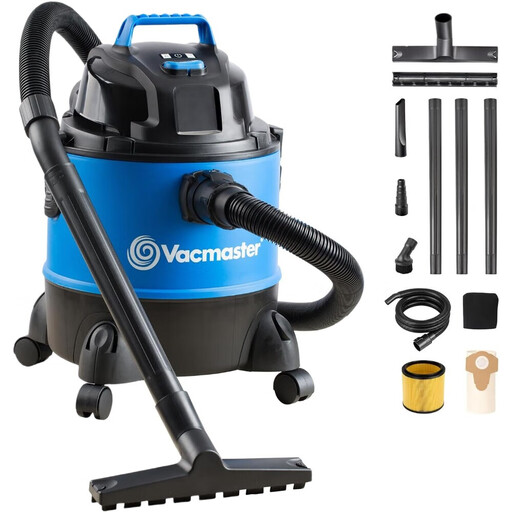 Image unavailable
Vacmaster VQ1220PF, 20 l wet and dry vacuum
Worth considering for wet and dry cleaning after DIY jobs, provided the instructions allow the debris you need to pick up. The model name lists a 1250 W motor, a claimed suction power of 200 AW and a blower function. In particular, check which debris it can handle and the set-up required for picking up liquids.
View on Joybuy
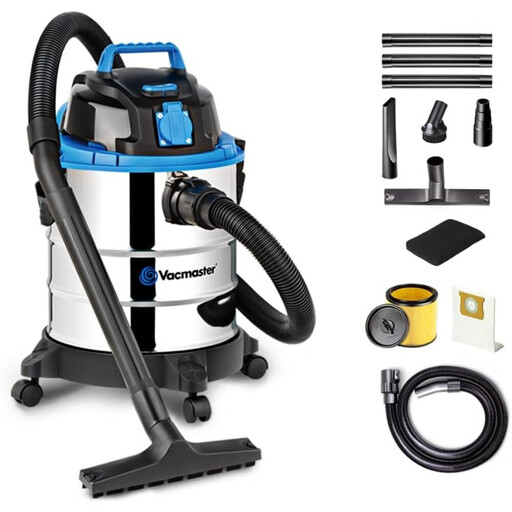 Image unavailable
Vacmaster VQ1220SC, 20 l wet and dry vacuum with power tool socket
Worth considering if you want to connect a tool while you work: the model name lists a 2430 W power tool socket. It also lists a 1250 W motor, claimed suction of 20 kPa, a blower function and a stainless steel tank. Before use, check that it connects to your tool, that it can handle the materials you need to pick up and that its filtration is suitable. Don’t assume it’s suitable for hazardous dust.
View on Joybuy
Frequently asked questions
Can you pick up water with any drum-style vacuum?
No. Only use a model whose instructions say it can pick up liquids, and follow the specified filter set-up. Bosch lists the AdvancedVac 20 for wet and dry vacuuming. STIHL offers a separate filter for regular liquid pick-up with some of its models.
Is a bag useful after sanding or drilling?
A compatible bag can make collecting dry debris easier, but it needs replacing and doesn’t make the vacuum suitable for every type of DIY dust. Bosch specifies that its paper bags compatible with the AdvancedVac 20 are for dry vacuuming.
Should you choose the biggest tank available?
No. A large tank can mean fewer trips to empty it when there’s a lot to pick up, but you also need to be able to move and store the vacuum. Que Choisir notes that drum-style vacuums take up space, so compare the capacity with the room you have available.
Is a domestic vacuum enough if a material may contain asbestos?
Don’t assume it is. The French ministry responsible for the environment says that drilling, sanding or cutting materials containing asbestos can release fibres. If you suspect a material contains asbestos, its identification and the appropriate preventive measures should guide what you do next, rather than buying an ordinary domestic wet and dry vacuum.
Is wattage enough to choose a model for fine dust?
No. Input power alone doesn’t tell you which materials the vacuum can handle, how effective its filtration is or how the filter performs as it becomes clogged. Check the instructions for the exact model, its accessories and filter care guidance. If the dust could be hazardous, first find out what risks the material poses.


