Homeowners after building work
You need to clear dust, small pieces of rubble and sometimes water or leaves, without using a household vacuum for jobs it wasn't designed for.


For non-hazardous waste containing a mix of dust, small pieces of rubble and possibly water, choose a wet and dry vacuum whose manual says it can handle the materials you need to collect. If the clean-up is a one-off and involves a large volume, compare hire options instead. Use a cylinder vacuum only for dry finishing tasks permitted by its manual. If the dust could be hazardous, particularly if asbestos or silica may be present, get advice on suitable precautions before cleaning.
You need to clear dust, small pieces of rubble and sometimes water or leaves, without using a household vacuum for jobs it wasn't designed for.
You want to connect a vacuum to a compatible tool to reduce the mess around your work area. This feature alone does not provide protection against hazardous dust.
You need a suitably sized tank for a one-off job, but may not want to store a bulky appliance afterwards.
First identify the waste and check the appliance's restrictions. Then choose between buying, using a cylinder vacuum for finishing touches or hiring, depending on how often you clean and how much there is to clear.
Consider one: for regular clean-ups involving dry waste and non-hazardous liquids that the model is approved to handle.
Bear in mind: the tank and accessories take up space between uses.
Keep it for: finishing touches on dry indoor surfaces, once building waste has been removed with suitable equipment.
Limitation: only the model's manual can confirm which dust it can handle. Don't use it for water or rubble unless the manual explicitly allows it.
Consider it: for a one-off clean-up that temporarily calls for a large tank, or if you don't want to store the appliance.
Bear in mind: collection or delivery, transport and local availability.
| Criterion | What to check | Who is this for? |
|---|---|---|
| Dry and wet waste | Check the model's manual for the materials and liquids it can handle, as well as instructions for the filter. | If dust, small pieces of rubble and water are all involved, I need an appliance approved for each type of waste. Around 33% of consumers put this versatility first. |
| Dust and tools | Check for a tool socket, connector compatibility and filtration guidance. If the dust may be hazardous, don't choose a standard consumer appliance. | After sanding or drilling, I want to keep ordinary dust around the tool to a minimum. Connecting tools and managing this dust are the priority for around 25% of consumers. |
| Tank and manoeuvrability | Compare capacity, weight, cable and hose length, emptying method and storage space required. | When cleaning several areas, I want a suitably sized tank without choosing an appliance that's too difficult to move or store. Around 25% of consumers prioritise this balance. |
| Occasional use | Assess the volume to be collected, any future needs and local collection or delivery arrangements. | If this major clean-up is a one-off, I'd rather look into hiring before making room for permanent storage. Avoiding a purchase for a one-off job comes first for around 17% of consumers. |
This description alone doesn't tell you which liquids, solids or filters are suitable for the model. INRS draws a distinction between different types of work, including tasks involving asbestos, for which a standard consumer vacuum is not suitable.
Identify where the waste comes from and read the manual for the exact appliance. If the dust could contain a hazardous substance, get advice on the necessary precautions before you continue.
A high capacity alone doesn't tell you how easy the appliance is to move, empty or store.
Also consider the weight, cable, hose, emptying method and dimensions in relation to your rooms and storage space.
A socket or adapter can make it easier to connect a compatible tool, but this feature doesn't prove that the vacuum is suitable for harmful dust.
Check tool compatibility and filtration guidance separately. If the material may be hazardous, don't base your choice solely on whether the appliance has a socket.
The models available and their capacities can vary by branch and location. A bulky appliance also needs to be transportable to the worksite.
Describe the waste and the volume to be collected, then confirm the model, its manual and the collection or delivery arrangements before booking.
The consumer range includes wet and dry vacuums designed for jobs such as building work and outdoor cleaning.
The DIY range includes wet and dry vacuums such as the AdvancedVac 20 and PAS20-220P.
The brand offers wet and dry vacuums for indoor, outdoor and workshop use.
These wet and dry models are worth considering if you're thinking of buying a wet and dry vacuum for regular clean-ups. Choose between them based on tank size, advertised features and the waste allowed by the model's manual.
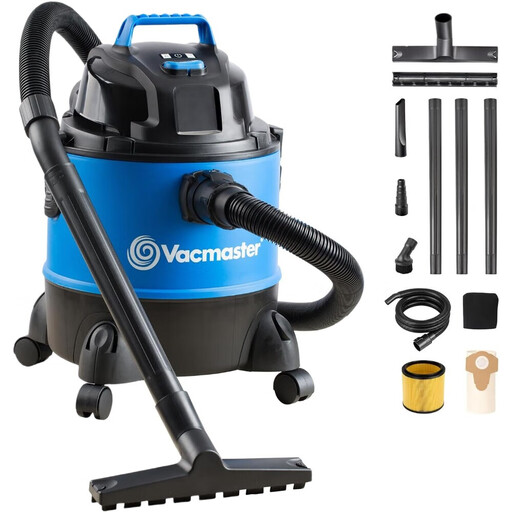 Image unavailable
Worth considering for regular clean-ups at home or in the garage, provided the model is approved for the waste you need to collect.
The product title lists a 1250 W motor, a 20 L tank and a blower function. Before vacuuming water, leaves or small pieces of rubble, check the manual for permitted materials and filter instructions.
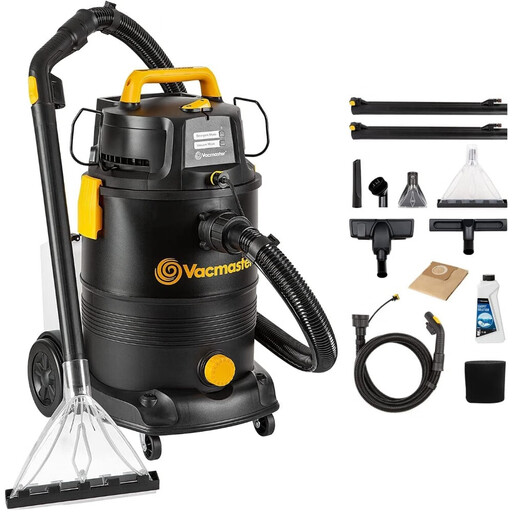 Image unavailable
Consider this model if you need a 30 L tank to clean several areas and have enough room to store the appliance.
The product title lists a power rating of 1300 W and a twin-tank design for cleaning floors and carpets. Check the manual for permitted waste and liquids, as well as the accessories suitable for your jobs.
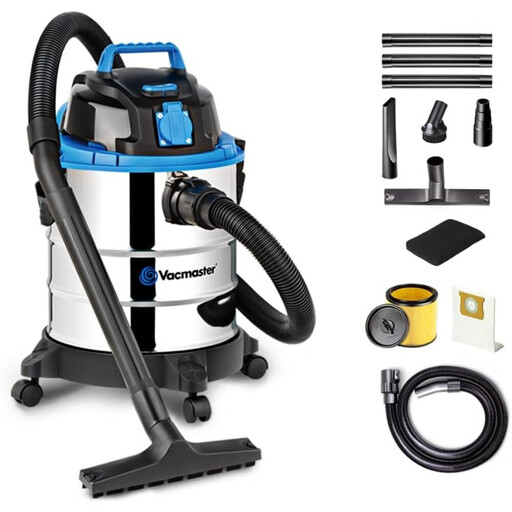 Image unavailable
Worth considering for a garage or workshop if you need to connect a power tool.
The product title lists a 1250 W motor, a 20 L tank, a tool socket and a blower function. Check that your tool is compatible and find out which filter is required for vacuuming liquids. The socket doesn't guarantee filtration suitable for hazardous dust.
Yes, if the model's manual allows the liquid in question and you follow its filter instructions. Kärcher France's product information for the WD 6 P S V-30/8/35/T and Bosch DIY France's information for the AdvancedVac 20 state that they can vacuum wet materials. This doesn't apply to every vacuum, particularly cylinder models.
A wet and dry vacuum is worth considering for this type of non-hazardous waste, provided its manual allows it. Que Choisir points out that a wider hose and tube can be useful for leaves and rubble, so check the diameter of the accessories on the model you choose too.
No. Don't assume that its wet and dry function means it's safe to clean up potentially hazardous materials. INRS sets out specific precautions for work on materials containing asbestos and refers to a Class H vacuum in relevant situations. Get the risk assessed and find out which method is suitable before starting any work.
Compare hire options if you have a one-off major clean-up, a large area or a temporarily high volume of waste to collect. Kiloutou, for example, offers machines with different capacities. Check locally which model is available, what waste it can handle and how transport is arranged.