To clear a mixture of non-hazardous dust, small debris and water after light DIY work, choose a wet and dry vacuum only if its instructions permit the materials in question. A cylinder vacuum is better suited to finishing floors once the debris has been removed. For a one-off, large-scale clean, hiring lets you use a larger tank without having to store it afterwards. In every case, check which waste materials are allowed, the accessories, the weight and the space available.
Who is this choice for?
You need to clear dry dirt and water
After light DIY work or clearing out a garage, cellar or empty property, you may have several types of residue to deal with. Make a list before choosing a machine: its instructions must permit it to vacuum both liquids and debris.
You’re short on storage space
If you only need to clean occasionally, a large tank can become awkward once the job is done. Compare its dimensions and weight, and check how the hose, tube and cable can be stored.
You have a one-off major clean to tackle
If you only need to carry out a large-scale clean once, it’s worth considering hiring before buying. Check which residues the equipment can handle, as well as the collection and transport arrangements.
What to consider when choosing
Wet and dry vacuum
Worth considering: if the clean-up involves non-hazardous dry residue and water, provided the instructions permit each material.
Bear in mind: the tank, weight and hose can make the machine harder to move and store.
Cylinder vacuum
Worth considering: for finishing floors, rugs and carpets after construction waste has been removed.
Limitation: don’t use it for water or rubble unless its instructions explicitly allow this.
Hire suitable equipment
Worth considering: for a one-off clean where the volume or area justifies using a large tank temporarily.
Plan for: collection, transport and how long you’ll need it. Hiring an ordinary wet and dry vacuum doesn’t make it suitable for hazardous dust.
After light DIY work, a clear-out or a move, start with what matters most to you: the materials to be cleared, ease of moving the machine, the finishing clean or the fact that you only need it once.
| Criterion |
What to check |
Who is this for? |
| Permitted waste and water |
Check the instructions for every material you plan to vacuum, and for the required set-up in wet mode. |
If I need to pick up dry debris and then spilled water, I want to know that the same machine is approved for both. Around 33% of consumers prioritise this mixed-cleaning requirement. |
| Capacity and storage |
Compare the tank capacity with the machine’s weight and dimensions, and the space needed to store the hose. |
In a home where every bit of space counts, I want a tank that I can move and store without difficulty. Around 25% of consumers prioritise this balance. |
| Finishing floors |
Choose accessories to suit the floors, rugs or crevices you’ll clean after removing the debris. |
Once the building-work residue has been cleared, my main priority is removing the remaining dust from everyday surfaces. This finishing clean comes first for around 25% of consumers. |
| One-off clean |
If you’re hiring, check the tank capacity, permitted materials, and collection and transport arrangements. |
For a single, large-scale clean, I’d rather consider a temporary solution than store a large machine. Around 17% of consumers prioritise this one-off requirement. |
Mistakes to avoid
-
Assuming a wet and dry vacuum can handle all types of waste
The materials a machine can handle depend on the model, filter and accessories. Hazardous dust, including dust containing silica, lead or asbestos, is not suitable for domestic cleaning with a general-purpose machine.
Identify the residue before choosing. If hazardous dust may be present, stop looking for a domestic machine and seek specialist equipment and procedures instead. INRS covers this type of dust in its guidance on industrial vacuum cleaners.
-
Choosing the largest tank without thinking about what happens afterwards
A large-capacity tank can mean fewer interruptions, but it also takes up more space and can make the machine harder to move.
Measure your storage space and check the weight, handle, and how the tube and cable are stored before settling on a capacity.
-
Forgetting about the hose and attachments
A hose that works well for fine dust may not be suitable for leaves or small pieces of rubble. Accessories also affect how easily you can reach crevices and clean floors.
Check the hose diameter and supplied attachments against the waste and surfaces you plan to clean.
-
Buying a large machine for a one-off job
Once the one-off clean is over, you’re still responsible for transporting and storing the machine. Hiring could be a better fit for a temporary need.
Before deciding, consider how long the clean will take, the collection arrangements for hired equipment and how much storage space you’ll have afterwards.
Brands to consider for different uses
Bosch Home & Garden
The AdvancedVac 20 and PAS20-220P vacuums are two models worth considering for wet and dry cleaning after light DIY work.
- According to Bosch DIY’s product information, both models can vacuum dry materials and liquids, and can be connected to power tools.
- These features apply to the models listed. Check the instructions for your chosen model to confirm which waste materials it can handle and what set-up is required.
Kärcher
The WD range includes wet and dry vacuums to consider depending on the residue you need to clear.
- Kärcher describes the WD 3 V-17/4/20 as suitable for dry, wet, fine or coarse dirt.
- This description applies to this specific model. Check the instructions and accessories for the version you’re considering.
Nilfisk
The ATTIX 751-0H EU is an example of a professional range, distinct from vacuums designed for light domestic cleaning.
- Nilfisk presents this model as a Class H vacuum for hazardous dust.
- This classification doesn’t apply to the brand’s other machines, and doesn’t remove the need for suitable procedures when hazardous dust is involved.
A wet and dry vacuum on Joybuy
This model fits the wet and dry vacuum option for the home, garage or workshop. Before considering it for building-work residue, check that its instructions specifically permit the materials you need to clear.
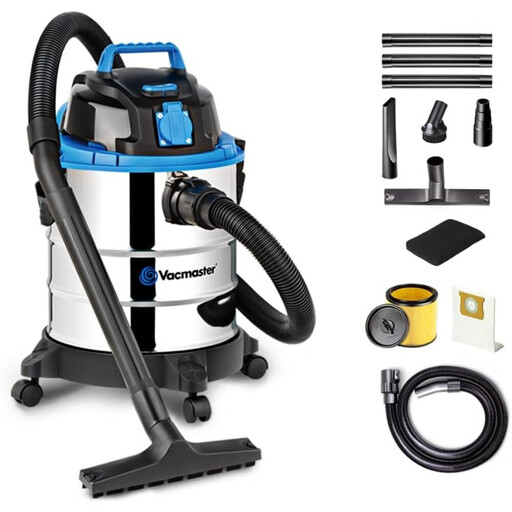 Image unavailable
Vacmaster VQ1220SC 20 L wet and dry vacuum cleaner
Worth considering for cleaning the home, garage or workshop when the waste you need to clear is permitted by the instructions.
The product title specifies a 20 L tank, a 1 250 W motor, a 2 430 W power tool socket and a blower function.
Before vacuuming liquids, check which filter is required and which liquids are permitted. Also clarify the instruction in the product description about indoor use and dry environments, and check the dimensions and accessories if transport or storage matters to you.
View on Joybuy
Frequently asked questions
Can I vacuum up water with any vacuum cleaner after moving house?
No. Use a model whose instructions permit liquids, and follow the specified set-up for wet vacuuming. Bosch DIY describes the AdvancedVac 20 as suitable for dry materials and liquids; this doesn’t apply to all vacuum cleaners.
Can a wet and dry vacuum pick up all types of rubble?
No. This depends on the rubble and the model. UFC-Que Choisir mentions using wet and dry vacuums for small pieces of rubble, but you should check the instructions for the model you’re considering. Hazardous dust requires a specialist solution.
What tank capacity should I choose after light DIY work?
Choose a capacity based on the volume you need to clear, how easy the machine is to move and the space you have for storage. UFC-Que Choisir says wet and dry vacuums often have tanks of more than 10 L; a larger capacity doesn’t guarantee that a machine can handle the waste in question.
Is hiring worthwhile for a one-off major clean?
It can be a good option if you only need a large tank occasionally and don’t want to keep it afterwards. Before booking, check which materials the machine can handle, its weight and the collection or delivery arrangements.
Can a cylinder vacuum replace a wet and dry vacuum after building work?
A cylinder vacuum can be used to finish floors and upholstery after the debris has been removed, but it isn’t automatically a substitute for a wet and dry vacuum when it comes to water or rubble. Only vacuum these materials with a cylinder vacuum if its instructions explicitly permit it.


