For ordinary debris left after small DIY jobs, consider a wet and dry vacuum whose instructions allow the materials in question, rather than using a household vacuum that is not designed for the job. Buying one makes more sense if you’ll need to clean up repeatedly and have room to store it; for a one-off, larger job, hiring is also worth considering. If the dust may come from a hazardous material, particularly one containing asbestos, don’t start cleaning it with a consumer vacuum.
Who is this choice for?
Households cleaning up different types of debris
After small DIY jobs, in a garage or on a patio, you may need to clear dust, small bits of rubble, leaves or water. UFC-Que Choisir describes these uses for drum vacuums; however, always check which materials are permitted in the instructions for the model you choose.
People using power tools
If you want to connect a vacuum while drilling or doing light sanding, check that the tool, adaptor and switched socket are compatible. Bosch DIY and Einhell offer these features on some of their models.
Households facing a one-off clean-up
If you may not use the vacuum again after a single job, storage space matters just as much as the amount you need to clean. Hiring a wet and dry vacuum is another option to consider.
How do the options compare?
Buy a wet and dry vacuum
Consider this: for repeated clean-ups after DIY jobs, when the debris is permitted according to the model’s instructions.
Bear in mind: the vacuum will take up space between uses.
Hire a wet and dry vacuum
Consider this: for a one-off job, particularly if the amount to be cleaned makes storing a large tank impractical.
Check first: local availability, permitted materials, and collection and return arrangements.
Keep using your household vacuum
Use it only: for household dust covered by its own instructions, after removing any unsuitable waste separately.
Limit: don’t assume it can handle water, small bits of rubble or other building waste.
To choose between these options, start with the materials you need to remove, then consider the volume and frequency of cleaning. If a material could be hazardous, identify the risk before choosing a vacuum.
| Criteria | What to check | Relevant to |
|---|
| Debris to vacuum |
Check the instructions for permitted materials and the required set-up for dry vacuuming or liquids. If the dust is suspicious, don’t assume a consumer model is suitable. |
I need to remove several types of ordinary debris without risking using a vacuum on a material it cannot handle. Compatibility would be the top priority for around 33% of consumers. |
| Capacity and storage |
Compare the tank capacity, hose reach and space needed to store the vacuum. |
I need a tank and reach suited to a large area, but I also need to be able to move and store the vacuum. Around 25% of consumers would prioritise this balance. |
| Tool and filtration |
Check that the socket and adaptor are compatible with your tool, and follow the filter care instructions. |
If DIY work produces dust, I want to connect my tool and maintain the filtration between uses. This would be the priority for around 25% of consumers. |
| Buy or hire |
Consider future uses and storage; if hiring, check the hire period, transport and permitted materials. |
For one big clean-up, I’d rather look into hiring before keeping a tank I’ll rarely use. Meeting this occasional need would come first for around 17% of consumers. |
Mistakes to avoid
-
Focusing only on electrical power
Power alone won’t tell you what waste the hose can handle, how much the tank holds or how far the vacuum can reach. UFC-Que Choisir also recommends considering the ducts, weight and storage.
Work out what debris and areas you need to clean, then compare the hose diameter, tank, reach and accessories.
-
Treating hazardous dust like ordinary debris
Asbestos fibres can be released when working on materials that contain asbestos, according to the ministries responsible for the ecological transition. A consumer wet and dry vacuum should not be treated as equipment designed for this hazard.
If you’re unsure where the dust came from, don’t start cleaning it. Have the material identified first and find out what precautions are appropriate.
-
Buying a large tank for a one-off job
Once the work is done, you’ll still need somewhere to store the vacuum. UFC-Que Choisir highlights how much space drum vacuums can take up.
Estimate how often you’ll need to clean in future and compare buying with the terms of hiring before choosing a capacity.
-
Using the same bag and filter for wet vacuuming
The set-up can differ between dry vacuuming and liquids. Bosch DIY, for example, says its replacement paper bag is designed for dry vacuuming.
Before vacuuming liquids, follow the instructions for the exact model on the bag, filter and emptying.
Brands to know
Bosch DIY
Bosch DIY presents the AdvancedVac 20 for wet and dry vacuuming and connection to a power tool.
- The manufacturer lists an adaptor, automatic start in sync with the tool and a drain valve.
- These features alone don’t make this model suitable for hazardous dust.
Nilfisk
In its Multi range, Nilfisk features the Multi II 30 T, with a 30 L tank and a 4 m hose.
- The manufacturer lists a filter cleaning indicator and a Push & Clean function.
- Nilfisk distinguishes its professional collectors for hazardous dust from its consumer Multi range. Don’t assume a feature of one range applies to the other.
Einhell
Einhell presents the TC-VC 3055 SA for use at home, in a workshop or in a garage.
- Its specifications list a 30 L stainless steel tank, a switched socket and a drain plug.
- Before switching between dry waste and liquids, check the instructions for the required bag and filter set-up.
Wet and dry vacuums on Joybuy
These two Vacmaster models are options to buy for vacuuming ordinary dry dirt and liquids at home, in a garage or in a workshop. For specific building waste, always check the uses permitted in the instructions.
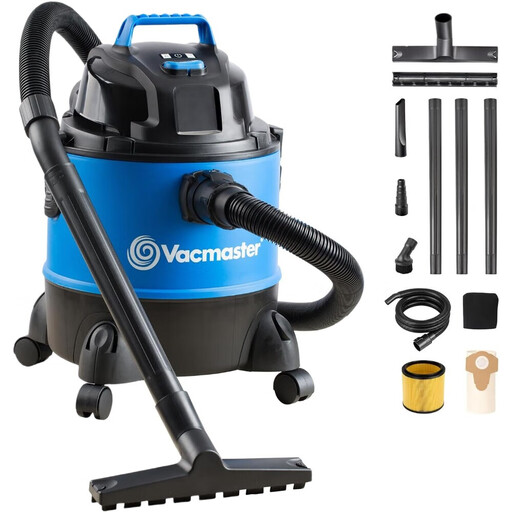 Image unavailable
Vacmaster VQ1220PF 3-in-1, 20 L tank
For ordinary dry dirt and liquids at home or in a garage, subject to the materials permitted in the instructions.
The product name specifies a 20 L tank, a 1,250 W motor, a stated suction power of 200 AW and a blower function.
Before vacuuming small bits of rubble, leaves or liquid, check which materials are permitted and how to configure the filter and bag. Don’t use it for dust suspected of containing asbestos or other hazardous dust.
View on Joybuy
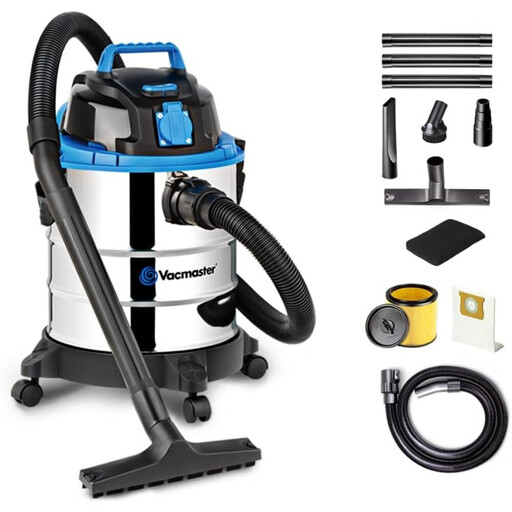 Image unavailable
Vacmaster VQ1220SC, 20 L stainless steel tank
For ordinary dry dirt and liquids at home, in a garage or in a workshop, subject to the uses permitted in the instructions.
The product name specifies a 1,250 W motor, stated suction of 20 kPa, a 2,430 W tool socket and a blower function.
Check that the socket is compatible with your tool, as well as which materials are permitted and which filter is needed for each use. Don’t use it for dust suspected of containing asbestos or other hazardous dust.
View on Joybuy
Frequently asked questions
Can I use a consumer wet and dry vacuum if I suspect asbestos?
No. Don’t attempt to clean it with a consumer model. The ministries responsible for the ecological transition state that asbestos fibres can be released when working on certain materials; the INRS refers to a class H vacuum for the operations concerned. Have the risk identified first and find out what precautions are appropriate.
Can a wet and dry vacuum pick up water from a patio?
Yes, if the model’s instructions allow that liquid and explain the required filter set-up and emptying procedure. Bosch DIY, for example, specifies liquid vacuuming and a drain valve for the AdvancedVac 20; this doesn’t apply to every vacuum.
When should I consider hiring rather than buying?
Consider hiring for a one-off clean-up if you don’t want to store the vacuum afterwards. Before deciding, compare the capacity on offer with the amount of debris you have and check the hire period, transport, accessories and permitted materials locally.
Is a switched socket enough to vacuum any sanding dust?
No. A switched socket synchronises a vacuum with a compatible tool, but doesn’t guarantee that the vacuum is suitable for every type of dust. Check the material and relevant guidance before choosing equipment; Nilfisk, for example, distinguishes specialist collectors for hazardous dust from consumer vacuums.


