How to choose
Start by identifying the waste, then choose a tank, hose and accessories suited to the area you need to clean. Hiring is worth considering when the job is a one-off but involves a very large volume of debris, or requires specialist equipment.
Domestic wet and dry vacuum
Consider it: for occasional cleaning after DIY or light renovation work involving clearly non-hazardous waste.
Bear in mind: a large tank takes up more space; check the accessories, hose diameter and storage requirements before buying.
Vacuum connected to a tool
Consider it: if you regularly sand, saw or plane materials identified as non-hazardous.
Bear in mind: the adaptor, hose and tool outlet must be compatible; an L-class vacuum is not suitable for suspected hazardous dust.
Hiring site equipment
Consider it: for a one-off job, a large volume of debris or a specialist appliance required for identified dust.
Bear in mind: check local availability, transport, the hire period and the required protective equipment.
| Priority |
What to check |
Your needs |
| Type of waste and level of risk |
Identify the material before cleaning. Check the filtration class, permitted materials, filters and bags required in the instructions for the exact model. Bosch presents L-class filtration for ordinary, non-harmful dust; the INRS associates H-class filtration with hazardous dust. |
I need to distinguish ordinary dust, small amounts of rubble and compatible liquids from unknown or potentially harmful dust before choosing or hiring an appliance. |
| Tank, hose and operating range |
Choose the tank capacity according to the volume of debris and water. For rubble or leaves, opt for a suitable hose diameter; also compare the combined cable and hose length for stairs, outdoor areas or a large room. |
I want to avoid repeated emptying, blockages caused by debris and unnecessary movement between sockets. |
| Connecting to a tool |
Check for a power tool socket, the connector diameter and whether the supplied or compatible adaptor is included. Filter cleaning can help when dust is produced repeatedly, but it does not change the appliance’s filtration class. |
When sanding or sawing non-hazardous materials, I want to capture dust close to the tool rather than after it has settled. |
| Weight, storage and hiring |
Check the weight, handles, cable and hose storage, as well as access to your garage, cellar or upper floor. When hiring, compare transport arrangements, the hire period and usable capacity. |
The format needs to be easy to move and store at home; for a major one-off clean-up, I may prefer to hire a suitable appliance. |
Joybuy products
Joybuy option for household cleaning after DIY, with dry or liquid waste and possible use around a workstation when working with materials identified as non-hazardous.
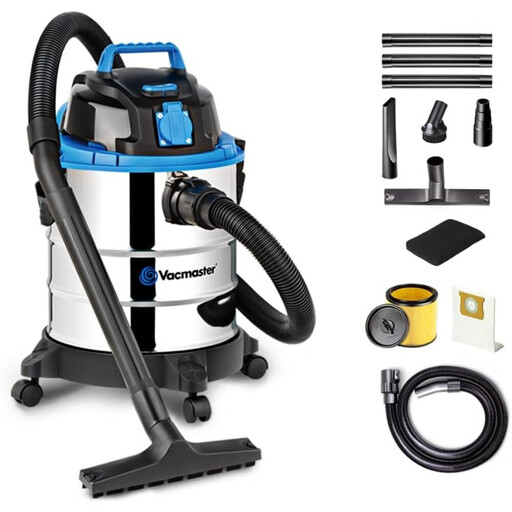 Image unavailable
Vacmaster VQ1220SC 20 L wet and dry vacuum
Suitable for cleaning after DIY at home, in the garage or workshop, handling non-hazardous dry or liquid waste.
20 L tank, 1,250 W motor, advertised suction of 20 kPa, 2,430 W power tool socket, blow function and stainless-steel tank.
Do not use with harmful dust. Before buying, check the hose diameter and length, the included nozzles, mechanical compatibility with your tool and the filter required for wet operation.
Joybuy
Frequently asked questions
Can a wet and dry vacuum collect small amounts of rubble and water after DIY work?
Yes, provided the exact model’s instructions allow it and the fitted accessories match dry or wet operation. Que Choisir and the model specifications consulted present these appliances for dust, water and small amounts of rubble; however, choose a hose with a diameter suitable for rubble or leaves.
Is an L-class vacuum sufficient for silica, lead or asbestos?
No, this should not be assumed. Bosch presents L-class filtration for ordinary, non-harmful dust, while the INRS associates H-class vacuums with hazardous dust such as silica, lead and asbestos. If the material is unknown or suspect, identify the risk before cleaning.
What should you do if an old material may contain asbestos?
Do not automatically choose a consumer vacuum as the solution. The French Ministry for Ecological Transition states that asbestos may still be present in many buildings and that exposure can occur during drilling, sanding or cutting. Follow the applicable preventive measures before carrying out any work.
When should you hire rather than buy?
Hiring may be suitable when the clean-up is a one-off, the volume of debris is substantial or specialist equipment is required. Check the hire period, transport, local hiring conditions and safety requirements before booking.
How should you maintain the filter after vacuuming a lot of dust?
Follow the instructions for the exact model and clean or replace the filter and bag according to the system provided. A saturation indicator or filter-cleaning function can help maintain suction, but it does not replace the filtration class required for a particular type of dust.


