After small jobs around the home, a wet and dry vacuum can handle ordinary dust, small pieces of rubble and accidental spills, provided the model and its accessories are designed for these uses. Choose the tank capacity, hose and size to suit the waste you need to collect and the space available. A tool-triggered socket may also be useful if you plan to connect a power tool. If the material is unknown or could contain asbestos, lead or another hazardous substance, stop before vacuuming and get the risk identified.
Who is this equipment for?
Occasional DIYers with a garage, cellar or patio
For collecting ordinary dust, leaves, small pieces of rubble or a little water after DIY, check the capacity without overlooking storage, weight and hose diameter. Que Choisir lists this type of waste among the uses for a wet and dry vacuum.
Power tool users
If you want to connect the vacuum while drilling or sanding materials that produce ordinary dust, look for a tool-triggered socket and check that the connection fits your tool. Bosch DIY and Kärcher offer these features on some models, but not across their entire ranges.
Anyone dealing with an old or unknown material
If the surface you’re working on could contain asbestos, lead or another hazardous substance, wait until the risk has been identified before choosing a domestic vacuum. The government departments responsible for the ecological transition point out that asbestos is still present in many buildings.
What should you check before choosing?
Start by identifying what you need to collect, then compare the model’s capacity, accessories and overall size with the jobs you have in mind.
| What to consider |
What to check |
Your needs |
| Waste and liquids |
Check that the instructions allow for the types of waste you need to collect and for vacuuming liquids. Check which nozzles are included and how to empty the tank. |
I need to collect ordinary dust or small pieces of rubble, and sometimes water: the “wet and dry” description must cover those specific uses. |
| Tank and manoeuvrability |
Compare the capacity with the amount you need to collect, then check the weight, handle, working radius and storage space required. |
For occasional cleaning, I’d rather have a vacuum that’s easy to move and store. After larger jobs, I want to avoid having to stop frequently to empty the tank. |
| Hose and attachments |
Check the diameter of the hose and tube, as well as the attachments included. Que Choisir recommends wider fittings for rubble or leaves. |
Leaves or small pieces of rubble need to pass through the hose; if I’m only dealing with ordinary dust, my needs may be different. |
| Filter and maintenance |
Check which types of dust the instructions allow, the part numbers for compatible bags and filters, and how to maintain them. A stated filtration class does not cover every material. |
I want to be able to maintain the vacuum after dusty jobs without assuming that a filter or bag from another range will fit. |
| Connecting a power tool |
If the model has a tool-triggered socket, also check the connection, diameter, adapter supplied and any limits specified for the tool. |
When I’m drilling or sanding a non-hazardous material, I want to connect my tool rather than only clean up after the job. |
| Suspect material |
Identify the material before vacuuming if it could contain a hazardous substance. The INRS sets out specific requirements for toxic or carcinogenic dust in workplaces; these do not certify a domestic vacuum. |
If I come across an old or unknown coating, I’ll stop before vacuuming and look for a solution suited to the identified risk. |
Which mistakes should you avoid?
-
Assuming “wet and dry” means “all types of dust”
A vacuum designed for ordinary household waste is not suitable for suspect materials. The government departments responsible for the ecological transition warn that buildings may contain asbestos; the INRS sets out separate workplace requirements for dust that may contain toxic or carcinogenic substances.
If the material is old or unknown, don’t vacuum it until you’ve identified the risk and the right way to deal with it.
-
Choosing based only on tank size or stated power
According to Que Choisir, hose diameter, weight and working radius also matter when choosing a wet and dry vacuum. A larger tank alone won’t solve problems with debris passing through the hose or finding space to store the vacuum.
Before comparing models, make a list of the waste you need to collect, the distance to the socket, how far you’ll need to move the vacuum and where you’ll store it.
-
Forgetting about bags and filters
Que Choisir warns about very fine particles in vacuums that aren’t designed to handle them. Maintenance depends on the filter and the model’s instructions; the Nilfisk Multi II 22, for example, has a filter-cleaning indicator.
Note down the exact part numbers for compatible consumables and follow the maintenance instructions in the manual.
Depending on the model and how you use it, you may need to buy compatible bags, filters or accessories later.
-
Assuming a tool-triggered socket will connect to every power tool
A socket that switches the vacuum on and off, and a compatible connection, are two separate considerations. Bosch DIY describes synchronised start-up on the AdvancedVac 20, while the stated connection options for its Home & Garden tools apply to that range.
Check the diameter, the adapter supplied and the limits set out in the instructions for both the vacuum and your specific tool.
Which brand ranges should you look at?
These range examples can help you identify features to compare, but always check that they’re available on the model you’re considering.
Kärcher
The WD range includes wet and dry vacuums for a variety of domestic uses.
- Kärcher recommends its WD 5 and WD 6 for renovation work, and lists a large tank, blower function, filter cleaning and a tool-triggered socket among their features.
- Check the accessories and connection options for the specific model you choose: this is the brand’s description, not the result of a comparative test.
Bosch DIY
The Home & Garden wet and dry vacuum range includes models designed for DIY.
- According to Bosch DIY, the AdvancedVac 20 switches on and off in sync with the power tool being used.
- The stated adapter compatibility applies to specific Bosch Home & Garden tools; check your tool and what’s included with the model you choose.
Nilfisk
The Multi II range is designed to collect waste both indoors and outdoors.
- Nilfisk says the Multi II 22 has an indicator that tells you when to clean or replace the filter.
- Check which bags, filters and accessories fit the specific model you’re considering rather than assuming the whole range has the same configuration.
Einhell
The range includes wet and dry vacuums with different features, depending on the model.
- Einhell states that the TE-VC 2350 SACL has L-class filtration, with an indication relating to particles for which the workplace exposure limit (WEL) is above 1 mg/m³.
- This model-specific feature does not mean the vacuum is suitable for the suspect or hazardous materials excluded here.
A Joybuy option for small jobs
This model may suit you if you’re looking for a wet and dry vacuum to clean a garage or workshop after small, non-hazardous jobs around the home. Check the conditions of use before using it with liquids or a power tool.
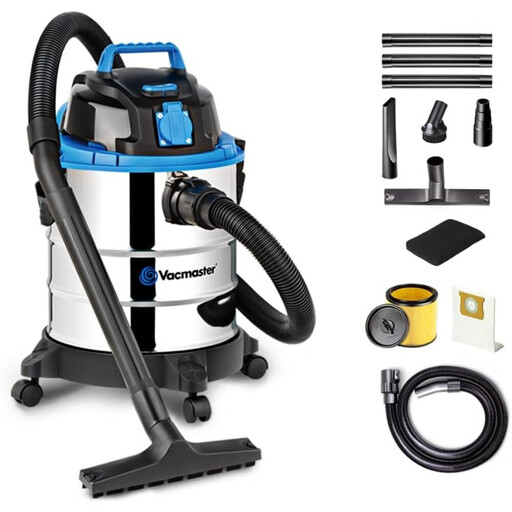 Image unavailable
Vacmaster VQ1220SC, 20 L wet and dry vacuum
Designed for cleaning a garage or workshop after small, non-hazardous jobs, this model is listed with a 20 L tank, a 1250 W motor and a blower function.
The product title lists 20 kPa suction and a 2430 W tool socket. Before connecting your tool, check the adapter and make sure both devices are compatible. Also check the filter, bags and accessories needed for the dust you’re collecting.
The product description limits use to indoors and excludes harmful dust. It refers to both wet vacuuming and a dry environment, so check the manual for the exact conditions for vacuuming liquids.
View on Joybuy
Frequently asked questions
Is a wet and dry vacuum suitable for cleaning up after a small building job?
Yes, for ordinary dust, small pieces of rubble or a little water, if the model’s instructions allow these uses. Que Choisir lists this type of waste among the uses for a wet and dry vacuum. Also check the hose, accessories and storage space required for the appliance.
Which hose should I choose for rubble or leaves?
Que Choisir recommends a wider tube and hose for rubble or leaves. Compare their diameter and the attachments included with the waste from your DIY jobs rather than choosing based only on tank capacity.
Do I need a particular bag and filter?
Check the vacuum’s manual to find out which bags and filters to use for the types of dust the model is designed to handle. Note down the exact model reference before choosing consumables, and follow the instructions for cleaning or replacing the filter.
Can you vacuum plaster or sawdust with any appliance?
No. Que Choisir advises against collecting these very fine particles with a vacuum that isn’t designed for them. Check which materials the manual specifically allows, and which filter and bag are required. This check does not make the appliance suitable for hazardous dust.
What should you do if the material could contain asbestos or lead?
Don’t use a domestic wet and dry vacuum on the material until you’ve identified the risk and found a suitable solution. The government departments responsible for the ecological transition point out that asbestos may still be present in buildings; the INRS sets out specific workplace requirements for dust that may contain toxic or carcinogenic substances. A large tank or a stated filtration class isn’t enough to determine what you should do for your project.


