To clear ordinary dust, small pieces of rubble, leaves or small amounts of water after DIY projects at home, choose a wet-and-dry vacuum suited to the waste you need to collect, rather than one designed for everyday cleaning. First check the hose and attachments, then the capacity, reach and storage requirements. If you want to vacuum while you work, also check that it can connect to your tool. Suspect materials, hazardous dust and hot ashes require a separate assessment before you vacuum them.
Who is this advice for?
For cleaning up after DIY
After drilling or doing light work in a room, workshop or garage, you may need to clear ordinary dust and small bits of debris. Que Choisir recommends considering the type of waste, the hose and the capacity of a wet-and-dry vacuum, rather than looking at its stated power alone.
For looking after a patio or garden
If you need to collect leaves, outdoor dirt or a little water, check that the model is suitable for each type of waste. The distance to the socket, ease of moving the vacuum and available storage space also matter.
For vacuuming while using a tool
If you want to collect dust while drilling or sanding, look for a connector that fits your tool and, if needed, automatic tool-activated start-up. Bosch DIY lists these features for the AdvancedVac 20; check that they are available on the model you’re considering.
Which features should you check?
Start with the type of waste you need to collect: this will determine which hose, attachments and precautions to check. Then compare the capacity and ease of moving the vacuum, based on where you’ll be cleaning.
| Feature |
What to check |
Who is it for? |
| Dust and small pieces of rubble |
Match the hose diameter to the debris, and check the attachments and filter-cleaning requirements. |
After light DIY, I want to clear ordinary dust and small pieces of rubble without choosing an unsuitable hose. Around 33% of consumers would prioritise this type of collection. |
| Water and capacity |
Check the model’s manual to confirm it can handle wet vacuuming, then look at the tank capacity and how it empties. |
If my cleaning involves water or wet dirt, I want to be able to empty the tank easily. Around 27% of consumers would prioritise handling liquids. |
| Connecting to a tool |
Check that the connector fits and that automatic tool-activated start-up is available if you need it. |
When I’m drilling or sanding, I’d rather collect the dust as I work than clean it all up afterwards. Around 20% of consumers would put this type of connection first. |
| Outdoor use and storage |
Compare the cable and hose lengths, the weight you’ll need to carry and the space required for storage. |
To clean a patio or reach a corner of the garage, I need to be able to move the vacuum and then store it away. Around 20% of consumers would prioritise portability and compactness. |
Which mistakes should you avoid?
-
Choosing based on wattage alone
Power consumption alone won’t tell you whether the hose, filter and attachments are suitable for the waste you need to collect. Que Choisir distinguishes, for example, between the needs of ordinary fine dust and those of rubble and leaves.
Identify the main type of waste before comparing the hose diameter, tank and filter-cleaning method.
-
Assuming “wet and dry” means it can handle every type of residue
You shouldn’t assume that a domestic wet-and-dry vacuum is suitable for suspect materials. The French ministries responsible for the ecological transition warn that drilling, sanding or cutting material containing asbestos can release fibres. INRS also notes that concrete and mortar may contain crystalline silica.
If you’re unsure about a material’s composition, identify the risk and find out which procedure is appropriate before cleaning up the residue. Don’t use a vacuum chosen for everyday cleaning to collect hot ashes.
-
Overlooking the tank and how it empties
A tank suitable for dry debris doesn’t necessarily mean that a model can handle liquids or will be easy to empty. Bosch DIY, for example, lists a drain valve on the AdvancedVac 20.
If you expect to collect water, check that wet vacuuming is permitted, and review the capacity and emptying instructions for the exact model.
-
Forgetting about the route and storage space
A canister vacuum takes up space and needs to reach the area you want to clean. According to Que Choisir, weight and overall size vary from model to model.
Measure the distance from the socket and the space where you’ll store the vacuum. Also compare the cable and hose lengths.
Brands to know for these tasks
Kärcher
Kärcher offers wet-and-dry vacuums for DIY projects at home, as well as professional models with different specifications.
- According to Kärcher France, the WD 3 S V-19/4/20 has a 19 L tank, a 4 m cable and a 2 m hose. The manufacturer says it can vacuum dry dirt and small amounts of water without changing the filter.
- The NT 30/1 Ap L belongs to a different range. Its stated Class L filtration and filter-cleaning system should not be attributed to the WD 3 or to all hazardous materials.
Bosch DIY
The AdvancedVac 20 is worth considering if connecting to a power tool is part of how you’ll use your vacuum.
- Bosch DIY lists an adapter, automatic start and stop in sync with the tool, and a drain valve for this model.
- Check that the adapter fits your tool. These features don’t prove that the vacuum is suitable for hazardous dust.
Nilfisk
The Multi II 22 Inox is a wet-and-dry vacuum to consider for the home, workshop or outdoors if tank capacity is an important factor.
- Nilfisk lists a 22 L tank, a 1 200 W motor and an indicator that tells you when to clean or replace the filter for this model.
- These specifications apply to the Multi II 22 Inox. Check which types of waste and attachments are suitable for the model you’re considering.
Wet-and-dry vacuums for DIY projects on Joybuy
These two Vacmaster wet-and-dry vacuums are suited to cleaning at home, in the garage or in a workshop. Before choosing one for water, rubble or connecting to a tool, check the instructions and set-up for the specific model.
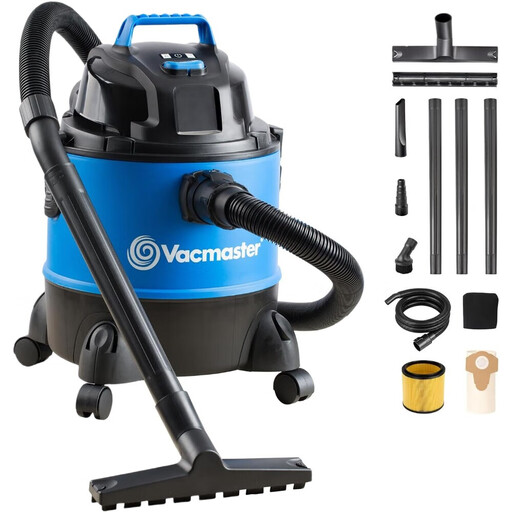 Image unavailable
Vacmaster VQ1220PF, 20 L wet-and-dry vacuum
For cleaning your home or garage after small DIY projects, if you’re looking for a canister vacuum described as suitable for dry and wet waste.
The product name lists a 20 L tank, a 1 250 W motor and a blower function. Before vacuuming rubble, leaves or specific fine dust, check which types of waste are permitted, as well as the hose and filter instructions in the manual.
View on Joybuy
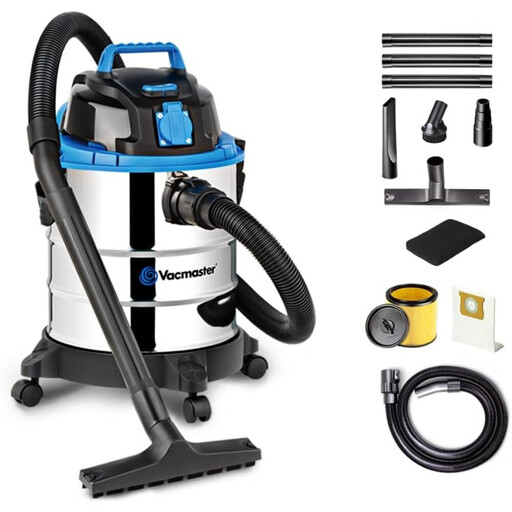 Image unavailable
Vacmaster VQ1220SC, 20 L vacuum
Worth considering for dry cleaning after DIY in a workshop or garage.
The product name lists a 20 L tank and a 1 250 W motor. If you plan to vacuum water, connect a tool or use the blower function, check the manual and set-up for the VQ1220SC before buying: the information available about these uses isn’t consistent.
View on Joybuy
Frequently asked questions
Can you vacuum water and dust without changing the filter?
Yes, on some models where the manufacturer specifies that this is possible, but not automatically on every wet-and-dry vacuum. Bosch DIY states this for the AdvancedVac 20, and Kärcher France for the WD 3 S V-19/4/20. Check the manual for your model for details on the bag, liquid level and care after wet vacuuming.
Which hose should you choose for rubble or leaves?
If small pieces of rubble or leaves are the main type of waste, look for a tube and hose wide enough for them to pass through. Que Choisir distinguishes this from the needs of ordinary fine dust, for which a narrower diameter may be enough. Also check which types of waste the manufacturer permits.
Is an ordinary canister vacuum suitable for concrete or mortar dust?
Don’t assume that it is: the right choice depends on the material, the dust produced and the uses specifically approved for the vacuum. INRS notes that concrete and mortar may contain crystalline silica. If this type of dust is involved, have a suitable prevention and extraction method determined rather than relying on the words “wet and dry” alone.
Can you vacuum debris from material that may contain asbestos?
Don’t choose a domestic canister vacuum for this. The French ministries responsible for the ecological transition warn that drilling, sanding or cutting materials containing asbestos can release fibres. Have the risk identified and a specialist procedure put in place before carrying out any work or vacuuming.


