For dust, small pieces of rubble, leaves or water after light DIY work, start by choosing a wet and dry vacuum designed for the waste you need to collect. Then compare the tank capacity, emptying system, hose, accessories and storage requirements. Hazardous dust, such as asbestos, silica or lead, requires a suitable solution and is outside the scope of this guide.
Who is a wet and dry vacuum suitable for?
Occasional DIYer after small jobs
You need to remove dust, shavings, small pieces of rubble or water after drilling, light sanding, assembly or home improvement work. Wet and dry versatility, tank capacity, filtration and the option to connect the vacuum to a tool are therefore key considerations.
Homeowner with a patio, garage or garden
You may sometimes need to clear leaves, outdoor dirt, spilled water or debris from your car and workshop. A blower function, suitable accessories and a format that is easy to store can matter just as much as capacity.
User dealing with a lot of non-hazardous fine dust
You want to reduce interruptions caused by the filter and use a compatible bag for dry dust. This situation excludes hazardous dust such as asbestos, lead or silica.
What to prioritise when choosing your vacuum
Start by identifying the waste you need to collect, then choose the tank, filtration and overall size to match how often you actually clean.
| Priority |
What to check |
Your needs |
| Dry, wet and coarse waste |
Check that the specifications cover the collection of liquids and dry waste. Review the instructions for any restrictions concerning the filter, bag and changeover from dry to wet use. |
I want to collect water, sawdust or DIY dirt without using a standard household vacuum for a job it is not designed to handle. |
| Tank and emptying |
Compare the capacity with the amount of debris to be collected. For liquids, look for a drain plug or valve, and consider how heavy a full tank will be. |
Repeated cleaning, rubble or a large volume of water calls for a tank capacity that matches the number of times I am prepared to empty it. |
| Fine dust and filtration |
Check the filter type, how it is cleaned or unclogged, and whether compatible bags are available. Follow the model’s instructions for dry dust. |
After light sanding or sawing, I want to be able to maintain the filter and empty the appliance while minimising contact with dirt. |
| Working range and storage |
Compare the cable and hose lengths, accessory storage, capacity and weight. Measure the intended storage space before choosing a large tank. |
I need to reach a garage, workshop or patio, then store the appliance without taking up unnecessary space in my home. |
Mistakes to avoid before buying
-
Using a standard household vacuum for DIY debris
Nilfisk states that gravel, sawdust, screws and glass can damage a standard vacuum cleaner. Water and DIY waste also require an appliance designed specifically for these uses.
For coarse dry waste or liquids, choose a suitable wet and dry vacuum. Keep your household cylinder vacuum for compatible dry-finishing tasks.
-
Choosing a large tank without planning for storage or movement
A 25 to 30 L tank means fewer emptying breaks when dealing with large volumes, but it takes up more space and may be harder to move.
Measure your storage space and compare capacity, cable length, hose, weight and storage fittings. For genuinely occasional small-scale cleaning, a more compact format may be more practical.
-
Treating the blower function as an indoor dust-removal solution
The blower can clear leaves or dirt from a corner, but it moves particles around before they are collected and may put them back into the air.
Use it mainly outdoors or for controlled preliminary clearing. For fine dust, prioritise vacuuming with a well-maintained filter, and never use it for potentially hazardous dust.
-
Neglecting filter maintenance when dealing with fine dust
A clogged filter reduces suction. A historical review published by Fnac of an older Kärcher WD 6 Premium mentions rapid clogging when collecting plasterboard dust.
Before buying, check the cleaning procedure, filter type, compatible bags and instructions for switching between dry and wet vacuuming.
Wet and dry vacuum brands at a glance
Kärcher
The Home & Garden range includes wet and dry vacuums for occasional use, as well as WD 5 and WD 6 models designed for larger volumes of debris.
- Kärcher lists 25 L and 30 L tanks on certain WD 5 and WD 6 models designed for large amounts of residue or dust.
- The WD 6 P S V-30/8/35/T is presented with a 30 L tank, drain, filter bag and power-tool socket.
- Volume, weight and storage space should be compared with how often you actually carry out DIY work.
Bosch DIY
Bosch DIY offers wet and dry vacuums for DIY and household cleaning, including the AdvancedVac 20 for small- to medium-sized projects.
- Bosch presents the AdvancedVac 20 as suitable for dry and wet materials, with a drain valve and blower function.
- A universal adapter for power tools and storage fittings are listed for this model.
- Check the adapter diameter and compatibility with the tool you own.
Nilfisk
Nilfisk’s wet and dry range includes small tanks for the home and garage, as well as larger formats offering greater capacity.
- Nilfisk describes uses including liquids, dry debris, leaves, sawdust and gravel, as well as garage, workshop and garden cleaning.
- The brand offers models from 8 to 16 L, along with others from 22 to 30 L, depending on your capacity requirements.
- Accessories, filtration and bag use vary by model: check the exact product specifications.
Joybuy products for wet and dry cleaning after DIY work
Joybuy option suitable for wet and dry cleaning at home, in a garage or workshop after light DIY work.
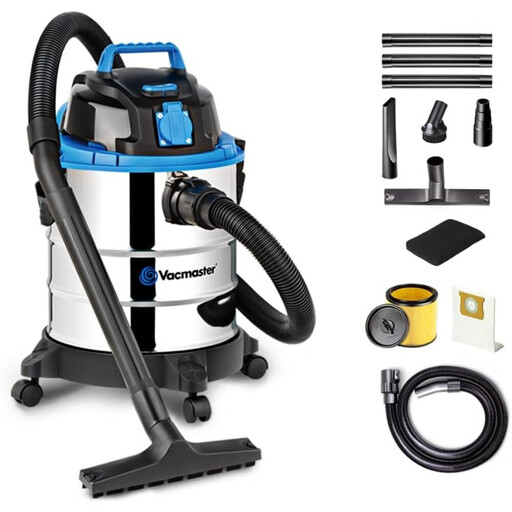 Image unavailable
Vacmaster VQ1220SC 20 L wet and dry vacuum cleaner
This model is advertised for wet and dry cleaning at home, in a garage or workshop after occasional DIY work.
20 L stainless-steel tank, 1250 W motor, blower function and socket for power tools up to 2430 W.
The instructions specify indoor use in a dry environment, so check whether it is suitable for an exposed patio. The product description excludes harmful dust; before buying, also check the filter, consumables and procedure recommended for fine dust.
Joybuy
Frequently asked questions
Can you vacuum up water with a wet and dry vacuum?
Yes, but only if the product specifications and instructions explicitly state that the model can collect liquids. For larger volumes, a drain plug or valve makes emptying easier. Follow the model-specific guidance for bags and filters.
Can you vacuum up plaster dust directly after sanding?
For small amounts of non-hazardous fine dust, first check the filtration, compatible bag and filter-cleaning system. A historical review of an older Kärcher WD 6 Premium reports that the filter quickly became blocked with plasterboard dust, so compare the required maintenance as well as the stated power.
Is a domestic wet and dry vacuum suitable for asbestos, lead or silica?
No. The INRS covers Class H vacuums under the NF EN 60335-2-69 standard for hazardous dust such as silica, lead and asbestos. A consumer-grade wet and dry vacuum should not be used for these risks. If you are unsure about the material, stop cleaning and seek a competent assessment.
Must the repairability index be displayed for a vacuum cleaner sold in France?
Yes. The French Ministry of the Economy states that the repairability index is compulsory for vacuum cleaners sold in France. Compare it across models, along with the availability of bags, filters and spare parts.
When is a domestic cylinder vacuum still useful after DIY work?
It remains useful for suitable dry-finishing tasks once rubble, shavings, water and large debris have been removed. Nilfisk states that gravel, sawdust, screws and glass can damage a standard vacuum cleaner.


