For light DIY jobs or cleaning a patio, choose a wet and dry vacuum cleaner based on the types of waste it is designed to collect. If you need to vacuum up water, the product must explicitly state that it can handle both wet and dry debris. Then check the filter, accessories, working radius and storage requirements. The blower function can clear leaves, but it won’t collect them. For tasks that create dust which may contain toxic or carcinogenic substances, the INRS says that class H machines are required. Don’t assume a domestic model is suitable.
Who is a wet and dry vacuum cleaner for?
DIYers tidying up after light jobs
After drilling, sanding or assembling something, you may need to collect dust, shavings or small pieces of rubble. If you want to connect the vacuum cleaner to a power tool, check that it has a tool-trigger socket and that the adaptor is compatible with your tool.
Anyone cleaning a garage or patio
To clear leaves, dust or damp dirt, check which types of waste the model can handle, as well as its accessories and hose length. The blower function can help clear awkward corners, but it won’t collect the debris for you.
Occasional users with limited storage space
If you’ll use the machine between DIY jobs or after a house move, its weight, dimensions and cable and accessory storage are just as important as the tank capacity.
What should you check before buying?
Start with the type of waste you need to collect. A cylinder vacuum designed for household dust shouldn’t be assumed to handle water or small pieces of rubble. With a wet and dry vacuum cleaner, wet pickup, blowing and connecting to a power tool are separate functions, so check which ones are available on the model you’re considering.
| Criteria | What to check | Who it matters to |
|---|
| Water and damp dirt |
Check that the model is designed for wet and dry pickup, and confirm the required filter and emptying instructions. |
After cleaning my garage or patio, I want to be able to collect damp dirt too, without assuming that every wet and dry vacuum cleaner can handle water; around 33% of consumers make this a priority. |
| DIY dust |
Check that the connector and tool-trigger socket are suitable for your power tool, and find out what requirements apply to the dust it produces. |
When I’m drilling or sanding, I want to know whether I can connect my tool and collect the dust as I work; around 27% of consumers put this need first. |
| Leaves and awkward corners |
Check for a blower function and accessories suited to the areas you need to clean. |
On my patio or in my garage, I may need to clear leaves or reach awkward corners before collecting the debris; around 20% of consumers prioritise this use. |
| Moving and storage |
Compare the weight, dimensions and tank capacity, and check how the cable and accessories are stored. |
For occasional cleaning, I want to be able to move the machine and find a place to store it between uses; this is a priority for around 20% of consumers. |
Mistakes to avoid
-
Assuming every tank can handle water
The shape of the machine doesn’t tell you whether it’s suitable for liquids. Kärcher, for example, describes the WD 3 S V-19/4/20 as suitable for small amounts of water.
Before buying, check the model’s stated wet-use capabilities, the filter required and the emptying instructions.
-
Leaving a paper bag in when vacuuming liquids
Bosch DIY France specifies that the relevant paper bags are for dry vacuuming only. Their presence doesn’t mean they’re suitable for water.
For wet vacuuming, follow the instructions for your model and consumables, including guidance on the bag and filter.
-
Treating hazardous dust like ordinary debris
You can’t tell what precautions are needed just by how fine dust looks. The INRS says that tasks producing dust which may contain toxic or carcinogenic substances require class H machines.
If your work could produce this type of dust, first establish the prevention procedure and equipment required. Don’t simply use a domestic wet and dry vacuum cleaner.
-
Choosing based on tank capacity alone
A larger capacity doesn’t tell you how easy it will be to reach your work area or put the machine away afterwards.
Also compare the hose and cable lengths, weight, dimensions and built-in storage.
Brands to know for these jobs
Bosch DIY
The range includes wet and dry vacuum cleaners for the home and DIY, with features that vary by model.
- For the PAS20-220P, Bosch DIY France lists a flat pleated filter that can be used for dust and liquids without changing the filter, along with an adaptor and a power tool socket.
- The relevant Bosch paper bags are designed for dry vacuuming. Check the instructions for your specific model before switching to wet vacuuming.
Kärcher
The WD/KWD range includes models for DIY around the home, garage cleaning and some outdoor tasks.
- Kärcher France lists a 19 l tank, blower function and built-in storage for the WD 3 S V-19/4/20.
- The product description mentions small amounts of water. Check the instructions before using it for a clean-up involving more liquid.
Nilfisk
The Multi wet and dry range includes models for the home, workshop and garage.
- For the Multi II 30 T, Nilfisk France lists a 30 l tank, a 4 m hose and Push & Clean semi-automatic filter cleaning.
- These features don’t mean that the model is suitable for hazardous dust.
A Joybuy model for the garage or workshop
For cleaning a garage or workshop, this model combines wet and dry vacuuming, a blower function and a socket for power tools. Check that the types of waste from your jobs are among its approved uses.
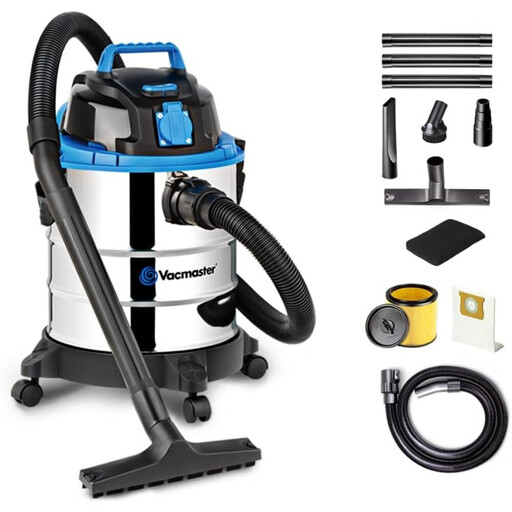 Image unavailable
Vacmaster VQ1220SC 20 L wet and dry vacuum cleaner
Designed for the garage or workshop, this model offers wet and dry vacuuming, a blower function and a socket for power tools.
It has a 20 L tank and a stated motor power of 1 250 W. Before vacuuming liquids, check the filter and how it is fitted. Also check the tank material for the variant you choose.
The product information advises against vacuuming harmful dust.
View on Joybuy
Frequently asked questions
Can you vacuum up water with any wet and dry vacuum cleaner?
No. Only do so if the model states that it can handle liquids, and follow its filter instructions. For the Kärcher WD 3 S V-19/4/20, Kärcher France specifically mentions small amounts of water.
Do you need to change the filter when switching from dry to wet vacuuming?
Not necessarily. It depends on the model and its filter. Bosch DIY France says the AdvancedVac 20 can be used for wet and dry vacuuming without changing the filter. Check the manual before assuming the same applies to another machine.
Can you use a paper bag to vacuum up water?
Not the Bosch paper bags mentioned here: Bosch DIY France states that they’re for dry vacuuming only. For any other consumable, check the bag and vacuum cleaner instructions before vacuuming liquids.
Is a domestic wet and dry vacuum cleaner suitable for hazardous dust?
Don’t assume it is. The INRS says that tasks producing dust which may contain toxic or carcinogenic substances require class H machines. Establish the relevant prevention procedure before choosing your equipment.
What should you maintain after cleaning up after DIY?
Empty the tank and check the filter according to the manufacturer’s instructions, taking into account the type of waste collected. For the Multi II 30 T, Nilfisk France lists a filter-cleaning indicator and the semi-automatic Push & Clean filter function.


