After small DIY jobs
If you’re cleaning a workshop, garage or refurbished room, distinguish between ordinary dust, shavings and small pieces of rubble. A tool connection and filter maintenance matter most when you vacuum regularly during DIY work.


A wet and dry drum vacuum is a good choice for post-work cleaning involving water, small pieces of rubble or leaves, provided the model’s specifications confirm it can handle the waste in question. Then choose the capacity, hose and accessories to suit the amount you need to collect. If you plan to use it with a power tool, check for a tool-activated socket and find out how to maintain the filter. If you suspect the dust may be hazardous, don’t assume that a versatile domestic vacuum will be suitable.
If you’re cleaning a workshop, garage or refurbished room, distinguish between ordinary dust, shavings and small pieces of rubble. A tool connection and filter maintenance matter most when you vacuum regularly during DIY work.
For leaves, light gravel or damp dirt, check the hose diameter and the accessories supplied. The cable and hose length also determine how far you can reach from a power socket.
If you need to collect water as well as dry waste, check the model’s specific instructions for liquid pick-up. Choose a drum capacity to suit the amount you expect to collect. For larger quantities, a drain plug makes emptying easier.
Start with the type of waste you need to collect, then check whether the vacuum can be used for wet pick-up, whether it can connect to a power tool and how much room you’ll need to use and store it.
| Factor | What to check | What I need |
|---|---|---|
| Waste and capacity | Confirm which materials the model can handle. Compare the drum capacity with the amount you expect to collect, and check that the hose diameter is suitable for leaves or small pieces of rubble. | I want to collect DIY waste without choosing a vacuum based on drum size alone. For rubble and leaves, UFC-Que Choisir also recommends checking the width of the tube and hose. |
| Water pick-up | Check that the vacuum is approved for liquid pick-up, along with any stated limits and filter instructions. If you need to dispose of a lot of water, see whether it has a drain plug. | I may need to collect water as well as dry dirt, so I need to be able to pick it up and empty the drum in line with the instructions for this model. |
| Using it with a power tool | Check for a tool-activated socket and make sure the connector is compatible with your tool. Check the filter type, how to clean it and which bags are compatible. | If I’m sawing or sanding with a connected tool, I want to know which accessories I’ll need and how to maintain the filter while I work. |
| Reach and storage | Compare the cable and hose lengths with the distance you need to cover. Check the weight, handles and accessory storage. | The socket is a long way from my patio or garage, and I still need to find somewhere to store the vacuum after use. |
| Suspected hazardous dust | Identify the material before vacuuming and find out which procedures and equipment class are required. Don’t assume a wet and dry bag or filter makes the vacuum suitable for hazardous dust. | If a material may contain asbestos, lead or silica, I won’t treat that dust as ordinary DIY waste. INRS identifies industrial class H vacuums, in particular, for dust that is hazardous to health. |
A vacuum made for ordinary dust may not be suitable for water or DIY debris. Nilfisk notes that some coarse debris can damage a conventional vacuum cleaner.
Make a list of the waste you expect to collect, then check the model’s specifications for approved materials and any accessories needed for leaves or small pieces of rubble.
INRS lists asbestos, silica and lead among dusts that are hazardous to health and, in this context, distinguishes industrial class H vacuums. A standard bag or filter is no guarantee that a domestic vacuum is suitable.
Stop vacuuming if you suspect the material may be hazardous. Before resuming work, find out which procedure and equipment are suitable. For asbestos, check whether the work falls under the French regulations requiring an asbestos survey before work starts.
Electrical power tells you nothing about whether the vacuum can pick up water, how to empty the drum or how to maintain the filter.
Check the exact version, including the filter, compatible bags, tool socket and connector, and drain plug if you need one.
If the model uses replaceable bags or filters, check which compatible consumables you’ll need.
UFC-Que Choisir highlights how much space drum vacuums can take up and recommends checking their weight, working radius and cable storage.
Measure the distance between the socket and the area you need to clean, then allow enough space for the drum, hose and accessories.
These ranges give you an idea of the different configurations available. Features vary by model, so always check the product specifications.
The WD range covers a variety of household DIY and wet or dry cleaning jobs. Kärcher recommends the WD 5 and WD 6 for larger or more frequent jobs.
The range includes models designed for DIY use around the home. Bosch DIY highlights the AdvancedVac 20 for collecting dust, shavings and damp materials in the workshop.
Nilfisk presents the Multi II range for workshops, renovations and demanding cleaning jobs around the home. The collection includes models with a choice of drum capacities.
These two Vacmaster drum vacuums are designed for cleaning a garage or workshop after small DIY jobs. Before choosing either model, check separately which waste it can handle and the conditions for liquid pick-up.
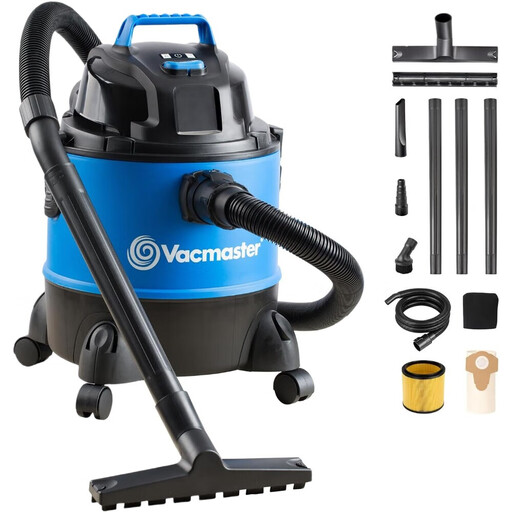 Image unavailable
This model is designed for wet and dry cleaning around the home or in the garage. It has a 20 L drum, a 2.5 m hose and a blower function. Its stated working radius is 7.5 m, and it comes with a bag and cartridge filter. For leaves, rubble or water, check which nozzle attachments are suitable and what limits apply to liquid pick-up.
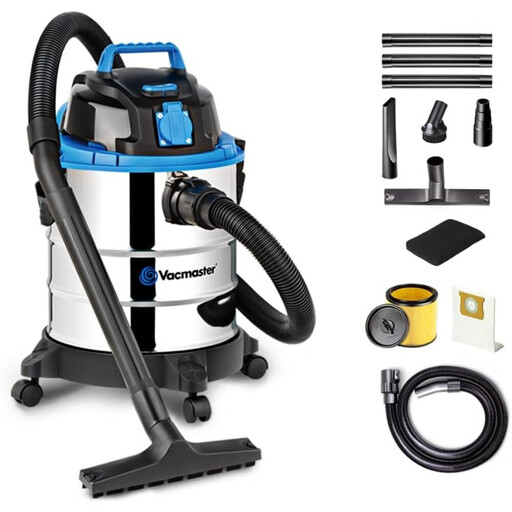 Image unavailable
Designed for the garage and workshop, this model features a 20 L drum, a blower function and a socket for power tools. Check which connector your tool needs and the exact socket configuration. The title mentions wet and dry vacuuming, but another detail says it should be used in dry environments. Clarify the conditions for liquid pick-up before using it with water.
Check the instructions for your specific model before vacuuming liquids. For example, Kärcher says the WD 3 P V-19/4/20 is suitable for small amounts of water, while the WD 6 P S V-30/8/35/T has a drain plug to make emptying easier. The category name alone doesn’t tell you the limits of use.
For this type of waste, look for a wider tube and hose. This is the feature highlighted by UFC-Que Choisir, which notes that a narrower diameter may be enough for fine dust. Check the diameter of the supplied accessories and make sure they’re suitable for the waste you expect to collect.
Don’t assume that a domestic wet and dry vacuum is suitable for this type of dust. INRS lists these among dusts that are hazardous to health and, in this context, distinguishes industrial class H vacuums. If a material is suspected, stop vacuuming and find out which procedure and equipment are suitable before doing any more work.
A filter bag can make emptying easier and reduce contact with ordinary dirt, provided it’s compatible with the model and the intended use. Check whether one is supplied and which filter the vacuum needs. A standard bag doesn’t make the vacuum suitable for hazardous dust.
Empty the drum and maintain the filter as instructed for the model you’re using. After vacuuming water, follow the drying instructions before putting the vacuum away. Store the hose and accessories without blocking their storage space.