
Livraison le jour même ou le lendemain

Qualité garantie

Débloquez vos offres de bienvenue: Livraison GRATUITE | Jusqu'à -80 % | 30 jours d'essai gratuits à JoyPlus
Téléchargez l'application
Choosing a wet dog food isn’t just about comparing flavours or the promotions splashed across the tins. Between a complementary recipe presented as a complete meal, a “rich in meat” claim that lacks precision, and a format that’s too bulky to store properly, some purchases can quickly become costly or impractical.
This guide to moist dog food helps you decode the essential information before you place an order, taking into account your pet’s age, weight, activity level and preferences.
The term “complete food” means the product is formulated to make up your dog’s daily ration, provided you follow the recommendations on the label. Conversely, a complementary mousse, soup or terrine must be paired with another food source.
So take the time to check the legal description on the packaging. An appetising recipe does not automatically constitute a complete dog food.
These phrases don’t mean much unless you look at the context. The ingredient list is given in descending order by weight, while the analytical constituents specify the protein, fat, fibre, ash and moisture content.
A wet food can contain more than 75% water. This high moisture level explains why the protein content shown on the product as sold may seem relatively modest. To compare two recipes properly, use the same calculation basis and check the actual percentages stated for the meats that are highlighted.
A large tin may seem more economical, but it needs enough space in the fridge and generally has to be used up quickly after opening. Recommendations vary by recipe: some advise consumption within 24 hours, others within two days, or even up to seven days.
For a small dog, a multipack of wet dog food made up of 100 g to 150 g portions often helps to limit waste. In a household with several pets, the 390 g or 400 g formats can, on the other hand, prove more practical.
For a puppy, look for a puppy wet food explicitly formulated for growth or for all life stages. The nutritional needs of a young dog are not necessarily the same as those of an adult or a senior.
An adult dog wet food must match the life stage indicated on the packaging. If your pet is on a special diet or has a food sensitivity, ask your vet for advice before changing its food.
The composition allows you to distinguish several recipe profiles:
So-called single-protein recipes can make reading the composition easier. However, it is still essential to check the entire ingredient list. A “grain-free” formula is not a general necessity for all dogs.
Compare at least:
The amount to serve depends on your dog’s weight, activity level and body condition. The instructions on the packaging are a useful starting point, but they do not replace monitoring your dog’s weight and body shape over time.
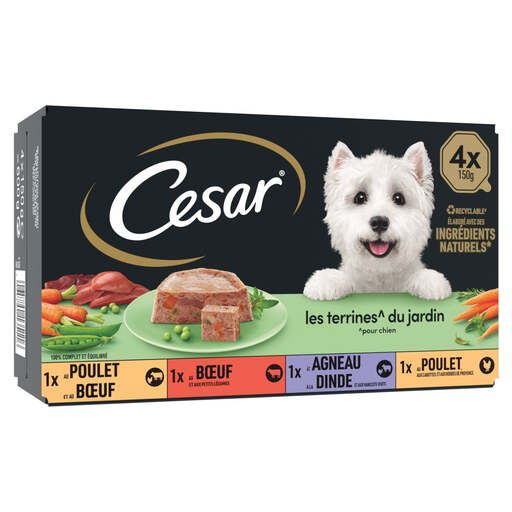
Why this choice suits this profile: This pack of four varieties in 150 g trays lets you try several recipes without buying a large volume straight away.
The listing states it is a complete food for adult dogs and specifies the storage conditions in the fridge after opening.
Four recipes, 83% stated moisture content and individual 150 g portions.
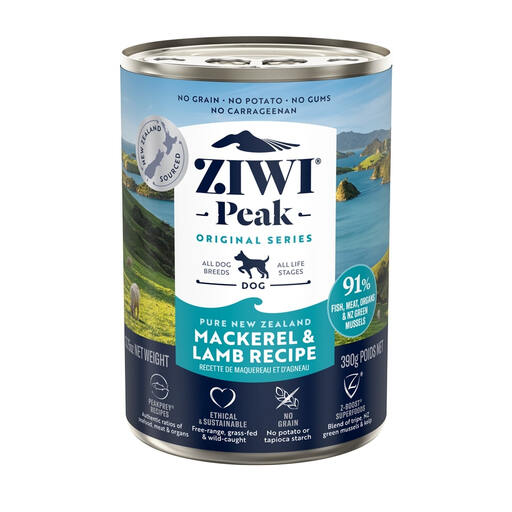
Why this choice suits this profile: This recipe is aimed at owners looking for a meat-rich wet food with a detailed composition.
The composition details the meats, offal, seafood and bone, rather than just making a general promise about meat.
Stated 91% meat, offal, seafood and bone; 10.5% crude protein and 78% moisture.
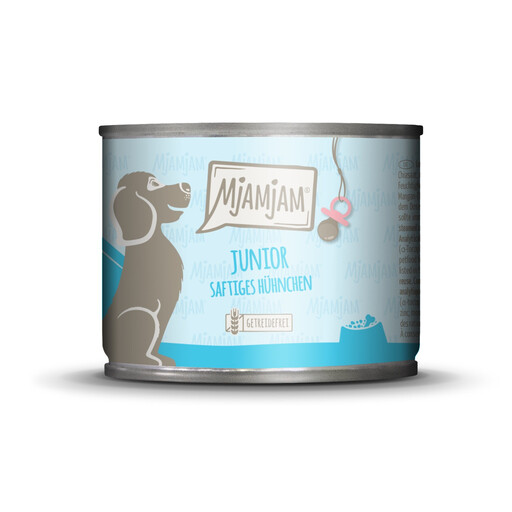
Why this choice suits this profile: This puppy wet food is designed for young, growing dogs and comes in 200 g portions.
The label specifies the junior life stage, the recommended amounts by age and weight, and the steps for a gradual food transition.
Stated 66% chicken and offal, a grain-free recipe and separate recommendations for 2–5 months and 6–12 months.
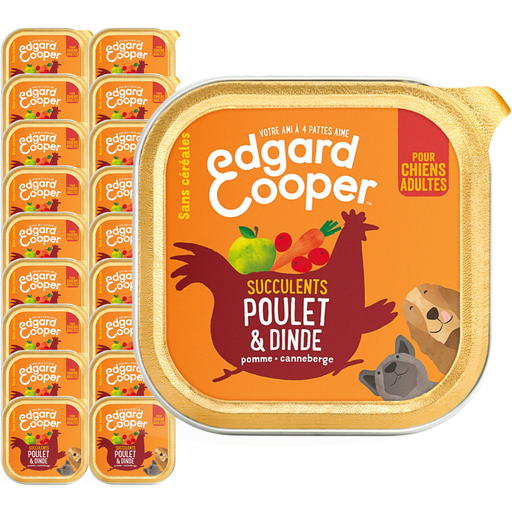
Why this choice suits this profile: This pack of 18 x 100 g trays is ideal for regular use, with portions that are easy to measure out.
The individual portions limit the amount to store once the product is opened, with a recommendation to consume within 24 hours.
Stated 56% chicken and turkey, a grain-free recipe and 18 x 100 g portions.
We have put together a comprehensive, real-time updated selection of products that meet these demanding selection criteria and European safety regulations.
Serve the wet food at room temperature and always leave fresh water available for your dog. After opening, place the tin or tray in the fridge, in a sealed container if necessary, and follow the storage time stated by the manufacturer.
When changing recipes, gradually mix the old and new food over several days. A sudden change can upset your dog’s digestion. For a puppy, a senior dog or a pet with special needs, have the ration adjusted with the help of your vet.
Yes, provided the label clearly states “complete dog food” and the recommended ration is followed. A complementary wet food should not make up the daily meals on its own.
The amount depends on the dog’s weight, age, activity level and the recipe chosen. Refer to the manufacturer’s feeding guide, then monitor your dog’s body shape and weight. If in doubt, ask your vet for advice.
Yes, some ranges are designed to be combined. In that case, you need to reduce the amount of each food so you don’t increase the daily calorie intake too much. Follow the recommendations for each product and make the transition gradually.