
Livraison le jour même ou le lendemain

Qualité garantie

Débloquez vos offres de bienvenue: Livraison GRATUITE | Jusqu'à -80 % | 30 jours d'essai gratuits à JoyPlus
Téléchargez l'application
Choosing wet cat food is not simply a matter of picking your companion’s favourite flavour. From pouches and mousses to shredded meat in gravy, soups and wet treats, differences in ingredients and intended use can have a noticeable impact on your everyday budget.
Attractive packaging or wording such as “gourmet recipe” is not always enough to tell you whether a product can replace a meal. Here are the key criteria to check so you can compare the different options with confidence.
The most important distinction usually appears in the product description. Complete wet cat food is formulated to form the basis of your cat’s diet, provided you follow the feeding guidelines shown on the packaging.
By contrast, cat soup or fillets in gravy may be complementary foods. They can be used as a treat, to increase your cat’s water intake or to add variety to meals, but they should not replace its main diet. The product page and label remain the only reliable references.
The percentage highlighted may refer to a specific ingredient, a recipe or a category of raw materials. You should therefore review the composition as a whole and check whether the ingredients are broken down by type.
For example, some recipes state that they contain 4% tuna, chicken or beef, while others give a higher proportion of fillets or offal. These figures cannot be compared directly without taking account of the moisture content and whether the product is complete or complementary.
A multipack of wet cat food can reduce the cost per serving, but this format is not suitable for every household. A cat that quickly tires of one flavour, eats small quantities or follows a specific diet may leave unused pouches behind.
Formats of 40 to 60 g are useful for trying out a texture or recipe. Packs of 12 to 18 pouches weighing 50 to 85 g are better suited to a regular routine, provided the composition genuinely meets your cat’s needs.
For an adult cat, look for clear wording such as “complete food for adult cats”. If your pet has been neutered, check that the recipe is designed for this profile and follow the recommended serving size. Requirements vary according to weight, activity level, build and the amount of dry food provided alongside it.
Wet food for adult cats should not be chosen solely based on the advertised flavour. The analytical constituents table — protein, fat, fibre, ash and moisture — allows you to compare recipes within the same format.
Wet cat food generally contains much more water than dry food. In the products featured here, moisture content ranges from 75 to 88.5%. A mousse may suit a cat that prefers a smooth, consistent preparation, while shredded meat and chunks in gravy offer a different texture.
Texture is ultimately a matter of individual preference. It is often better to order a smaller format before investing in a large multipack.
Read the ingredients in the order in which they appear and check for nutritional additives such as taurine, vitamins and certain minerals. For chicken or fish recipes, also look at the proportion actually attributed to the highlighted ingredient.
After opening, most products should be stored in the fridge and consumed within the stated timeframe, often 24 to 48 hours. Serve wet food at room temperature and always provide fresh water. The manufacturer’s recommendations should take precedence over any general estimate.
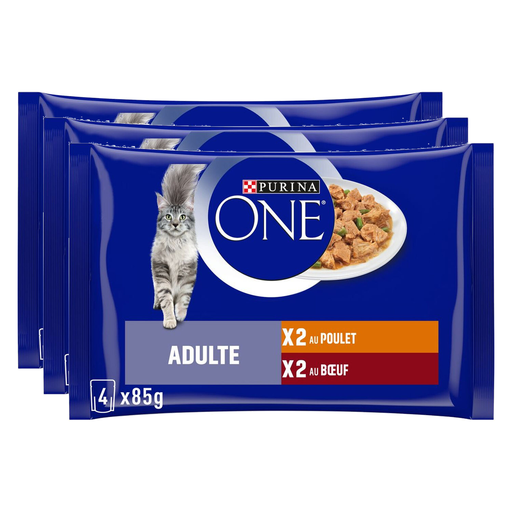
Why this choice suits this profile : The pack of 12 85 g pouches makes it easy to establish a routine with two recipes — chicken and beef — without buying multiple product lines.
It is presented as a complete food for adult cats, with serving recommendations for wet-only or mixed feeding.
Two flavours, 12 individual 85 g pouches, 12% protein and 78% moisture, according to the product information.
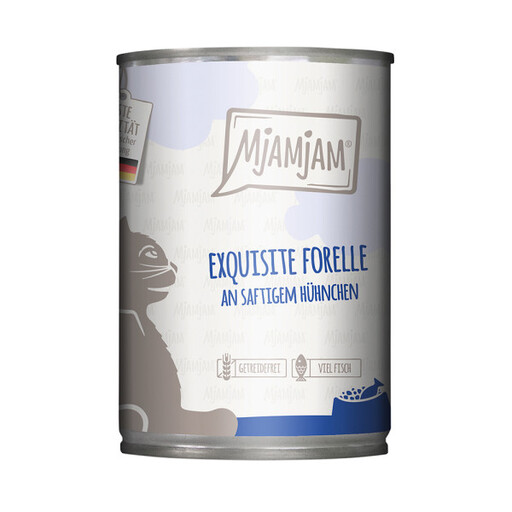
Why this choice suits this profile : Its 400 g format and recipe combining chicken and trout are aimed at households looking for a detailed composition and a family-sized pack.
The product information clearly states that it is a complete food and gives the proportions of chicken, stock and trout.
45% chicken meat, 26% trout, 79% moisture and 1,500 mg of taurine per kilogram, according to the information provided.
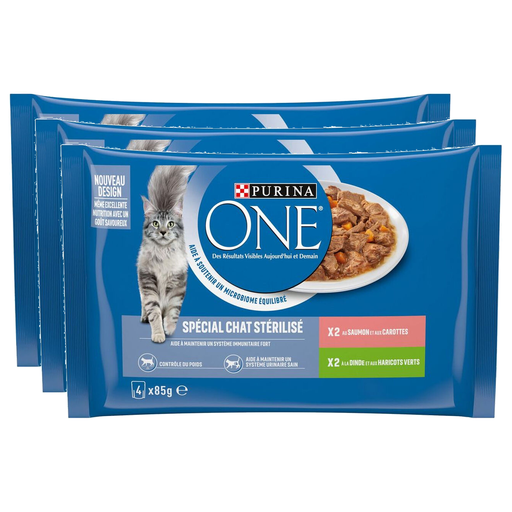
Why this choice suits this profile : This product is intended for neutered adult cats and offers two recipes — salmon and turkey — in individual portions.
A recipe intended for neutered cats does not remove the need to adjust serving sizes : the product information recommends adapting quantities according to weight and body condition.
Complete food for neutered adult cats, 13% protein, 3.6% fat and 78% moisture, according to the product information.
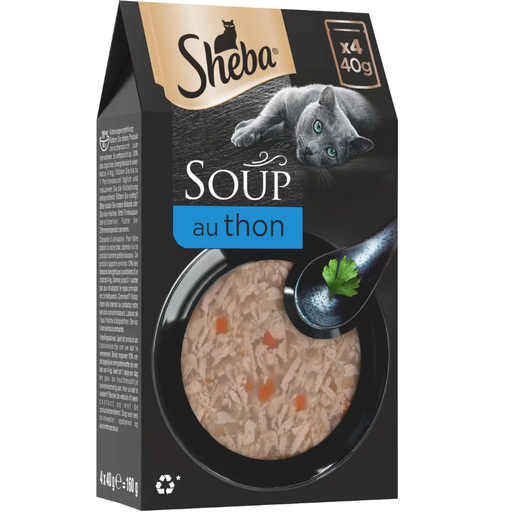
Why this choice suits this profile : The 40 g pouches are ideal for occasional serving, to add variety to meals or offer a small wet treat.
The product information states that this is a hydrating complementary food, not a substitute for complete meals.
88.5% moisture, 19 kcal per 40 g pouch, with a composition stating 16% chicken fillet and 4% tuna.
We have put together a complete, real-time updated list of products that fully meet these strict selection criteria and European safety regulations.
Yes, provided the product is clearly identified as a complete food and the daily serving follows the manufacturer’s recommendations. Cat soup, chicken fillets and certain wet treats are often complementary products that should remain part of a complete diet.
The amount depends on your cat’s weight, age, activity level and the recipe. As a guide, some product pages recommend around 3 to 4 85 g pouches per day for a 4 kg adult cat fed exclusively on wet food. Always refer to the table on the packaging and adjust portions if your cat also eats dry food.
Place any leftovers in the fridge, in a suitable container, and follow the timeframe stated on the packaging. The products featured generally recommend consuming them within 24 to 48 hours. Dispose of the food if its appearance or smell seems unusual, then serve the portion at room temperature.