For fine dust from everyday DIY jobs, choose a filter and, if needed, a dust bag that are suitable for your model. For leaves and small rubble, check the hose diameter; for liquids, make sure the manufacturer specifies a wet-vacuum configuration. A larger tank means less frequent emptying, but takes up more space, so consider how easy it is to move and store. If dust may contain silica, lead or asbestos, don’t assume a domestic vacuum is suitable: the INRS outlines the specific risks and protective equipment involved.
What can you use it for?
Cleaning up after small DIY jobs
After drilling, sawing or light sanding, you’ll need to remove fine dust and keep an eye on the filter for clogging. If you connect the vacuum to a tool, check that the fittings are compatible. This type of domestic vacuum isn’t suitable for potentially hazardous dust.
Maintaining a patio or garden
Leaves, small rubble and water each call for accessories and a configuration suited to the type of debris. Hose diameter, reach and the space needed for storage also matter when using a vacuum outdoors.
Cleaning a workshop regularly
If dirt builds up over several jobs, tank capacity and ease of emptying become important. Depending on your tools and how often you use the vacuum, a tool-triggered socket or filter-cleaning indicator may also be useful.
Which features should you prioritise?
For DIY jobs around the home and outdoor cleaning, start with the type of debris you’ll be dealing with most, then check the operating requirements of the model you’re considering.
| Feature |
What to check |
Who it suits |
| Fine dust |
Filter and bag compatible with dry worksite dust; filter-cleaning method. |
After drilling or sawing, I want to remove dust without overlooking filter maintenance. Around 31% of consumers would put dust management first. |
| Water and outdoor cleaning |
Explicit approval for liquid pick-up, required filter and emptying method. |
When I need to collect water as well as dirt from a patio or garage, I need a vacuum configured for that purpose. This would be a priority for around 25% of consumers. |
| Leaves, rubble and capacity |
Hose and tube diameter for the debris in question; tank capacity. |
If leaves and small rubble build up, I’d rather check that they’ll pass through the hose and how often I’ll need to empty the tank. Around 25% of consumers would put this need first. |
| Moving and storage |
Weight, wheels and handle; cable and hose length, and space taken up by accessories. |
Moving the tank between my workshop and storage space needs to be straightforward. For around 19% of consumers, this would be the main consideration. |
Which mistakes should you avoid?
-
Treating all worksite dust as ordinary dust
According to the INRS, crystalline silica can be found in materials including concrete, mortar and plaster. The organisation also provides information on specific equipment for hazardous dust, including dust containing silica, lead or asbestos.
Identify the material before cleaning. If hazardous dust is known or suspected to be present, have the risk assessed rather than automatically using a domestic wet and dry vacuum.
-
Picking up water with a filter designed for dry use only
Set-ups vary between models. Bosch DIY says the UniversalVac 15 has a wet and dry cartridge, while Einhell specifies that the relevant pleated filter must be replaced with a foam filter when picking up liquids.
Check the instructions for the exact model before switching from dry to wet use, and make sure you know which filter needs to be fitted.
-
Choosing a large tank without making room for it
A larger capacity can mean fewer trips to empty the tank, but you’ll still need to move and store it. Que Choisir recommends taking the weight of canister vacuums into account, among other things.
Measure the space available and compare the weight, wheels, handle, and storage fittings for the tube and accessories.
-
Using a narrow hose for frequent leaf pick-up
Que Choisir distinguishes between narrower fittings, which are suitable for fine dust, and wider tubes and hoses, which help leaves and small rubble pass through.
Choose the diameter to suit the type of debris you’ll deal with most. For mixed use, check which accessories are included or compatible.
Brands to consider for these uses
Bosch DIY
Its range for DIY around the home includes models such as the UniversalVac 15 and AdvancedVac 20.
- Bosch DIY says the UniversalVac 15 has a cartridge that can be used for wet and dry materials without changing the filter during use.
- Check the features and filter set-up for the specific model: equipment included with one model may not apply to the whole range.
Nilfisk
The Multi range caters for garage, workshop and outdoor use, with a choice of tank capacities.
- Nilfisk lists the Multi II 22 as having a 22 L tank and a filter-cleaning indicator.
- Check filtration specifications, including the L class listed for some models, for each product individually.
Einhell
The brand offers tank vacuums for the home, garage and workshop, including the TC-VC 3055 SA.
- Einhell lists a 30 L tank, a hose with a 36 mm internal diameter, a tool-triggered socket and a drain plug for this model.
- For the relevant accessories, Einhell specifies the pleated filter for dry vacuuming and a foam filter for liquids. Follow the instructions for the exact model.
PARKSIDE
Its range includes wet and dry vacuums in different capacities and versions.
- The listed models offer a choice of tank sizes, so you can compare them based on the space available and the amount of debris to clean.
- Before choosing a model, check its product details and instructions for the required filters, limits on wet vacuuming and compatible accessories.
Wet and dry vacuum available on Joybuy
This tank vacuum is designed for indoor cleaning in a garage or workshop. Its instructions specify indoor use in dry conditions, so don’t assume it’s suitable for a patio or garden.
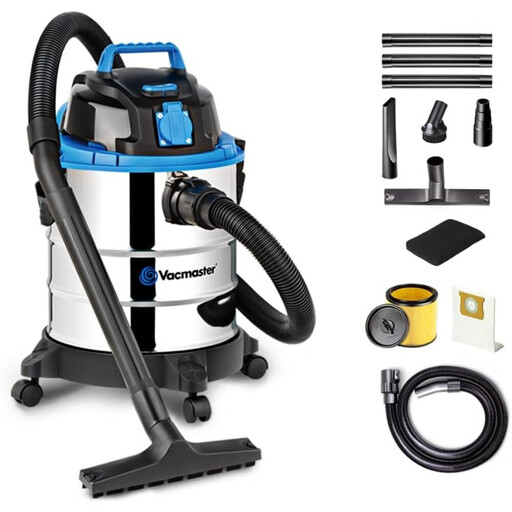 Image unavailable
Vacmaster VQ1220SC, 20 L wet and dry vacuum
Designed for indoor cleaning in a garage or workshop, this model is listed for wet and dry vacuuming and features a socket for power tools and a blower function.
Before picking up liquids, check which filter is required. The product information specifies indoor use in dry conditions only, so don’t assume it’s suitable for a patio or garden.
View on Joybuy
Frequently asked questions
Can all canister vacuums pick up water?
No. The model must be designed for liquids and set up as directed in its instructions. Bosch DIY says the UniversalVac 15 has a wet and dry cartridge, while Einhell specifies that the relevant pleated filter must be replaced with a foam filter when picking up liquids.
Do you need a wide hose for fine dust?
Not necessarily. According to Que Choisir, narrower fittings are suitable for fine dust, while a wider tube and hose make it easier to pick up leaves and small rubble. If you’ll be vacuuming both types of debris, check which accessories are compatible with your model.
Can you vacuum dust from concrete or a suspect older material?
Don’t assume a domestic wet and dry vacuum is suitable. The INRS states that crystalline silica can be present in concrete and provides information on specific equipment for hazardous dust, particularly dust containing silica, lead or asbestos. Have the risk assessed if you’re unsure what the material contains.
Which consumables should you check before buying?
Check which bags and filters are suitable for the model you’ve chosen, as well as how they should be cleaned or replaced. Nilfisk, for example, offers bags and a filter kit for the Multi II 22, while Einhell specifies different filters for dry use and liquid pick-up on the relevant models.


