What to check before buying
Start by identifying the debris and the dust risk, then choose the tank, hose and storage solution to suit your workspace.
| Priority |
What to check |
Your needs |
| Debris to be vacuumed |
Choose a suitable hose and tube: a narrower passage may be suitable for fine dust, while a wider diameter is better suited to leaves and small pieces of rubble. Also check which attachments are actually included. |
I want to avoid blockages when moving from fine dust to leaves or small bits of building debris. |
| Tank and dust management |
Compare the tank or bag capacity with the expected volume. Check bag compatibility, the filter reference and the cleaning method specified for the model. |
For a garage or several rooms, I would rather reduce emptying while limiting contact with dry dust. |
| Mobility and storage |
Consider the cable and hose length, weight, wheels and accessory storage together. A larger tank may be more cumbersome to move once it is full. |
I need to reach my workshop, car or an outdoor area without constantly moving the appliance, while still being able to store it easily. |
| Dust safety |
First identify the material being worked on. Check the dust class, the manufacturer's usage limits and the actual compatibility between the tool and the extraction system. |
If the dust could come from concrete, mortar, plaster, lead or older materials, I do not treat this risk as ordinary DIY dust. INRS specifically states that a Class H appliance is required for lead dust. |
Joybuy options for ordinary household residues
These Joybuy options are intended for moderate-volume wet and dry cleaning after light DIY work in the home, garage or workshop. They are not a substitute for equipment suitable for hazardous dust.
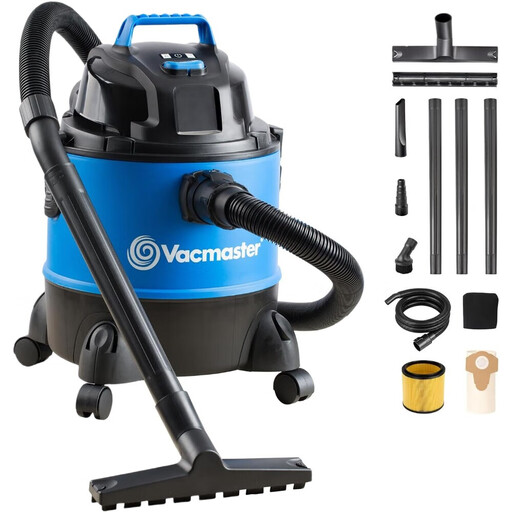 Image unavailable
Vacmaster VQ1220PF 3-in-1 wet and dry vacuum, 20 L
Suitable for the garage, car or occasional cleaning after light DIY work, with advertised dry and wet vacuuming.
The product title states that it has a 20 L tank, a 2.5 m hose, a 7.5 m operating range, a weight of 4 kg and a blower function.
Before buying, check the hose diameter, included attachments, compatible bag and filter references, and the usage limits for fine dust. Do not use it for asbestos, lead or suspected hazardous dust.
Joybuy
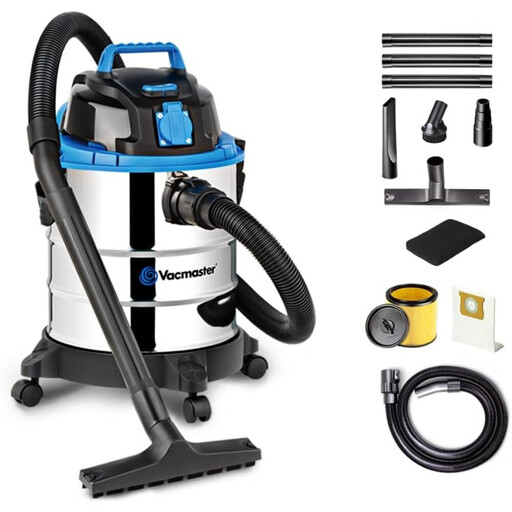 Image unavailable
Vacmaster VQ1220SC wet and dry vacuum, 20 L stainless-steel tank
This model is advertised for ordinary dust and liquids in the home, garage or workshop.
The product title mentions a 20 L stainless-steel tank, a 1250 W motor, a 2430 W power-tool socket and a blower function.
The listing specifies indoor use in a dry environment, so it is not confirmed for an outdoor patio. Also check the extraction connection, hose, attachments, filtration and replacement filters. The listing prohibits vacuuming harmful dust.
Joybuy
Frequently asked questions
Can I use a standard wet and dry vacuum after sanding or drilling?
Yes, but only if the dust has been identified as ordinary and the manufacturer permits this use for the exact model. To limit dispersal during the work, look for a model specifically designed to connect to the tool; Bosch DIY France and STIHL France advertise this function on certain models. If the dust could contain asbestos, lead or another hazardous substance, do not treat it as ordinary DIY dust: INRS specifically states that Class H extraction is required for lead dust.
Is a Class M filter suitable for all types of work?
No. The dust class must correspond to the material, process and manufacturer's instructions. STIHL France states that the SE 62 E and SE 122 have a main filter meeting Class M requirements during filtration, while INRS specifies that operations generating dust likely to contain toxic or carcinogenic substances require Class H appliances.
What hose diameter should I choose for leaves and small pieces of rubble?
Choose a wider tube and hose for leaves and small pieces of rubble. For fine dust alone, a narrower passage may be sufficient. Check which attachments are actually included, as these vary from one model to another.
Can I vacuum liquids with the same appliance I use for dust?
Yes, but only if the exact model is advertised for wet and dry vacuuming and its instructions permit it in the configuration being used. Bosch DIY France, Nilfisk France and STIHL France describe some of their models as suitable for dry materials and liquids, but the accessories, filters and maintenance procedures must be checked before use.
What precautions should I take in an older building?
Asbestos has been banned in France since 1997, but INRS states that it may still be present in buildings, equipment or installations. If the material is uncertain, stop cleaning with a household vacuum and have the situation assessed according to the applicable preventive measures; respiratory protection must be selected according to the identified risk and the actual conditions of use.


