For a shop that needs to last several days, start by working out how much space you really need for fresh and frozen food. A fridge is a good choice if fresh food makes up most of your shop, while a fridge-freezer gives you space for both in one appliance. If you regularly store lots of frozen food, a separate freezer can complement your fridge, but it takes up extra space and runs continuously too. Compare the capacity of each compartment, the dimensions and the annual energy consumption rather than looking at the total capacity alone.
Which configuration is right for you?
Households that mainly buy fresh food
If you buy fruit, vegetables and other perishable fresh food to last several days, choose a fridge with enough capacity and storage to suit your usual shop. The ANSES recommends checking the temperature in the coldest part of the appliance and avoiding overfilling it.
Households that buy both fresh and frozen food
A fridge-freezer lets you store both in one appliance. To see if it will suit your shop, check the fridge and freezer capacities separately: a large total capacity doesn’t guarantee the right balance for your needs.
Households that store lots of frozen food
If frozen food or frozen portions regularly take up a lot of space, compare the freezer capacity of a fridge-freezer with that of a separate appliance. A separate freezer complements your fridge, but needs its own space and runs continuously, as the ADEME points out.
What should you compare?
First, decide how much space you need for fresh and frozen food. Then compare capacity, installation requirements and energy consumption to find the right configuration.
Fridge
Consider this if: fresh food makes up most of your shop and you buy few frozen items, or already have another way to freeze food.
Bear in mind: a small freezer compartment, if the model has one, may not meet your regular freezing needs.
Fridge-freezer
Consider this if: you regularly buy both fresh and frozen food but don’t want to install two appliances.
Bear in mind: the two compartments share the appliance’s capacity, so check that each one has enough space for your shop.
Separate freezer
Consider this if: you already have a fridge and regularly need more space for frozen food or portions than a fridge-freezer can provide.
Bear in mind: it needs a second space and is an extra appliance that runs continuously.
| Consideration | What to check | What shoppers say |
|---|
| Space for fresh food |
Compare the fridge’s usable capacity with your usual shop and check how the storage areas are laid out. |
If I fill the fridge with fresh food for several days, I want to be able to put everything away without blocking airflow; around 36% of shoppers prioritise space for fresh food. |
| Freezer capacity |
Check the usable litres in the freezer compartment separately from the total capacity. |
When frozen food and portions are part of my regular shop, I need enough room to store them without relying on a small freezer compartment; around 29% of shoppers put freezer capacity above other considerations. |
| Space required |
Measure the space available and check that the doors can open fully. For a built-in model, check the niche dimensions and the specified fixing method. |
In a kitchen where space is limited, I want an appliance that fits without compromising the balance of compartments I need; around 21% of shoppers put installation requirements first. |
| Everyday use |
Compare the annual energy consumption shown on the energy label and the noise level of the model you’re considering. |
If the appliance is near my living space, I pay attention to its noise and continuous operation; these are the top considerations for around 14% of shoppers. |
The ADEME points out that fridges and freezers run continuously, and that choosing an appliance that’s too large or has more capacity than you need can affect energy consumption. For storing fresh food, the ANSES recommends keeping the temperature at 4 °C in the coldest part of the fridge. Even if you choose the right capacity, you still need to leave room for air to circulate.
Mistakes to avoid
-
Going by a fridge-freezer’s total capacity
Two fridge-freezers with similar total capacities can have very different amounts of space for chilling and freezing. UFC-Que Choisir recommends taking into account how often you shop and how much frozen food you buy.
Start with a typical shop, then compare the usable capacity of each compartment and the appliance dimensions.
-
Buying a bigger model for better food storage
Extra capacity won’t solve the problem of an overfilled fridge: the ANSES recommends leaving room for cold air to circulate. The ADEME also highlights the potential impact of an appliance’s size on its energy consumption.
Choose a capacity that suits your shop, with enough room to put everything away, then compare the annual energy consumption of your shortlisted models.
-
Adding a freezer without planning where it will go
A separate freezer gives you more space for frozen food, but it doesn’t replace the fridge you need for fresh food. You’ll also need room to install it and a power supply for an appliance that runs continuously.
First check whether a fridge-freezer’s compartment will meet your needs. If you’re considering a separate freezer, measure the space where you plan to put it.
-
Relying on No Frost for all your food storage needs
No Frost helps manage frost in models with this feature; it doesn’t replace the need for a suitable temperature or for storing perishable food in the coldest part of the fridge.
Check that the exact model you’re looking at has this feature, and follow the ANSES recommendations for checking the coldest part of the fridge without overfilling it.
Brands to consider
These ranges give you a starting point for comparing configurations and specifications. Always check the details of the specific model you’re interested in.
Bosch
The range includes freestanding and built-in fridge-freezers.
- The Bosch KGN39VLCT specification lists 260 l for refrigeration and 103 l for freezing, so you can assess each compartment separately.
- These capacities are for the KGN39VLCT. Check the compartment split and dimensions for any other model.
Liebherr
The range includes built-in fridge-freezers and models with BioFresh or NoFrost, depending on the model.
- The Liebherr ICBNSd 5123 Plus specification gives a total capacity of 244 l and a noise level of 34 dB.
- This is a built-in model. Check the niche dimensions and compartment capacities before comparing it with a freestanding appliance.
Beko
The range includes fridges, fridge-freezers and freezers.
- With several configurations available, you can compare a single appliance with a setup that includes a separate freezer.
- The features highlighted by Beko don’t replace checking the usable capacities, dimensions and energy label of the model you choose.
Whirlpool
The range includes fridges and fridge-freezers, both freestanding and built-in, depending on the model.
- Whirlpool offers No Frost models among its fridges and fridge-freezers.
- Check the exact model’s specifications for this feature, its capacities and its energy consumption.
Fridge-freezers to compare
These appliances combine refrigeration and freezing for shops that include both fresh and frozen food. Before choosing this configuration over a fridge alone or a fridge with a separate freezer, compare the compartments and space required with your needs.
 Image unavailable
Candy CFQQ5T817EPS, 467 l four-door fridge-freezer
Combines space for fresh and frozen food in a four-door appliance. Check that the compartment capacities suit your shop.
Advertised total capacity: 467 l. Total No Frost, energy rating E, silver finish.
Measure the space and required clearances before installation.
View on Joybuy
 Image unavailable
Samsung RF50C530EB1, 495 l multi-door fridge
Worth considering if you want to store fresh and frozen food in one large appliance. Compare the capacity of each compartment, not just the total.
Advertised capacity: 495 l. Energy rating E, black finish.
Check the dimensions and installation clearances. If you want to use the water and ice dispenser specified for this model, check its installation requirements too.
View on Joybuy
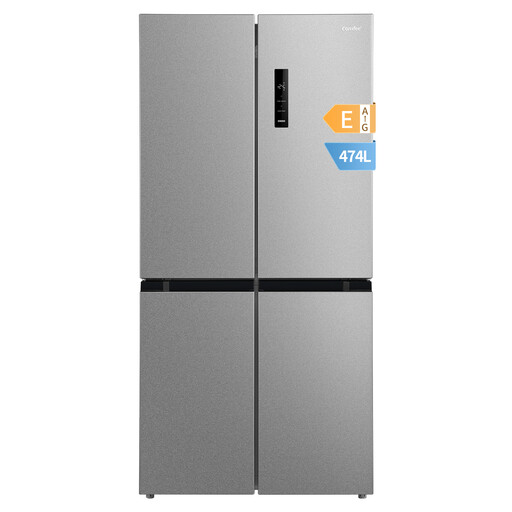 Image unavailable
COMFEE' RCF470LS2EU(E), 474 l four-door fridge
For shops that include both fresh and frozen food, with a salad drawer advertised as having three temperature settings. Check how much space is allocated to each compartment.
Advertised total capacity: 474 l. Energy rating E, silver finish.
Compare the individual capacities and annual energy consumption in the model specifications before choosing.
View on Joybuy
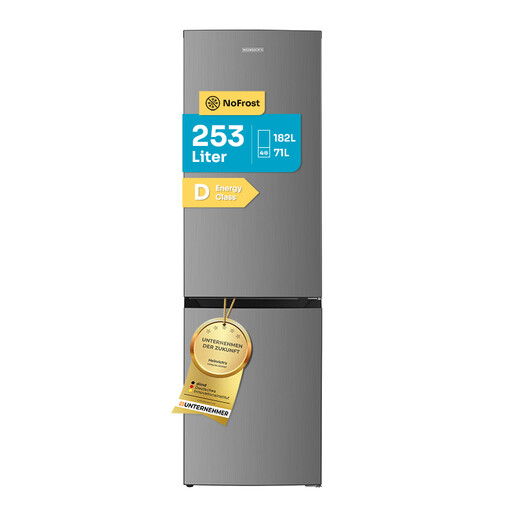 Image unavailable
Heinrich´s, 253 l fridge-freezer, 182 l fridge and 71 l freezer capacity
For shops that include fresh food and an amount of frozen food suited to a 71 l freezer compartment.
182 l fridge capacity and 71 l freezer capacity. No Frost and an advertised noise level of 39 dB.
Check the full dimensions, clearances and annual energy consumption before comparing installation and day-to-day use.
View on Joybuy
 Image unavailable
CHiQ JR227LSE, 227 l fridge-freezer, 153 l fridge and 74 l freezer capacity
Worth considering if you have limited width available and need space for both chilled and frozen food.
153 l fridge capacity and 74 l freezer capacity. Advertised width of 54 cm, reversible door, Low Frost and energy rating E.
Check the exact height before buying: two different figures are listed in the product description. Also check the annual energy consumption.
View on Joybuy
Frequently asked questions
What temperature should I aim for in the fridge after shopping?
The ANSES recommends keeping the temperature at 4 °C in the coldest part of the fridge. Store perishable fresh food there, including meat, fish and cooked dishes, without overfilling the appliance so that air can circulate.
Can a separate freezer replace a fridge for fresh food?
No. A separate freezer gives you extra space for frozen food, but it doesn’t replace the fridge you need for fresh food. First work out how much space you need for fresh food, then decide how much extra freezer capacity you need if a fridge-freezer compartment isn’t enough.
How do I compare the energy consumption of a fridge-freezer with two separate appliances?
Compare the annual energy consumption shown on the energy label for each model you’re considering. If you choose a separate fridge and freezer, take both appliances into account. The ADEME points out that they run continuously, so work out how much capacity you really need before choosing between configurations.
Does No Frost mean I don’t need to check the temperature?
No. No Frost doesn’t replace checking the coldest part of the fridge or arranging food so that air can circulate. Check that the model you choose has this feature, and follow the ANSES recommendations for storing perishable fresh food.


