Households doing a weekly shop
If you store several days’ worth of fresh food, prepared meals and frozen food, compare the space available in each compartment and the storage layout, rather than looking at total capacity alone.


If your weekly shop includes fresh and frozen food, start by comparing the usable capacity of each compartment in a fridge-freezer, then check its dimensions and storage layout. Total capacity alone won’t tell you which model is right for you. A compact fridge is better suited to smaller shops that you top up frequently; a separate freezer is a solution for a lasting shortage of freezer space, not fridge space. Whichever type you choose, Anses recommends keeping food between 0 and +4 °C at the coldest point in the fridge.
If you store several days’ worth of fresh food, prepared meals and frozen food, compare the space available in each compartment and the storage layout, rather than looking at total capacity alone.
When space is limited, the dimensions and door opening can help you choose between a compact appliance and a fridge-freezer. How often you shop matters too: a smaller capacity leaves less room to store several days’ worth of food.
If your current fridge has enough room for fresh food but its freezer is often full, a separate freezer could meet that specific need, provided you have a suitable place to put it.
Start by identifying what your current storage is genuinely short of — space for fresh food, space for frozen food or room in the kitchen — before comparing appliance features.
Best for: a household that stores both fresh and frozen food for several days and has room for a full-height appliance.
Bear in mind: check the capacity of both compartments separately, and allow enough room to open the door and access the drawers.
Best for: a household that mainly stores fresh food and keeps only small amounts of frozen food.
Bear in mind: check the compartment capacity before relying on it for several days’ worth of frozen shopping.
Best for: a small kitchen where shops are modest or you top up frequently.
Bear in mind: saving space means less storage; for example, Whirlpool France lists the Whirlpool ARG 94312 FR at 96 L.
Best for: a household whose fridge already meets its fresh food needs, but whose freezer is often full.
Bear in mind: you’ll need extra space and a power socket; this appliance won’t provide any extra room for chilled food.
| Factor | What to check | What I need |
|---|---|---|
| Usable capacity | Compare the fridge and freezer capacities separately, in litres. Check the space provided by the shelves, drawers and door balconies for the food you usually buy. | My shop includes fresh and frozen food: I need enough space in the right compartment, not just a large total capacity. |
| Temperature | Check the temperature controls and monitoring options. Anses recommends keeping food between 0 and +4 °C at the coldest point in the fridge; a No Frost function is no substitute for temperature control. | I want to be able to store fresh food at a suitable temperature, even when the fridge is full after a shop. |
| Installation | Measure the height, width and depth, then check the delivery route, the clearances specified in the manual, and whether the doors and drawers can open fully. | The appliance needs to fit in my kitchen and give me easy access to all its storage. |
| Energy use and noise | For models with comparable features and capacities, compare the energy rating and annual consumption in kWh. Check the noise level in dB(A) too. | Noise matters to me day to day in an open-plan kitchen; I also want to compare the energy use of the types that meet my needs. |
| Separate freezer | Make sure it’s frozen food you’re short of space for. If you’re adding a second appliance, check its dimensions and the installation requirements in its manual. | There’s enough room for fresh food in my fridge, but prepared portions and food I buy to freeze often fill the freezer. |
An appliance can have plenty of litres without offering space where you need it. Fridge and freezer capacities need to suit two different types of shopping.
Estimate how much room you need for fresh and frozen food over a typical shopping cycle, then compare each compartment separately.
A door blocked by a wall or unit can stop you pulling the drawers all the way out, even if the appliance fits in its space.
Check the delivery route, the appliance dimensions, the installation clearances and the door swing specified in the manual.
This feature doesn’t mean you can skip setting the fridge or checking its temperature. Anses recommends keeping food between 0 and +4 °C at the coldest point.
Check the temperature if needed and follow food storage guidance, whatever the internal layout.
A second freezer gives you more room for food to freeze, but it won’t solve a shortage of fridge space.
Make sure frozen food is what’s taking up too much room, and check the manual, socket requirements and conditions for the room where you plan to install it.
You’ll also need to make room for and power an additional appliance.
These models illustrate different capacity and installation considerations; their features aren’t representative of every appliance from the same brand.
The KGN392XCF fridge-freezer is a useful example for comparing the stated fridge and freezer capacities.
The CND 5703 offers another point of comparison among full-height fridge-freezers.
The built-in ARG 94312 FR fridge is an example of a compact model for when space is the priority.
The RFNE448E35W is an example of a separate upright freezer for households that need extra space for frozen food.
These five fridge-freezers are suited to shops that include both fresh and frozen food. Compare their listed capacities, then check that your chosen model fits the available space and the way you like to store food.
 Image unavailable
For storing fresh and frozen food in one appliance. The listed total capacity is 333 L; compare the capacity of each section with your shopping and check the dimensions before choosing.
 Image unavailable
A three-door design to consider if you want to keep fresh and frozen shopping separate. The product listing gives a total capacity of 360 L, an E rating, Total No Frost, Wi-Fi and My Zone; check the space needed for installation.
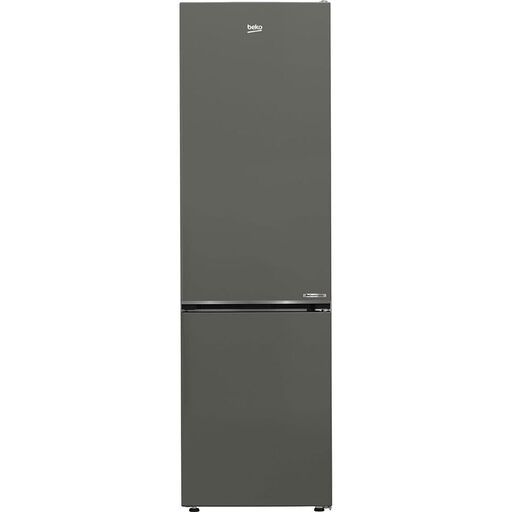 Image unavailable
For storing fresh and frozen food in a freestanding fridge-freezer. The product listing gives a total capacity of 355 L and Total No Frost; check the width, clearances and capacity split before choosing this model.
 Image unavailable
Its four-door design and listed total capacity of 467 L could suit a household with a large shop to store. It has an E rating and Total No Frost; check the dimensions and make sure the doors can open fully in your kitchen.
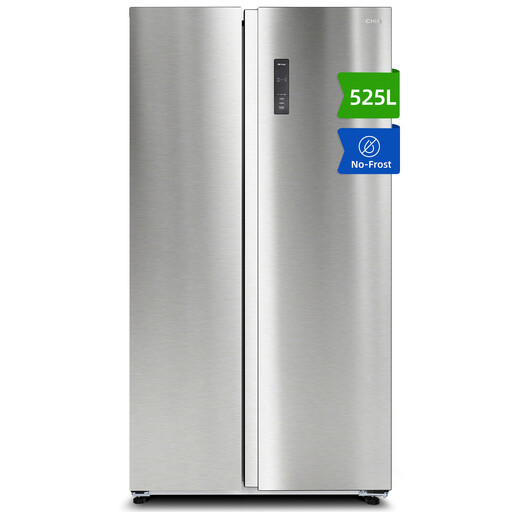 Image unavailable
Worth considering if your shopping needs room for both fresh and frozen food: the product listing gives a fridge capacity of 333 L and a freezer capacity of 192 L. It also lists an E rating and 37 dB; measure the space before considering this side-by-side design.
Anses recommends keeping food between 0 and +4 °C at the coldest point in the fridge. Set the appliance and check its temperature if needed; its capacity or a No Frost function won’t tell you what temperature it’s actually reaching.
No. Extra capacity only helps if it suits your actual storage needs and lets you organise your food. ADEME also recommends buying appropriate quantities and regularly organising your fridge to reduce food waste.
Compare the energy rating and annual consumption in kWh for appliances with features and capacities that suit your needs. Also check the compartment capacities and noise level listed for each model; the rating alone won’t tell you how much room there is for your shopping.
Consider a separate freezer if your current fridge still has enough room for fresh food but its freezer is often full. If you’re short of fridge space too, compare the capacities of both compartments in a fridge-freezer instead, and check how much room it needs for installation.