
Livraison le jour même ou le lendemain

Qualité garantie

Débloquez vos offres de bienvenue: Livraison GRATUITE | Jusqu'à -80 % | 30 jours d'essai gratuits à JoyPlus
Téléchargez l'application
Plugging in your lawnmower, string lights, or pressure washer shouldn't be a headache. Yet, choosing the right waterproof outdoor power strip can often feel like a real challenge. Between marketing jargon and technical standards, it's easy to make a mistake—one that can be costly and dangerous. Our mission is to help you decode the labels to make an informed and 100% safe choice.
Before we even get into the technical details, let's review the two most common mistakes. These can jeopardise your setup... and your wallet.
To avoid these pitfalls, let's focus on the features that truly make a difference. A quality power supply for your patio or garden must meet specific standards.
The Ingress Protection (IP) rating is your key indicator. For outdoor use in a sheltered area (covered patio, awning, etc.), the benchmark standard is an IP44 power strip. Here's what that means in practice:
In short: an IP44 power strip can handle light rain or splashes from a sprinkler, but it must never be left in a puddle or exposed to a powerful water jet. This is the absolute minimum for safe outdoor use.
The cable on your outdoor extension cord is just as crucial as the socket housing. Two types of cables are common:
Cable length is also a safety factor. Choose a sufficient length to avoid daisy-chaining extension cords, an extremely dangerous practice that leads to a risk of overheating and fire.
A good waterproof garden socket should be as convenient as it is safe. Make sure it includes these two features:
Because every situation is unique, here are our recommendations, selected for their reliability, standards compliance, and suitability.
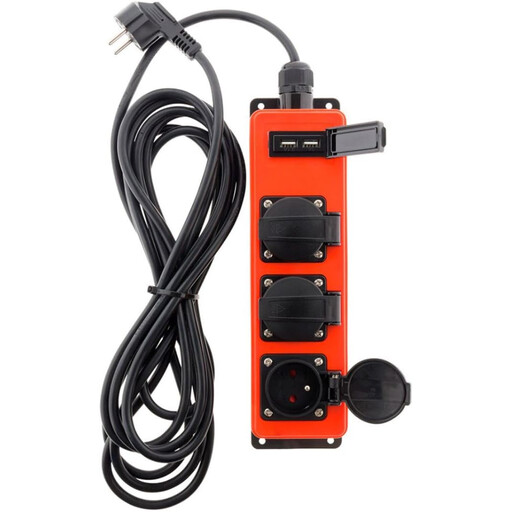
Perfect for plugging in string lights, a laptop, or charging a smartphone on a balcony or covered patio. Its compact design and USB ports make it a versatile ally for everyday needs.
Its IP44 certification is clearly displayed, specifying its use for sheltered outdoor areas. No unpleasant surprises. The individual covers and waterproof switch complete the safety features.
Its 2 USB ports (2.1 A) let you charge mobile devices without sacrificing a 230 V socket. The 3-metre H05VV-F cable (3G1.5 mm?) is well-suited for this type of use.
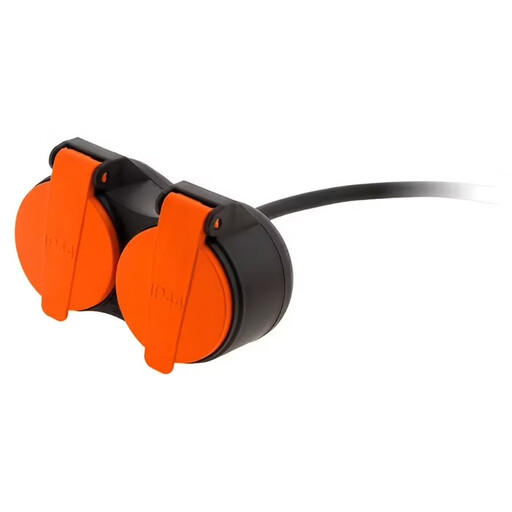
Essential for plugging in powerful tools (lawnmower, hedge trimmer, pressure washer) far from a wall outlet. Here, the priority is durability and range.
Its H07RN-F cable (3G1.5 mm?) is the gold standard for worksites and tough conditions. Unlike a standard PVC cable, it is resistant to impacts and harsh weather. The risk of premature wear is eliminated.
Its 10-metre length provides excellent freedom of movement. Its bright orange colour makes it highly visible on grass, reducing tripping hazards. CE and NF certifications guarantee its compliance.
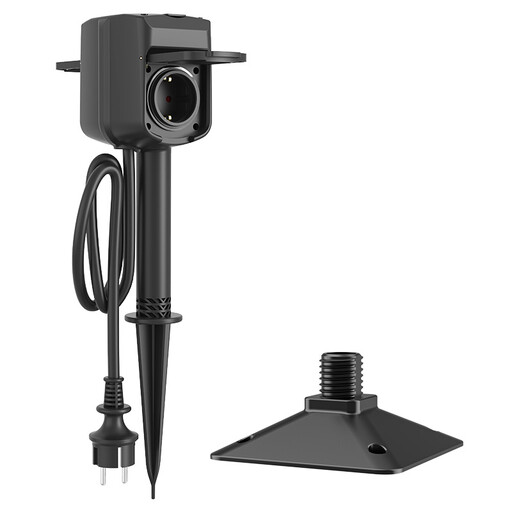
Designed for those who want to remotely control garden lighting, a pond pump, or Christmas decorations from an app or via voice commands (compatible with Google and Alexa assistants).
Its stake allows you to anchor it securely in the ground, raising the sockets to protect them from standing moisture. The IP44 standard is, of course, met for risk-free smart use.
The two sockets can be controlled independently via Wi-Fi (2.4 GHz). Ideal for creating lighting scenes and schedules to manage your energy consumption.
Explore our full selection of products that comply with safety standards and have been approved by our experts.
1. Can you leave a waterproof outdoor power strip out in the rain? An IP44 power strip is resistant to water splashes, like light rain. However, you should avoid leaving it in a heavy downpour or in an area where water can pool. For maximum safety, always place it in a sheltered or elevated location. Warning: It is by no means submersible!
2. What is the difference between an H05VV-F and an H07RN-F cable? It all comes down to the sheath and its durability. The H05VV-F (PVC sheath) is made for indoor or very occasional, sheltered outdoor use. The H07RN-F (neoprene rubber sheath) is the professional standard: it resists weather, impacts, abrasion, and even hydrocarbons. For garden tools or regular outdoor use, it is the only truly safe choice.
3. Do you need to fully uncoil an outdoor extension cord before use? Yes, it is imperative. A coiled extension cord acts like an inductor: the heat generated by the current (the Joule effect) cannot dissipate and builds up. This creates a very high risk of overheating, which can melt the insulation and start a fire, especially with a power-hungry appliance. The golden rule: always fully uncoil the cable before plugging anything in.