
Livraison le jour même ou le lendemain

Qualité garantie

Débloquez vos offres de bienvenue: Livraison GRATUITE | Jusqu'à -80 % | 30 jours d'essai gratuits à JoyPlus
Téléchargez l'application
A double mattress measuring 140 x 200 cm deserves more than a cover simply labelled “waterproof”. Sweat, spilt coffee, small leaks and everyday stains can quickly reach the fabric and filling. Some purchases also disappoint for very practical reasons: inaccurate sizing, poor fit or overly demanding care instructions.
Before choosing a waterproof mattress protector 140 x 200 cm, check your mattress depth, the fastening system and the washing instructions. These details often matter more than marketing promises of “total protection” or “superior comfort”.
A 140 x 200 cm mattress needs more than a protector measuring exactly 140 x 200 cm. You also need to consider its depth. A protector that is too tight may come loose during the night, while one that is too large can bunch up and feel uncomfortable.
For a deep mattress, look for a 30 cm mattress protector or a fitted protector that clearly states its compatible pocket depth. If it says “up to 30 cm”, compare this with the actual height of your mattress, including any mattress topper.
A waterproof membrane won’t do much if the protector slips or folds over. Deep-pocket designs, full-perimeter elastic and models with elastic straps don’t all offer the same level of hold.
Straps at the four corners can be useful if your mattress moves around a lot, but they need to be fitted correctly. A protector that isn’t pulled taut can crease and disturb your sleep.
A breathable mattress protector may improve comfort, but the label alone doesn’t tell you anything about its thickness, material or airflow. Instead, check the composition, the surface fabric and the care instructions.
A machine-washable protector will also be more practical for everyday use. Remember to check the maximum washing temperature, drying instructions and whether bleach is prohibited.
To choose a waterproof mattress protector 140 x 200, start by measuring:
A model listed as suitable for a mattress up to 30 cm deep may fit a deep double mattress, as long as its dimensions match those stated on the product page.
The products featured here are mainly made from polyester. Some have a towelling surface, while others have a quilted finish. The waterproof barrier is generally combined with a layer of fabric to prevent direct contact with the membrane.
To protect against sweat, stains and leaks, look for a protector described as stain-resistant, washable and designed for repeated use. For incontinence protection, check the area actually covered and how easy the protector is to replace and wash, rather than relying on the product name alone.
A machine-washable mattress protector makes it easier to rotate between two protectors. Wash it before using it for the first time and follow the temperature stated by the manufacturer. Tumble-drying on a low heat or air-drying can help preserve the fibres and membrane.
Don’t use the protector as a sleeping surface on its own, and keep it away from flames and sources of heat.
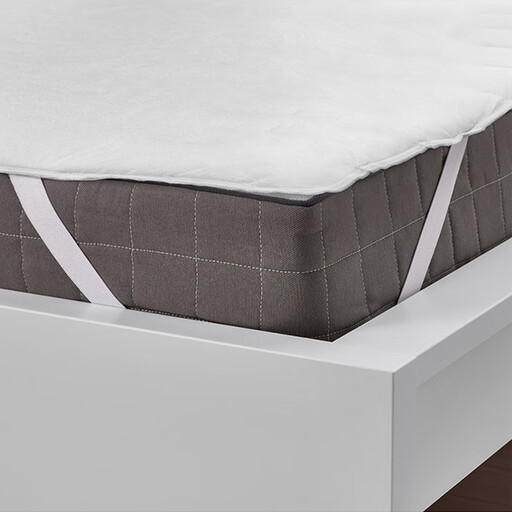
Why it suits this profile : This model is for people with a 180 x 200 cm bed. It isn’t suitable for a 140 x 200 cm mattress, even though its stated depth is 30 cm.
The four side straps are designed to keep the protector in place, but it’s still essential to check the width of your mattress.
180 x 200 cm size, four elastic straps and stated compatibility with mattresses up to 30 cm deep.
If you have children or pets, or need to wash your protector frequently, having two makes it much easier to rotate them. That way, you won’t have to put a damp protector back on the mattress.
We’ve put together a comprehensive, real-time updated list of products that fully meet these strict selection criteria and European safety regulations.
Choose a model whose product details state that it fits a depth of 30 cm, taking into account any mattress topper. A slightly deeper pocket can make fitting easier, but the protector should still sit taut.
That depends on the material, thickness and design of the membrane. A surface described as breathable may help reduce discomfort, but the result will vary according to your bedding, bedroom temperature and sleeping habits.
Follow the washing temperature, avoid products not recommended in the care instructions, and don’t iron the protector if the manufacturer advises against it. Drying it on a low heat or in the open air, and fitting it without pulling it too tight, can help preserve the fabric and membrane.